Neutrino flavor oscillations are the quantum mechanical phenomenon where neutrinos switch between their three types—electron, muon, and tau—as they travel through space. This happens because the neutrino's mass states are not the same as its flavor states, leading to a quantum interference pattern. The effect explains why detectors on Earth see fewer solar neutrinos than expected: many have changed flavor by the time they arrive.
History
The idea was proposed by Bruno Pontecorvo in 1957, inspired by kaon oscillations. The solar neutrino problem, first observed in the 1960s, was definitively explained by oscillations in the early 2000s with the Sudbury Neutrino Observatory.
How it works
A neutrino is born in a weak interaction with a definite flavor, but this is a superposition of three mass states. As it propagates, each mass state acquires a slightly different phase, and the interference between them causes the flavor composition to oscillate. The probability of finding a given flavor depends on the distance traveled, the neutrino energy, and the mixing angles between mass and flavor states. In dense matter, like inside the Sun or a supernova, the oscillation pattern is modified by interactions with electrons—the MSW effect.
In practice
Neutrino oscillations are used to probe the interior of the Sun, study supernova dynamics, and search for differences between neutrinos and antineutrinos that might explain the matter-antimatter asymmetry of the universe.
Fun fact
Neutrinos can change flavor even in a vacuum, but passing through Earth's dense core can 'resonate' the oscillation, dramatically increasing the chance of a flavor change—a phenomenon exploited by long-baseline experiments.
Neutrinos are tiny particles that pass through our bodies by the billions every second without touching a single atom. They have a mysterious property: on their way from the Sun or an accelerator, they can change their type, or 'flavor'—for example, turning from an electron neutrino into a muon neutrino.
At the heart of a dying star, as its core collapses into a neutron sphere, an invisible storm is born. Trillions of neutrinos, particles that barely interact with matter, race through the scorching plasma. There are so many of them that they begin to influence each other, changing their 'flavors' (electron, muon, tau) like chameleons.
High in the mountains, where the air is clear and still, physicists are preparing to catch elusive visitors from space — neutrinos. These particles, like ghosts, pass straight through the Earth, leaving almost no trace. But occasionally a neutrino does slam into an atom, producing a shower of particles that can be seen.
A hot infant and a cold adult — the same neutron star looks different. Just born in a supernova explosion, it is scorching hot at tens of billions of degrees. But as time passes, it cools, contracting like cooling metal. For the star PSR J1012+5307, this transition means an almost twofold reduction in radius.
The Sun is not just a source of light but a giant laboratory where ghostly particles are born. Every second, billions of neutrinos fly through your body, barely noticing you. But inside the Sun, these particles behave differently: they change their type on the fly, like an actor playing three roles in a single play.
Neutrinos are nearly elusive particles that permeate everything around us. In a dense cloud, such as during a star explosion, they begin to collectively change their type, or 'flavor.' This process is like a crowd of people synchronously changing the color of their clothes, but not all at once — rather in waves.
The speed of light in a vacuum is physics' metronome: it sets the rhythm for all processes. If it falters, the familiar harmony collapses. Neutrinos, ubiquitous but almost intangible particles from space, can check if this rhythm ever stumbles under extreme conditions.
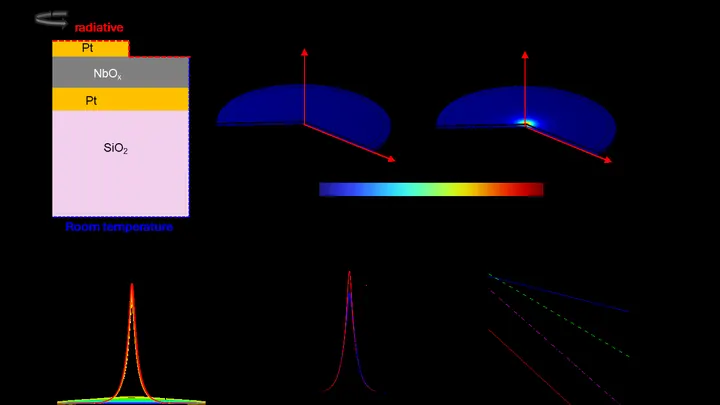
A memristor is a resistor with a memory: after the current is turned off, it retains its resistance. Inside, a thin film of metal oxide is sandwiched between two metal electrodes. When a strong current is first passed through the device, conductive filaments of oxygen vacancies form in the oxide, and the resistance drops sharply.
When a massive star dies, its core collapses, and a neutrino storm is born. These ghostly particles fly outward, changing their flavor along the way, like a chameleon changes color. This dance of flavors can either boost the explosion or, conversely, dampen it.
But this dance has a choreographer — the density gradients of matter.
A barium titanate crystal is like a crowd where everyone holds a pointer. Normally, the pointers face in random directions, but when you apply an electric field, they all snap to point the same way. This ordered state is called ferroelectric: it stores information the way a compass needle stores direction.
When a massive star dies, its core collapses into a neutron star, and the outer layers are blown off in an explosion. At that moment, an unimaginably dense cloud of neutrinos is born — particles that barely interact with matter but actively 'talk' to each other. There are so many of them that together they behave like a fluid, with waves rippling across it.
The crystal Pr₄Ni₃O₁₀ is like a three-layer sandwich: nickel oxide layers separated by praseodymium spacers. As it cools, three magnetic regimes switch on in sequence, as if, inside the sandwich, the nickel spins first align, then slightly rearrange, and finally the praseodymium spins join in.
Muons, heavy cousins of electrons, penetrate the crystal and sense internal magnetic fields.
Two teams of radio telescopes pointed their antennas at two gas clouds: one at the very center of the Milky Way, the other in its quiet outskirts. Both clouds contain methanol molecules — an alcohol that acts as a tiny pendulum in space: it absorbs and emits radio waves at strictly defined frequencies.
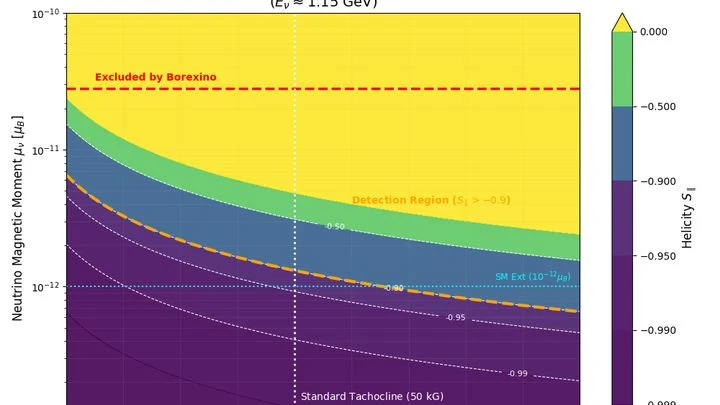
The Sun doesn't just shine: it continuously emits streams of tiny particles, neutrinos. They are born in thermonuclear reactions in the core and pass through the star almost unhindered. But inside the Sun, there are magnetic fields that can influence these particles, like invisible corridors that slightly bend their path.
Predicted by Wolfgang Pauli and named by Enrico Fermi, neutrinos are nearly elusive particles. Inside dying supernova giants and merging neutron stars, an immense number are born. Each particle has a flavor that can change.