Holey Film Cools Silicon express
A crowd on a narrow street moves slowly because people bump into each other. In silicon, heat is carried by similar 'shoves'—atomic vibrations called phonons. If you cut tiny holes in a silicon film, phonons will bump into them like pedestrians into lampposts, and heat will flow worse.
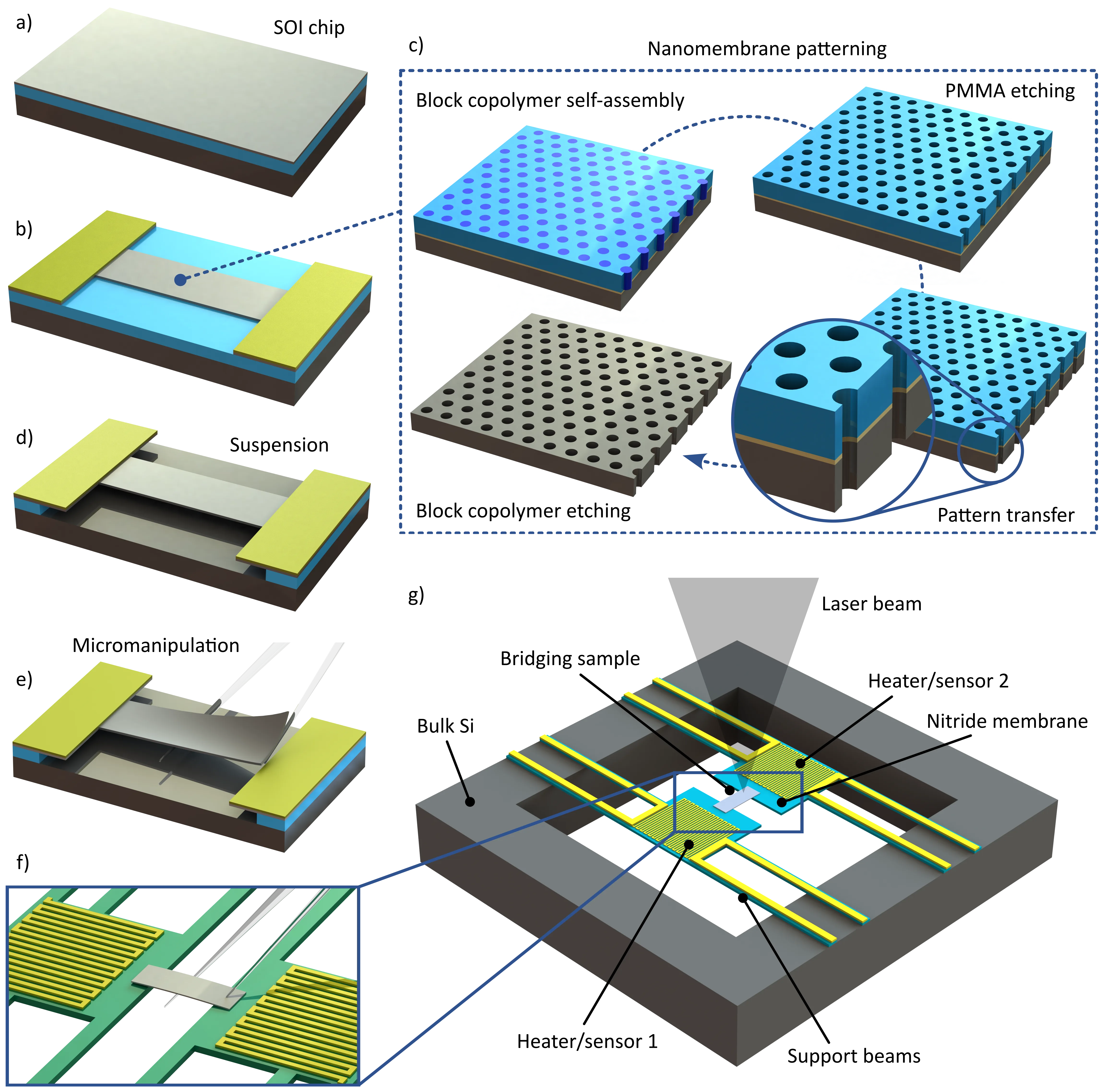
That's exactly what the scientists did: in a silicon film 40 nanometers thick (a thousand times thinner than a human hair), they made holes 35 nanometers in diameter, spaced 63 nanometers apart. The holes are arranged neatly, like a honeycomb, because they were 'drawn' by a self-assembling polymer — long molecules that arrange themselves into a pattern on their own. Then the silicon was etched away following that pattern.
The key trick is the depth of the holes. You can change it without touching either the diameter or the spacing. Fully through-holes block heat the most, while shallow ones block it less. This gives you a 'volume knob' for heat flow: turn the depth, and you change the thermal conductivity.
To accurately measure how much heat passes through such a film, the old three-probe method had to be improved. Usually, the contacts between the film and the substrate get in the way: they add extra resistance, like bad doors in the path of a crowd. The new method accounts for these 'doors' and gives an honest value.
The result is a simple, controllable technology: holey silicon can be tuned for different tasks, from cooling microchips to thermoelectric generators that turn temperature differences into electricity. A street with obstacles turned out to be useful.
The holes in silicon aren't drilled: they're made using a polymer that self-assembles into a hexagonal pattern, like a honeycomb, only a thousand times finer.