How Strain Changes Light express
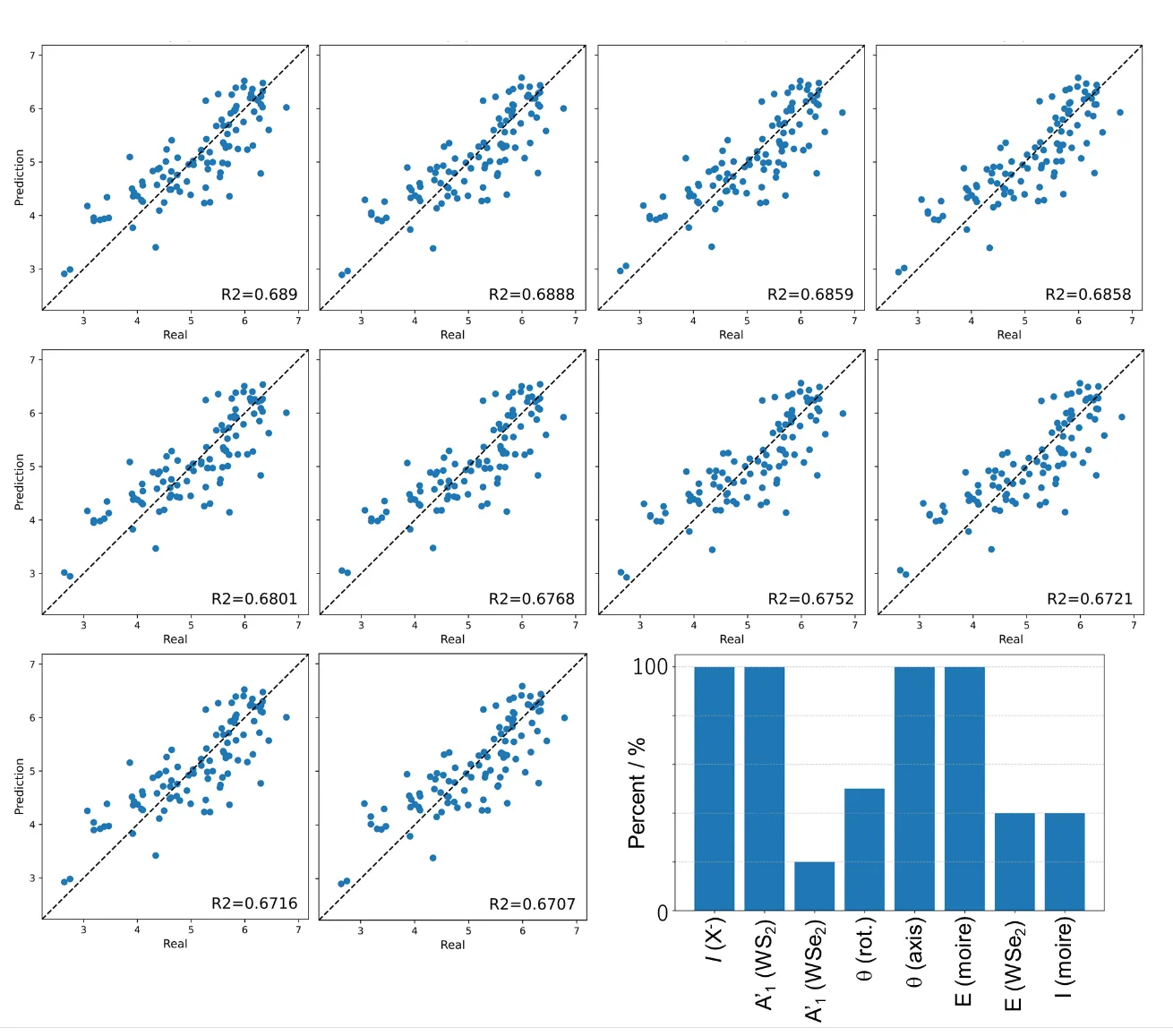
Light from thin semiconductor layers can be polarized: its waves oscillate in a single plane. Previously, it was thought that the direction of oscillation was set by how the sample was illuminated. But new experiments with two layers of different materials (WSe2 and WS2) showed otherwise: when cooled to cryogenic temperatures, the polarization of the emitted light barely changes, no matter how we illuminate the sample.
The key is strain in the crystal lattice. Even a weak stretch or compression breaks the symmetry of the structure, and light from different parts of the sample becomes elliptically polarized: its waves trace out ellipses. Away from the sample, these ellipses partially cancel each other out, but not completely: a noticeable linear polarization remains. Automated mapping with polarization and Raman spectral resolution revealed a strong link between the degree of linear polarization and local frequency shifts caused by strain.
Linear regression confirmed that strain parameters best predict the observed polarization. So for reliable optical readout in moiré superlattices, it is strain that needs to be controlled, not the polarization of the excitation light. The discovery offers a simple and practical way to control light in future optoelectronic devices based on two-dimensional materials.
Moiré superlattices arise when two layers with slightly different periods are stacked on top of each other, just as two combs with different tooth spacings create a pattern.