Malus's law describes how the intensity of polarized light transmitted through a polarizer varies with the cosine squared of the angle between the light's polarization and the polarizer's axis.
23 related articles · 3 formulas · 1 who worked here
In 1809, French officer Étienne Louis Malus, looking through a crystal of Iceland spar at the reflection of the setting sun in the windows of the Luxembourg Palace, noticed something astonishing: as he rotated the crystal, the reflection alternately faded and brightened. He realized that reflected light was no longer chaotic but preferred one direction of vibration, and he called this polarization. Passing such light through a second crystal, Malus derived a strict relationship: intensity I depends on the angle θ as I = I₀cos²θ. Today, a simple turn of the head in sunglasses or the motion of a pixel on a screen are governed by this cosine. Malus's law became the first quantitative conquest of polarization optics and proved the transverse nature of light waves.
History
Étienne Louis Malus, an officer in the Napoleonic army and engineer, was studying birefringence in crystals in 1809. One evening, while looking through a crystal at the sunset reflection in the Luxembourg Palace, he was surprised to notice that one of the two images disappeared when rotating the crystal. Thus, the phenomenon of polarization by reflection was discovered. Malus measured how brightness changed and derived the relation: intensity is proportional to the square of the cosine of the angle. The law confirmed the transverse nature of light waves and became part of the toolkit of optics. Later, Augustin Fresnel provided a theoretical justification within the wave theory.
How it works
Malus's law works for fully polarized light and an ideal dichroic analyzer. It underlies the operation of polarimeters, LCD displays, polarizing filters in photography, and is also applied in polarization microscopy and in studies of optically active substances. Limitations: it does not hold for partially polarized light — a statistical generalization is required; in real materials, there are always small losses and depolarization.
In practice
In LCD screens, each pixel is a tiny liquid-crystal shutter that, on command, rotates the polarization, adjusting brightness strictly according to Malus's law. Polarizing sunglasses quench glare on water, glass, and wet asphalt because reflected light is polarized horizontally, while the glasses are oriented vertically — angle 90°, light does not pass.
Fun fact
Light from the blue sky is polarized: if you look at a patch at 90° to the sun through a polarizer and rotate it, the sky noticeably darkens — a direct consequence of Malus's law. Bees and ants use the same trick for navigation.
Effective temperature of the surface — temperaturekelvin
\sigma
constant
Proportionality constant relating blackbody radiated power to temperature — stefan boltzmann constant= 5.670374419e-8watt per metre squared per kelvin to the fourth
Light born when a fast electron enters a material is usually assumed to be the same in all directions. But in crystals where optical properties depend on direction, that's not the case. Run your hand over velvet: one way it's smooth and shiny, the other — dark and rough. Similarly, a crystal responds differently to light depending on how it's oriented.
A laser hits an atom, and tears out an electron. The brighter the light, the stronger the kick, and the faster the electron flies away. That's how the familiar picture works, where light is a smooth wave. But what if the light isn't smooth but 'squeezed,' with quantum fluctuations, like the trembling of a string?
A perovskite solar cell is like a young athlete: it performs brilliantly at first, but tires with age. Over eight hours, its performance drops noticeably, with no visible cause like cracks or dust. Scientists took one cell and recorded its performance at 0, 90, 280, and 480 minutes of its life.
When two heavy nuclei collide in an accelerator, a tiny fireball of quark-gluon plasma is born — a special state of matter where quarks and gluons are not confined inside particles. As it expands and cools, the emitted particles often come out "spinning"—their spins align along the beam direction.
On the wall: light and dark fringes. That’s what light looks like when it cancels itself out.
Way back in the 17th century, Christiaan Huygens suggested that light is a wave.
Light bends in a lens — everyone knows that. Gravitational waves passing a massive body also curve their path. But the authors of this work looked further: what happens to the wave's very "color" — its polarization, that is, the direction of oscillation?
Gravitational lensing is the deflection of…
A light wave is like a rope that has been shaken: it oscillates in a specific plane. This property, polarization, reveals the shape and composition of objects. But capturing it is not easy, especially when you need to cover a wide range of colors. Usually, this requires bulky systems of lenses and filters.
Gravitational waves are the trembling of spacetime itself. Usually we only catch their overall hum, but each wave also has a direction of oscillation – polarization. Old maps were built only from signal loudness, which led to errors. It's like trying to see the bottom of a pond through sun glare.
Two ultra-thin sheets, each just one atom thick, are placed on top of each other and slightly rotated. Like two sheets of colored tracing paper: while they lie flat, the picture is one thing, but give them a twist and a moiré pattern appears. Here, though, the pattern isn't visible to the eye, but it completely changes how the material handles light.
A flashlight beam glides over uneven glass. The glass is massive galaxy clusters, and the flashlight is ancient light born shortly after the big bang. Passing by such clusters, light doesn't just bend around them like water around a rock. Its path shifts slightly sideways, and the amount of shift depends on how the light is 'twisted'—right or left.
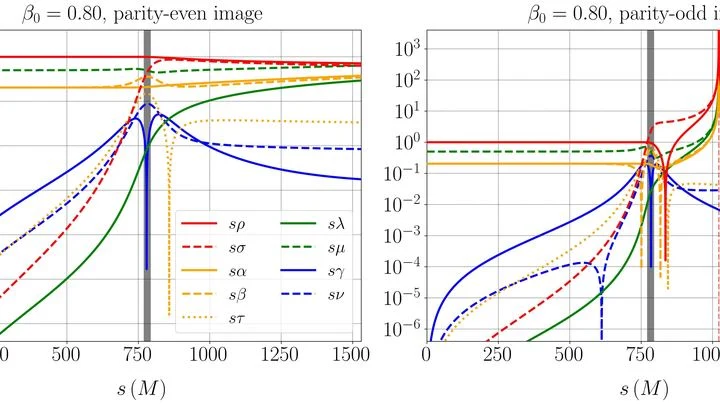
When two black holes merge, they shake the very fabric of spacetime. The newborn giant doesn't settle instantly (it rings like a cosmic bell, emitting a characteristic pattern of damped gravitational waves) the so-called ringdown.
A drop of water stretches in a strong electric field. The deuterium nucleus, a bound pair of a proton and a neutron, behaves the same way, except here the field comes from a passing gamma ray, and instead of just stretching, the nucleus can simply fall apart.
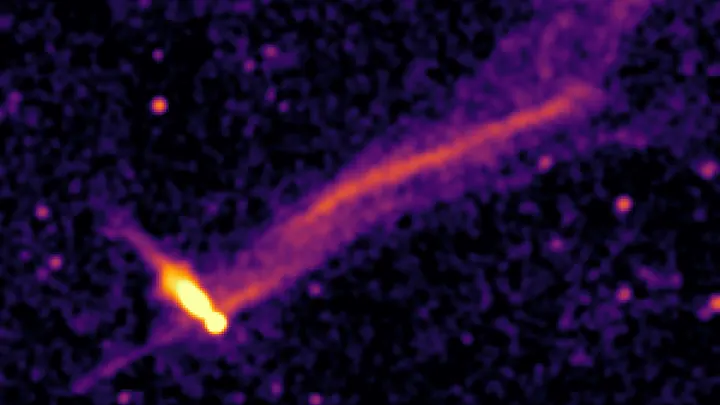
Deep in space, a rapidly spinning neutron star, a pulsar nicknamed the Lighthouse, speeds through tenuous gas. Like a motorboat cutting through water, it leaves a glowing trail of charged particles behind. In X-rays, this trail appears as a bright tail and a thin filament stretching over many light-years.
In a dark room, a flashlight beam picks out only a narrow strip from the gloom. In much the same way, Roger Penrose proposed looking at gravitational waves — ripples in spacetime traveling at the speed of light.
Light from thin semiconductor layers can be polarized: its waves oscillate in a single plane. Previously, it was thought that the direction of oscillation was set by how the sample was illuminated.
Shine light on an FePS3 crystal, and it responds with its own glow, like a neon sign, but much fainter and in the infrared range. This glow is not random: it depends on how the crystal is oriented. The scientists took samples from a thick chunk down to a single-atom layer and observed four emission bands — at 1.24 electronvolts, 1.79, 2.3, and 2.56.
Ordinary light scatters in all directions, like water from a shattered glass. But in some crystals, light waves can bunch together into narrow beams and flow in a single direction, like water in a trough. Physicists studied such a material: layered vanadium oxide α-V2O5.
In this crystal, atoms vibrate differently along and across the layers.
An ordinary sheet of black phosphorus looks like a layered cake of atoms. If you shine a regular lamp on it, nothing special happens: the electrons sit still, like spectators in a dark theater. But a short laser flash lasting millionths of a billionth of a second shakes up that theater.
During a thunderstorm, the sky acts like a giant battery: charge builds up in the cloud, and a lightning bolt discharges it. That charge is invisible, but cosmic particles (muons, which constantly rain down on Earth from space) can sense it. As a muon flies through a charged cloud, it speeds up or slows down slightly, and these changes reveal the voltage inside the cloud.
You can make a light beam look like a flower with several petals. If you send such a beam through a cloud of cold rubidium atoms and switch on a magnetic field, the petals start to rotate. The angle of rotation is directly linked to the field's strength.
Light from the Sun is usually unpolarized: its waves oscillate in all directions, like a crowd where everyone waves their arms as they please. But on May 3, 2023, astronomers in Locarno, Switzerland, noticed that during a flare, the light from helium became organized — the waves aligned in one direction, like soldiers on parade.
A neutron star the size of a city spins faster than a kitchen blender, flinging particles around itself. A glowing cloud forms around it — called a pulsar halo. The shape of this cloud depends on invisible magnetic fields that, like ocean currents, steer the particles.
The Sun is not a calm sphere. Waves constantly ripple through its interior, like a bell after being struck. These oscillations reach the surface and reveal what's happening on the far, invisible side. Astronomers have long been able to 'listen' to this ringing and find large sunspot groups there.
The X-ray pulsar Centaurus X-3 is a neutron star that spins rapidly and emits pulses of X-ray light like a lighthouse. Scientists pointed three space telescopes at it and studied the polarization of its emission — how the electric field of the light wave oscillates.
Light passing through a thin crystal can change color and the direction of its oscillations. In a molybdenum disulfide flake just hundreds of atoms thick, an infrared beam turns green, and its polarization, the way the light wave oscillates, obeys the crystal's geometry.
In a giant particle accelerator, where protons traveling at nearly the speed of light smash into a neon target, charmed baryons are born — particles that live for less than a billionth of a second.
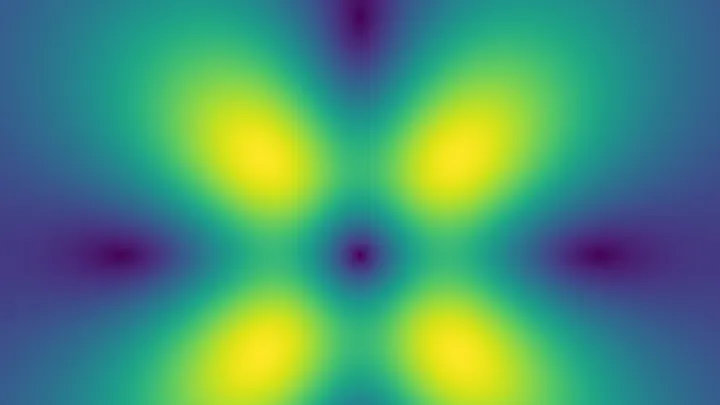
In the dark cloud L43, where stars are born, dust grains twirl like tiny compasses. Light from a young star pushes them, while the magnetic field lines them up in a specific direction. When a grain is turned sideways to us, its heat reaches us polarized, like light passing through a narrow slit.
Light from the star HD 163296 passes through the surrounding gas-and-dust disk like a flashlight beam through murky water. The disk's particles scatter the light, giving it a special property — polarization: the waves begin to oscillate in a single plane, like a rope shaken strictly up and down.
Terahertz radiation sits between microwaves and infrared light. It passes through clothing, paper, and plastic but is blocked by water and metal. That's why these waves are used in security scanners and for quality control of materials.
A beam of circularly polarized light hits a MAPbI3 perovskite crystal. The electrons inside start behaving like tiny spinning tops, their axes aligning along the beam. This phenomenon is known as optical spin orientation.
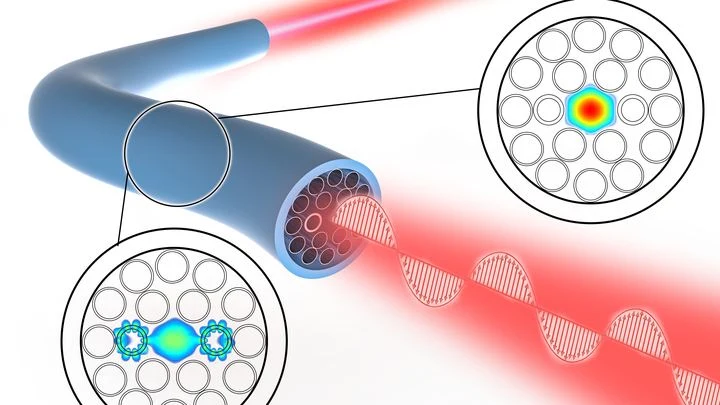
A light wave is like a crowd where everyone waves a flag in their own direction. To get such a crowd through a narrow corridor without losing order, you need guides. In optical fibers, polarization, the strict direction of the light wave's oscillation, plays that role.
A football kicked with spin doesn't fly straight: it bends to the side. A tightly focused beam of light does something similar: it starts pushing an atom not just forward but also sideways. Physicists measured this shift on a single calcium ion trapped in a light trap.
The beam was aimed at the atom like a spotlight on a grain of sand.
Light from distant galaxies passes through telescope lenses like through a stack of window panes. Each pane is coated with a thin film to reduce glare. But this film acts as a polarizing filter: one component of the light wave passes a bit more freely, the other a bit worse. As a result, the wave rotates slightly, and the telescope sees a different picture than what is in the sky.
Light traveling through an optical fiber is like a crowd in a narrow corridor: each photon takes its own path, and if the paths get mixed up, you end up with mush at the exit.
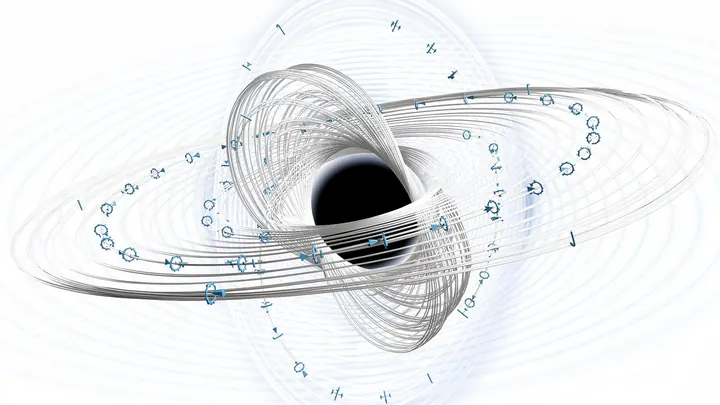
A black hole doesn't just suck in matter — like a giant cosmic whirlpool, it warps the very fabric of reality and bends light rays around itself, focusing them. The effect is even stronger for black holes that spin at nearly the speed of light: their rotation twists space into a tight spiral.
In 1976, Canadian physicist Bill Unruh asked a simple question: what does an observer see when accelerating through empty space? The answer turned out to be strange: emptiness ceases to be empty. An accelerating observer bathes in thermal radiation with a temperature proportional to the acceleration.