The polarization degree quantifies how much of a light wave's oscillation is aligned in a single direction rather than being randomly oriented. In natural light, such as sunlight, the electric field vibrates in all directions perpendicular to the direction of travel, so the polarization degree is zero. When light reflects off a surface, scatters through a medium, or passes through a polarizing filter, the vibrations can become partially aligned, giving a polarization degree between zero and one. A perfectly polarized beam, like that from a laser, has a degree of one.
History
The concept emerged in the 19th century as scientists like Augustin-Jean Fresnel and George Gabriel Stokes developed mathematical descriptions of polarized light. Stokes introduced the parameters that bear his name in 1852, providing a rigorous framework for quantifying polarization.
How it works
The polarization degree is defined as the ratio of the intensity of the polarized component to the total intensity of the light. Mathematically, it is often expressed using Stokes parameters: the degree is the ratio of the square root of the sum of the squares of the linear and circular polarization parameters to the total intensity. In practice, it is measured by rotating a polarizer in front of a detector and recording the maximum and minimum transmitted intensities; the degree is then (Imax - Imin) / (Imax + Imin).
In practice
Polarization degree is used in remote sensing to analyze atmospheric aerosols, in astronomy to study magnetic fields in interstellar clouds, and in materials science to characterize stress in transparent plastics.
Fun fact
The polarization degree of light from the sky is used by some insects, like bees, as a navigation aid, and it can be measured by a simple camera with a polarizing filter.
The universe sometimes resembles an old fabric: after rapid cooling, wrinkles could have remained — thin, almost invisible threads of monstrous density. They are called cosmic strings. Usually, at the center of such a string hides a singularity — a point where the laws of physics lose their meaning.
Light, like a shaken rope, oscillates in a specific plane. Astronomers and engineers often rotate images using a three-mirror system, the so-called K-mirror, but this inadvertently rotates the plane of oscillation as well. For precise measurements, that's a problem.
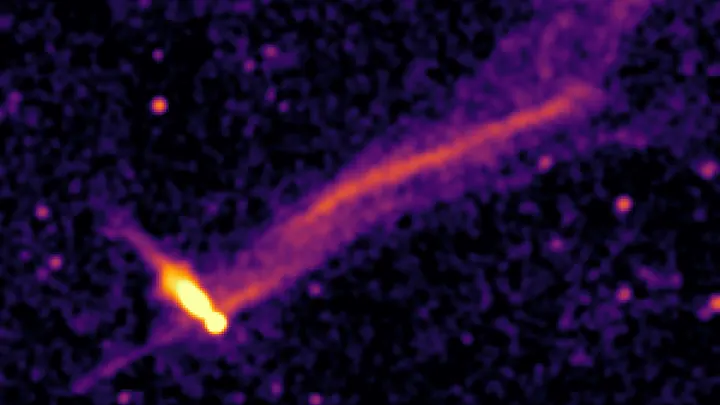
Deep in space, a rapidly spinning neutron star, a pulsar nicknamed the Lighthouse, speeds through tenuous gas. Like a motorboat cutting through water, it leaves a glowing trail of charged particles behind. In X-rays, this trail appears as a bright tail and a thin filament stretching over many light-years.
Light from thin semiconductor layers can be polarized: its waves oscillate in a single plane. Previously, it was thought that the direction of oscillation was set by how the sample was illuminated.
Around young stars, disks of gas and dust swirl — the building blocks for future planets. Inside these disks, dust grains don't just fly randomly: they align along invisible lines of gas flow. Recently, astronomers noticed that dust grains in such disks behave like badminton shuttlecocks — always turning their long side into the wind.
Two tiny emitters, each about the size of an atom, can together do what neither can do alone. We're talking about light scattering — when light hits particles and bounces off in all directions. Usually, a pair of particles scatters light only slightly more than a single one.
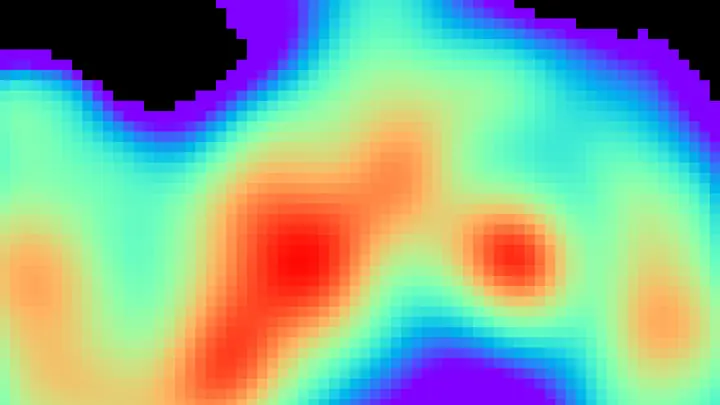
In the dark cloud L43, where stars are born, dust grains twirl like tiny compasses. Light from a young star pushes them, while the magnetic field lines them up in a specific direction. When a grain is turned sideways to us, its heat reaches us polarized, like light passing through a narrow slit.
Light from a star is not just a stream but a wave that can oscillate in different directions. Ordinary light is like a crowd where everyone waves their arms randomly. But after reflecting off dust grains or passing through a magnetic field, some waves align in a single line, like soldiers in a row.
In a container the size of a coin, light behaves like water: it gathers into a single quantum fluid. When energy is added, whirlpools, quantum vortices, spin up on their own. Each vortex is like a tiny whirlpool that cannot simply disappear.
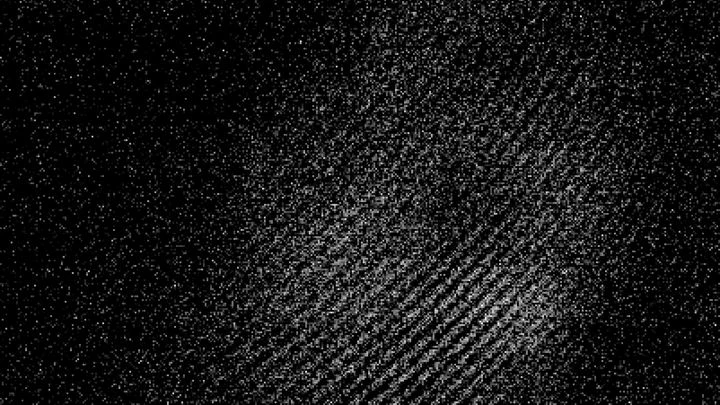
Physicists illuminated this fluid with a laser and took snapshots.
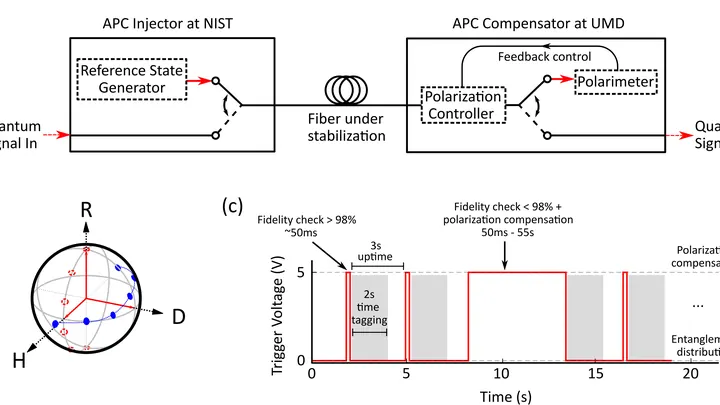
Two photons, like two halves of the same coin, fly tens of kilometers apart but remain linked: measure one, and you instantly know the state of the other. This property is called entanglement, and it underpins quantum communication.
A black hole doesn't just suck in matter — like a giant cosmic whirlpool, it warps the very fabric of reality and bends light rays around itself, focusing them. The effect is even stronger for black holes that spin at nearly the speed of light: their rotation twists space into a tight spiral.
The ACT telescope in Chile's Atacama Desert stared at the sky from 2007 to 2022. Its target: the cosmic microwave background, light that has been traveling toward us for 13.8 billion years. This light is polarized: its waves oscillate in specific planes, like strings stretched in different directions.