How the Robin 'Sees' the Magnetic Field express
Every autumn, a robin weighing as much as a pat of butter lifts off from a branch somewhere near St. Petersburg and flies south toward the Mediterranean, never once checking a map. It is believed that its eye contains a built-in magnetic compass, and the main component of this device is the protein cryptochrome 4a. Blue light triggers an electron transfer within it, giving rise to a radical pair, two molecules with unpaired electrons, whose quantum state depends on the tilt of Earth's magnetic field. The problem is that the quantum lifetime of such a pair lasts only microseconds, while the bird needs a signal that lasts long enough for a nerve cell to notice.
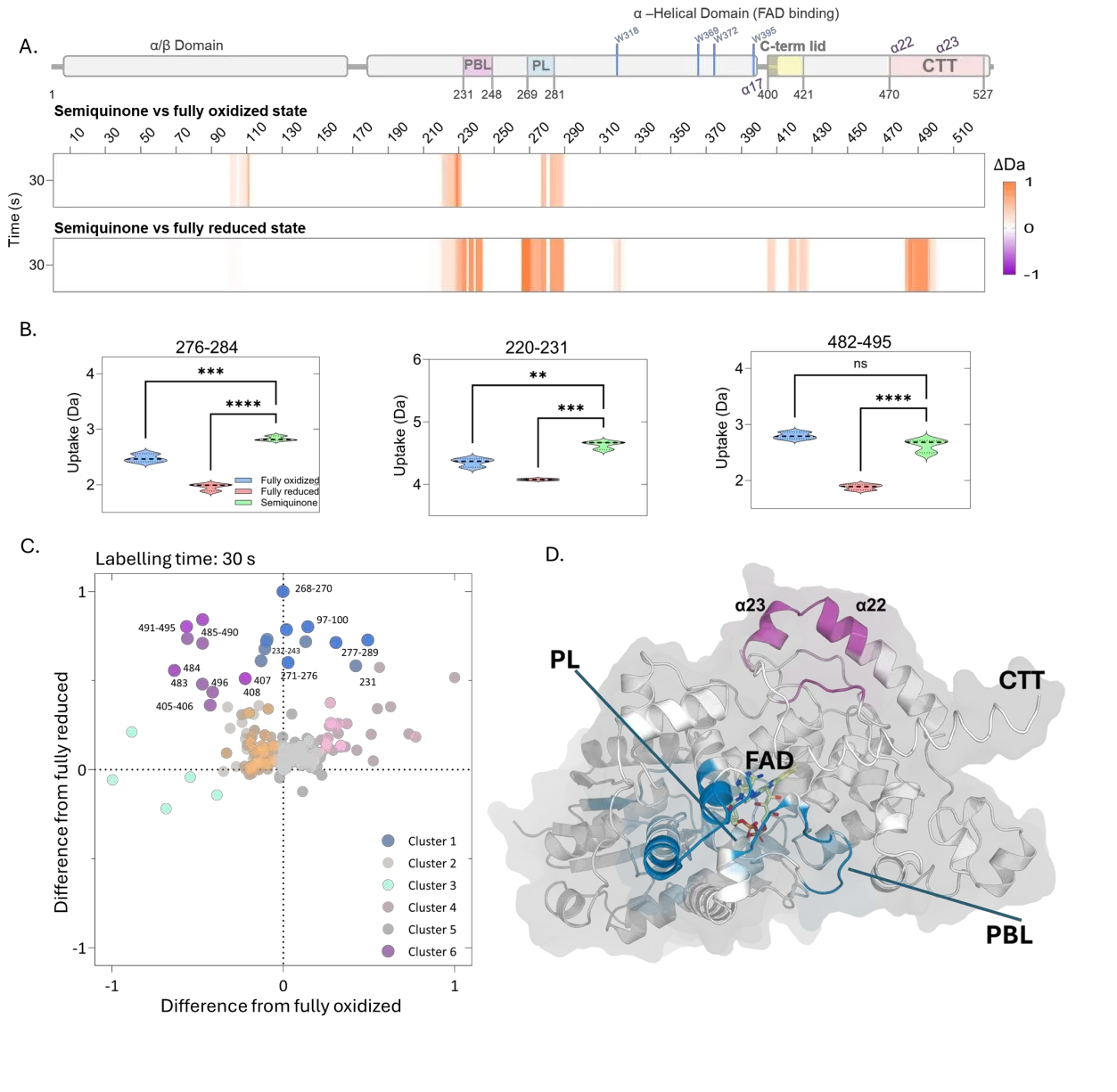
The researchers studied the ErCry4a protein from the European robin using a method that can be compared to flash-freezing a moving mechanism. They irradiated the protein with blue light and then, at various time points, plunged it into heavy water. Where the protein chain was mobile and open, hydrogen atoms were quickly replaced by deuterium; where the structure was rigid, the exchange was slow. This allowed them to capture a 'snapshot' of the protein's shape at each stage: the dark state, the transition to the active state under light, the short-lived semiquinone, and the final, fully reduced state.
It turned out that the semiquinone behaves not like a bridge but like a distinct entity with its own character. In the fully reduced protein, everything becomes rigid, as if the mechanism were locked in one position. In the semiquinone, by contrast, two important loops, the phosphate-binding loop and the protruding loop, lose stability and become mobile. It is this instability, rather than rigidity, that may serve as a clear signal for the next player in the chain: a mobile loop can touch a partner protein and trigger a cascade that eventually reaches the bird's brain. Thus, a fleeting quantum event gains a long biochemical life.
A robin can detect the inclination of the magnetic field with an accuracy better than five degrees — roughly like being able to tell, with your eyes closed, which way a compass needle points by the faint warmth on your skin.