Color charge is a special property of quarks and gluons, like paint on balls. Only instead of paints there are three colors: red, green, and blue. It helps particles 'communicate' via the strong interaction.
History
The concept was introduced by Oscar Greenberg in 1964 to explain the symmetry of baryonwave functions. Soon Yoichiro Nambu and Han Moo-Young proposed using a triplet structure. The final formulation in the framework of QCD was completed in the 1970s, when asymptotic freedom was discovered and the role of SU(3) as an exact gauge symmetry was understood. Experimentally, the existence of color charge is confirmed by analysis of hadron production cross sections in e⁺e⁻ collisions (ratio R = σ(e⁺e⁻ → hadrons)/σ(e⁺e⁻ → μ⁺μ⁻)).
How it works
In QCD, each quark current changes color by emitting or absorbing a gluon. The interaction Lagrangian has the form g_s \bar{ψ} γ^μ t^a ψ A_μ^a, where t^a are the generators of SU(3) in the fundamental representation. Gluons themselves carry color, so their self-interaction leads to charge anti-screening: the effective coupling constant α_s increases with decreasing energy scale. This leads to confinement at distances of about 1 fm: the potential V(r) ≈ -4α_s/(3r) + σ r, where σ is the string tension. At high energies (small distances) α_s decreases (asymptotic freedom). Observed hadrons are always white (singlet under SU(3)).
Fun fact
Quarks constantly change their color, like chameleons in the jungle. But in nature we see only 'colorless' combinations — like light from three colored flashlight beams.
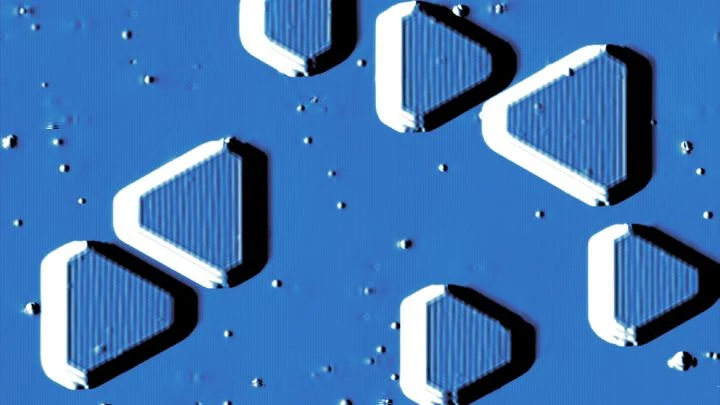
In a pot of water, microscopic spheres, colloidal particles, are floating. Each sphere is coated with long polymer chains that look like a brush and carries an electric charge. If you get the temperature and solution composition right, the spheres start arranging themselves into ordered patterns — crystals.
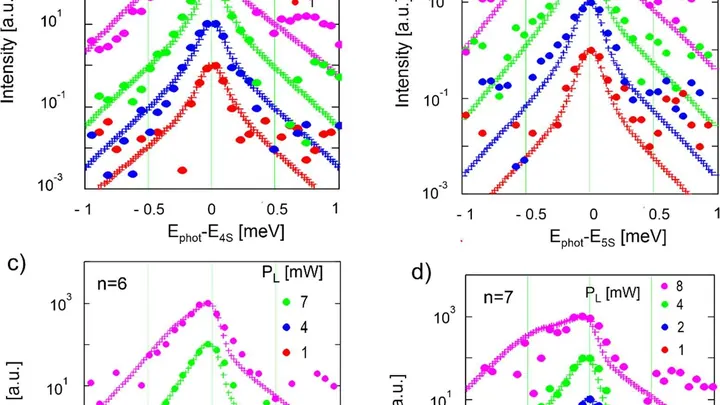
A copper oxide crystal looks like a dark red pebble. But when a short laser pulse hits it, pairs are born inside: an electron and a 'hole'—a place where an electron is missing. Such a pair is called an exciton and behaves almost like a hydrogen atom: the particles circle each other, bound by electric attraction.
Electric charge is a slippery thing. You can measure how much there is in the entire universe or in a single particle, but try to point your finger and say, 'Right here, in this cubic centimeter, there is exactly this much charge right now,' and you hit a fundamental wall.
The issue is that total charge, which physicists denote by the letter Q, is nonlocal.
The proton is not a solid ball but a tiny prison. Inside it, three quarks are locked up, and the gluon field keeps them from escaping — something like invisible threads that only grow stronger if the quarks try to move apart.
A classical black hole has a temperature and other thermodynamic properties. When physicists began accounting for changes in the cosmological constant, the energy of empty space, a strange coupling emerged in the equations.
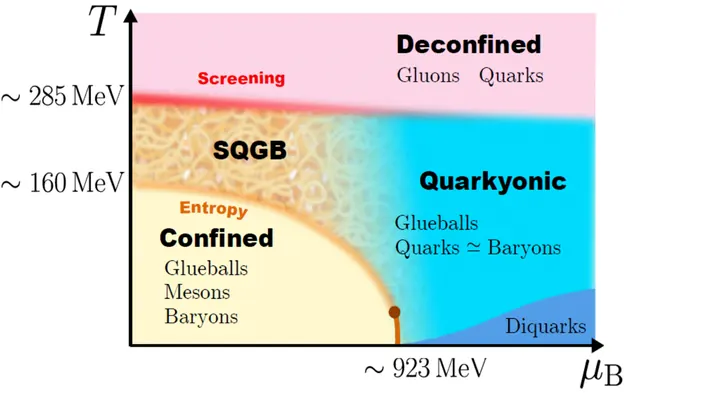
In the microscopic world of the strong interaction, nature's most powerful glue, quarks never wander alone. Over large distances, they stick together into the protons and neutrons we know. But under extreme compression, like in the depths of a neutron star, this glue creates far more exotic forms of matter.
When an electric charge moves with acceleration, it emits electromagnetic radiation, i.e., light — a familiar phenomenon in physics. However, researchers have found that when moving along a specially chosen trajectory, the radiation acquires unusual properties.
Inside a neutron star, matter is squeezed so hard that atomic nuclei stop being separate clumps. Neutrons and protons get closer together, and their innards, quarks, begin to feel their neighbors through the walls of their 'bags'.
A neutron star is a sphere about the size of a small city but with a mass of one and a half Suns.
If you squeeze a handful of sand down to the size of a pinhead, it turns into a rock. But squeeze it even harder, to the density of an atomic nucleus, and the grains lose their identity. Protons and neutrons dissolve, and the stuff becomes a soup of free quarks.
Quantum batteries harness quantum effects to circumvent the limitations of ordinary devices imposed by entropy — a measure of disorder and energy losses. Imagine a bucket under a powerful jet: filling is lightning-fast. But the bucket has holes: the environment constantly drains the energy.
Ordinary batteries lose charge like tea cools down. A quantum battery works differently: its heart is a tiny cavity with darting photons. If you illuminate it with special photon pairs, energy flows into a chain of qubit cells instantaneously — much like a swing gets a boost from strong pushes.
The atomic nucleus is not a solid ball but a dense swarm of tiny particles called quarks, glued together by a special glue (the strong force). In light nuclei, such as calcium, this swarm is simply arranged: the numbers of the two quark types, up and down, are almost equal, like the white and black keys in an octave.
If you try to break a proton apart and pull out a quark, you're in for a surprise. Ordinary forces, like the electric force, weaken as particles fly apart. Here, it's the opposite. The farther a quark gets from its neighbors, the harder it's pulled back.
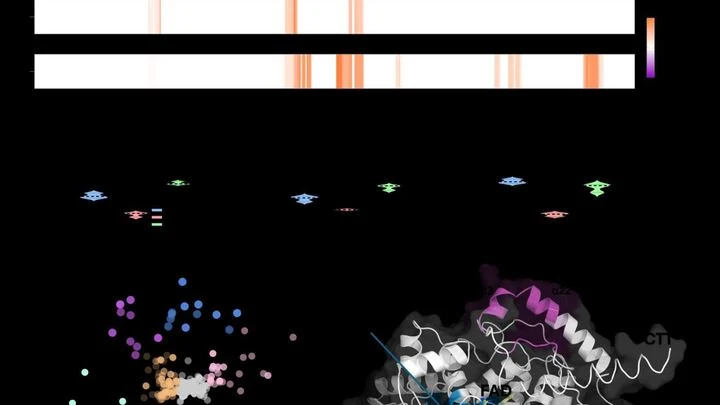
Every autumn, a robin weighing as much as a pat of butter lifts off from a branch somewhere near St. Petersburg and flies south toward the Mediterranean, never once checking a map. It is believed that its eye contains a built-in magnetic compass, and the main component of this device is the protein cryptochrome 4a.
In collisions of heavy nuclei at colliders, quark-gluon plasma is born — a state of matter where quarks and gluons are as free as water in steam. Heavy quarks, such as b-quarks, entering this plasma lose energy, and their bound states, bottomonia, are destroyed.
When heavy nuclei collide in accelerators, a multitude of particles is produced, and physicists want to understand how electric charge moves through this chaos. Two trains crash into each other: the passengers (quarks) scatter, but their luggage (charge) may end up far from the crash site.
A sheet of graphene is a mesh of carbon atoms one atom thick. Even the slightest contamination shows up on it, like dust specks on eyeglass lenses. Ten years ago, researchers learned to hide graphene between layers of boron nitride, like placing a fragile sheet between two pieces of plastic wrap.
A drop of metal on a semiconductor is like an island in the sea. For an electron to reach that island, it must pay a "toll": overcome a barrier that arises because the island is tiny, and each extra charge significantly changes its energy. This phenomenon is called Coulomb blockade. It underpins single-electron transistors, where current flows one electron at a time.
In the first moments after two lead nuclei collide at the Large Hadron Collider, a tiny fireball is born — a quark soup where particles move freely. If a very strong magnetic field arises at that moment, it can separate positive and negative charges, much like a comb parts hair into strands.
A flashlight wrapped with red tape on its sides shines white straight ahead and reddish from the side. Active galactic nuclei work the same way: at the center, a supermassive black hole is surrounded by a disk of hot gas and cosmic dust. Dust accumulates in the plane of the disk. Looking from above, we see a bright blue glow.
In layers of molybdenum telluride twisted at a specific angle, electrons behave unusually: they can split into parts. This is akin to a whole pie suddenly being cut into perfectly equal slices, even though there's only one knife. In ordinary materials, the electron's charge is indivisible, but in these layers, under strong cooling, states emerge where the charge splits into three parts.
A quantum computer is like an orchestra where electrons and nuclei play different instruments. Usually, the conductor needs two batons: microwaves for electrons and radio waves for nuclei.
When you pluck a guitar string hard, it doesn't sound a single note but several at once — the fundamental tone and overtones. Physicists have pulled a similar trick with light: they aimed an infrared laser at a crystal, and the crystal lit up with sixteen colors at once, from invisible heat to hard ultraviolet.
Ten microseconds after the Big Bang, the Universe resembled a pot of boiling broth. Floating in it were quarks and gluons — the particles that would later assemble into protons and neutrons. As the broth cooled, at some point the quarks clumped together into lumps — the very protons and neutrons that make up all visible matter.
A silicon wafer is like cookie dough. Heat it in an oven, and tiny raisins appear inside — defects in the crystal lattice that can emit single photons. These "raisins" are called color centers, and they are needed for quantum computers and secure communication.
Water in a kettle heats to 100 degrees, and stops being water, turning into steam. Something similar happens to atomic nuclei when they are smashed together at enormous speeds in the Large Hadron Collider.
Two beams of light, red and blue, enter a tiny ring made of silicon nitride. The ring is smaller than the thickness of a human hair. At the input, both beams are equally bright. But inside the ring, one of them suddenly starts to outshine the other, like two equally matched people in a debate where one unexpectedly gains the upper hand.
Quantum batteries lose energy due to entropy — the tendency toward disorder. Just as parallel wires pick up interference, the battery's contacts with the environment create leakage channels. The solution: braid the giant atoms, which act as both charger and storage, into a braid.