Deuterium is a stable isotope of hydrogen whose nucleus contains one proton and one neutron, making it roughly twice as heavy as ordinary hydrogen. It is often called "heavy hydrogen" and is found naturally in seawater, where about one in every 6,400 hydrogen atoms is deuterium. Because of its extra neutron, deuterium participates in nuclear reactions more readily than ordinary hydrogen, making it a key fuel for fusion.
History
Deuterium was discovered in 1931 by Harold Urey, who later received the Nobel Prize in Chemistry for this work. He identified it by detecting small shifts in the spectrum of hydrogen gas.
How it works
In fusion, deuteriumnuclei can be forced together with other light nuclei (like tritium or another deuterium) at extremely high temperatures and pressures. The strong nuclear force then binds them into a heavier nucleus, releasing a large amount of energy in the process. The extra neutron in deuterium lowers the Coulomb barrier between nuclei, so fusion reactions involving deuterium occur at lower temperatures than those involving only ordinary hydrogen.
Inside the steel of a future fusion reactor, tiny helium bubbles form, and on their walls a chemical drama unfolds. Chromium and tantalum atoms, like sentinels, take positions at the cavity boundary and change the rules of the game for hydrogen.
In the depths of sub-Neptunes, the most common type of planet in the Galaxy, though not one you could stand on, silicate magma and hydrogen mix into a single supercritical cocktail. Previously, it was thought that beneath the dense hydrogen atmosphere lay a sharp boundary with molten silicate, like oil on water.
Atomic batteries powered by plutonium decay have been running pacemakers and space probes for over sixty years. But the raw material is scarce: worldwide, only a few kilograms of plutonium-238 are produced each year, barely enough for the most critical missions.
In nuclear physics, a puzzle has long been nagging: why among elements lighter than bismuth, only technetium (No. 43) and promethium (No. 61) have no stable isotope at all? All their neighbors in the periodic table can boast at least one long-lived variant, but these two seem to fall out of the general pattern.
Through three minutes after the Big Bang, the Universe played its first symphony. It was the big bang nucleosynthesis — the formation of light nuclei, where each element sounded its own note, and the tempo was set by the expansion of space.
Water in a glass looks continuous, but it's made of molecules. Similarly, physicists have long described the matter inside a neutron star as a uniform soup of protons and neutrons. But real neutron stars are not soup. They are a dense crowd of particles where each neutron feels its neighbors.
The authors of the new work abandoned the uniform picture.
Water comes in different varieties. Not just fresh or salty, but also "heavy"—when one of its hydrogen atoms is replaced by deuterium, its heavier cousin. Such water is called HDO, and it's a true cosmic passport: the amount of deuterium in water reveals where and when that water was born.
In a quiet room, you can hear the faintest whisper. Likewise, in the hydrogen atom, the lightest of all, an uninvited guest is easier to spot. That guest could be the Z' boson, a mediator particle of a new force predicted by many unification theories. The Standard Model already has its own mediator — the Z boson.
At the center of every atom lies a nucleus — a dense ball of protons and neutrons. These particles don't just crowd together randomly; they fill strict energy levels, much like floors in a skyscraper. When a floor is completely filled, the nucleus becomes especially stable — physicists call this a magic number.
Water is not just a wet substance. On a picosecond scale, it resembles a dance floor where molecules continuously break and form bonds with each other. Usually, this dance is described by one main movement — collective relaxation, as if the whole crowd simultaneously slows down after the music stops.
In nuclear physics, the belief long reigned that two neutrons cannot form a bound state — they attract too weakly and immediately fly apart. However, on the surface of neutron-rich nuclei, where the matter density drops to a thousandth of normal nuclear density, the situation changes dramatically.
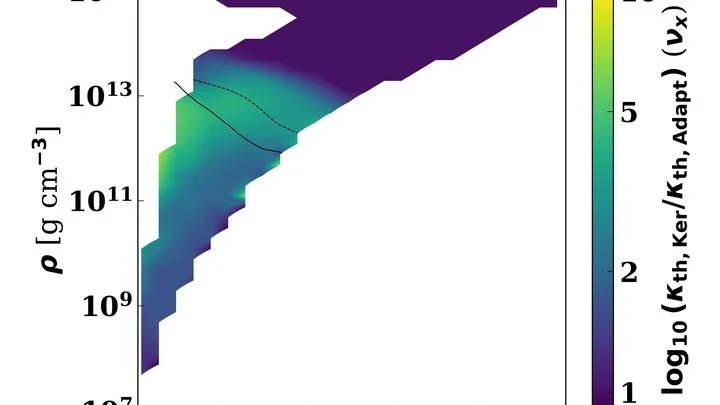
The collision of two neutron stars is a cosmic laboratory where matter is compressed to unimaginable densities. In the first moments after the merger, a hot cloud forms and cools by emitting neutrinos. These ghostly particles carry away energy and dictate how much matter is ejected into space and which heavy elements are synthesized.
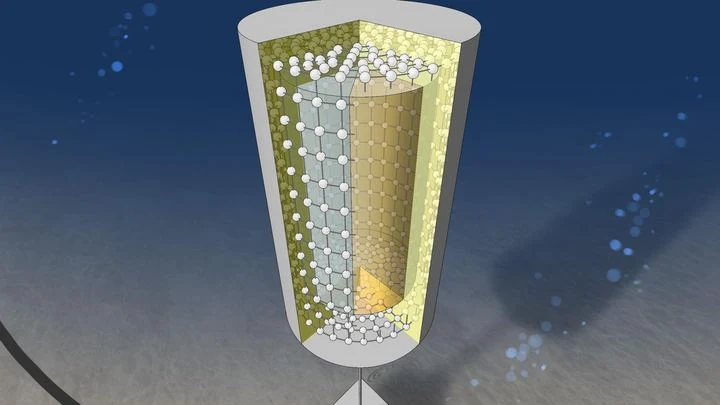
In the depths of the ocean, where light never reaches, a plan is taking shape to capture particles that barely interact with anything. Geoneutrinos, tiny messengers from the scorching mantle, are emitted during the decay of uranium and thorium. Their flux carries information about how much heat lies hidden beneath our feet.
A planet the size of Neptune, but glowing white-hot. Beneath the clouds lies an ocean of magma capable of absorbing an entire hydrogen atmosphere. The new SEAMIST model is the first to trace how such dissolution changes a planet's fate from birth to old age.
The big surprise is the mechanism of catastrophic boiling.
Atomic nuclei are wrapped in fluffy electron coats — in such attire, they can't get close enough to embrace. But swap the light coat for a heavy one: a muon, a particle from the standard model, shrinks the cloud by nearly 200 times.
An invisible fence blocks the strait. You can't climb over it or dive under it: it's not made of steel, but of a stream of particles penetrating the water column. That's one way to describe the idea of detecting nuclear submarines by their antineutrino emission.
In a crystal of water and caustic cesium, oxygen and cesium atoms sit in place like beads in a rigid lattice. Hydrogen atoms behave differently: they are like passengers constantly changing seats. In this layered material, each oxygen is linked to three neighbors via hydrogen bridges, forming a honeycomb-like pattern.
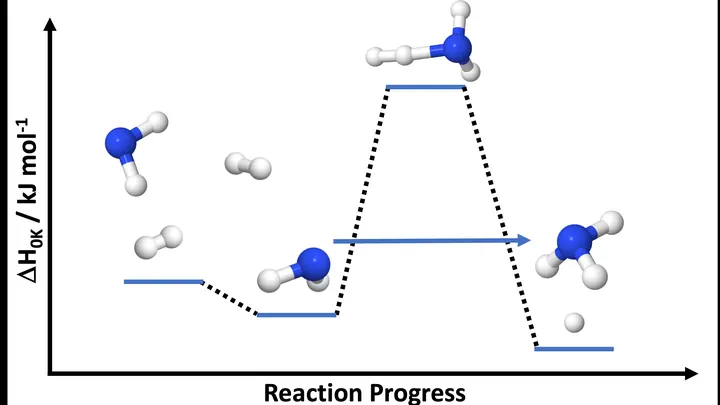
A ball rolls up a hill, but it doesn't have enough energy, so it rolls back down. That's classical mechanics for you. But in the quantum world, a tiny particle can sometimes pass right through the hill, as if the barrier weren't there. This trick, tunneling, is business as usual for a light atom like hydrogen.
Fusion, the merging of a proton with a boron-11 nucleus, promises a near-perfect energy source: no dangerous neutron flux, just a stream of charged particles that can be directly converted into electric current. But there's a fundamental problem: the Coulomb barrier.
Nitrogen, the very gas we breathe, behaves like a finicky metal under a million atmospheres of pressure. In a diamond anvil cell, it is squeezed to 78–98 gigapascals and heated with a laser to 1800–2500 kelvin. Under these conditions, N₂ molecules rearrange into crystals that can store energy more densely than explosives.
Light twisted in one direction hits a proton. The particle can absorb the photon or deflect it — depending on how its own spin, a tiny internal top, is oriented. In the experiment at the MAMI accelerator in Mainz, a beam of polarized photons struck targets of polarized protons and deuterons (nuclei of heavy hydrogen).
At the Large Hadron Collider, not only nuclei but also individual protons collide. Even in such small systems, collective behavior resembling the flow of a liquid is observed. But the proton is a quantum object; its state is described by a wave function, not by temperature and pressure.
If an atomic nucleus is a family, then in an ordinary helium house live two protons and two neutrons, holding hands tightly. Now imagine that one family member is an oddball who loves to wander far from home.
Neutrinos are tiny particles that pass through the planet's bulk like light through a windowpane. Every second, billions of them fly through your pinky fingernail, but catching even one is no easy feat. To do it, scientists dug a two-kilometer-deep mine in Canada and installed the SNO+ detector.
Deep beneath our feet, within the planet's bulk, radioactive elements are slowly decaying. This process spawns tiny particles — geoneutrinos. They pass through the crust, mantle, and core, barely interacting with anything.
An ordinary nuclear reactor is like a boiler where fuel burns evenly throughout the volume. Here the picture is different: a fission wave, a narrow zone where atoms split and release heat, slowly creeps along a cylindrical rod of uranium carbide. Ahead of the wave, the fuel is untouched; behind, it is already spent. So fire runs along a candle wick, leaving wax behind.
Comet 3I/ATLAS was spotted when it entered the Solar System from interstellar space. The James Webb Telescope split the light from its gas cloud into a rainbow, a spectrum, and in this pattern, the lines of rare molecules with deuterium (heavy hydrogen) appeared.
Hydrogen is a champion in energy per kilogram, but storing it is a hassle. As a gas, it takes up a huge volume, and if you compress it or cool it to a liquid, you need heavy tanks and lots of energy. There's a third way: some solid materials absorb hydrogen like a sponge soaks up water and hold it within. Heat it up, hydrogen comes out; cool it down, it gets absorbed back.
An atomic nucleus usually follows its own rules: its decay doesn't care about temperature, pressure, or molecular neighbors. But the uranium-235m isotope is a striking exception. This nucleus sits in an excited state, like a tightly coiled spring, and sooner or later it releases the extra energy.
Every time deuterium and tritium fuse in a fusion reactor, a fast neutron flies out. It can turn one substance into another — for example, create valuable isotopes for medicine.
Today such neutrons cost a fortune, because there are few experimental facilities and they rarely operate.
At the Large Hadron Collider, protons are smashed into lead nuclei. At the moment of impact, hundreds of new particles are born, and some of them fly out in narrow beams — jets. Inside such a jet, like in a dense stream, protons and neutrons can stick together to form larger nuclei, for example a deuteron — the nucleus of heavy hydrogen.
Inside a future fusion reactor, a magnet weighing as much as a small car will float. It holds the superheated plasma like an invisible hand holding a cloud. Previously, such a magnet was considered unsuitable for deuterium-tritium fuel: neutron fluxes would quickly destroy it.
A multitude of atoms can act like a synchronized orchestra: if each emits light in unison with the rest, the flash becomes many times brighter. This is superradiance — a phenomenon well studied in the lab, but almost never sought in space. Now astrophysicists suspect that such collective 'notes' also play out in interstellar space.
Planet HIP 67522 b is quite young: it's only 17 million years old, compared to Earth's 4.5 billion. It's a hot Jupiter — a gas giant that orbits very close to its star, so its atmosphere is heated and puffed up.
Every year, in the United States alone, doctors perform more than 16 million scans using the radioactive isotope technetium-99m. It lights up the heart, bones, and lungs in images, helping to find tumors or check blood flow. But the isotope itself has a half-life of only six hours, so you can't stockpile it: you need a steady supply.
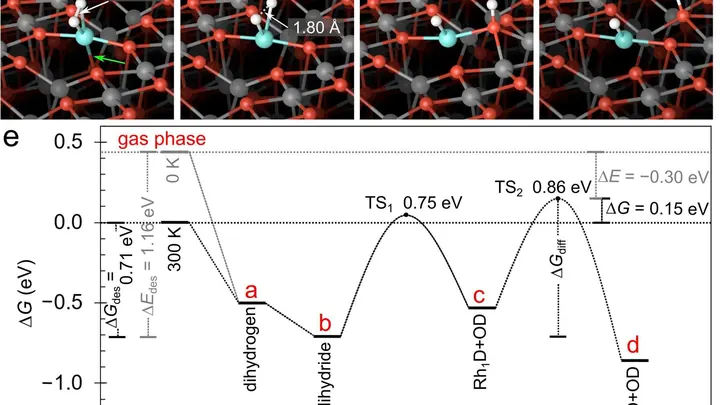
Chemistry has two worlds: in one, the catalyst is a solid particle and the reaction happens on its surface; in the other, it's a dissolved molecule where everything occurs around a single metal center. These worlds rarely meet. But in a new study, they collide.
The researchers took iron oxide, a black powder used in magnetic tapes, and scattered single rhodium atoms across its surface.
In the first minutes after the Big Bang, the Universe was like a blazing hot stove. On it, according to the 'recipe' of the standard theory, hydrogen, helium, and a bit of lithium were supposed to cook. But telescopes see only a third of the lithium that this recipe calls for.
Uranus and Neptune have long puzzled scientists: their magnetic fields are heavily tilted and tangled, nothing like Earth's. The answer lay in an exotic form of water — superionic ice, which fills their interiors.
For two atomic nuclei to fuse, they must overcome their fierce electric repulsion — like trying to bring two angry bulls together. Normally, only monstrous energy does the trick, as in stellar cores, where Hans Bethe explained fusion back in the 1930s.