Why a Battery Can Burst Into Flames express
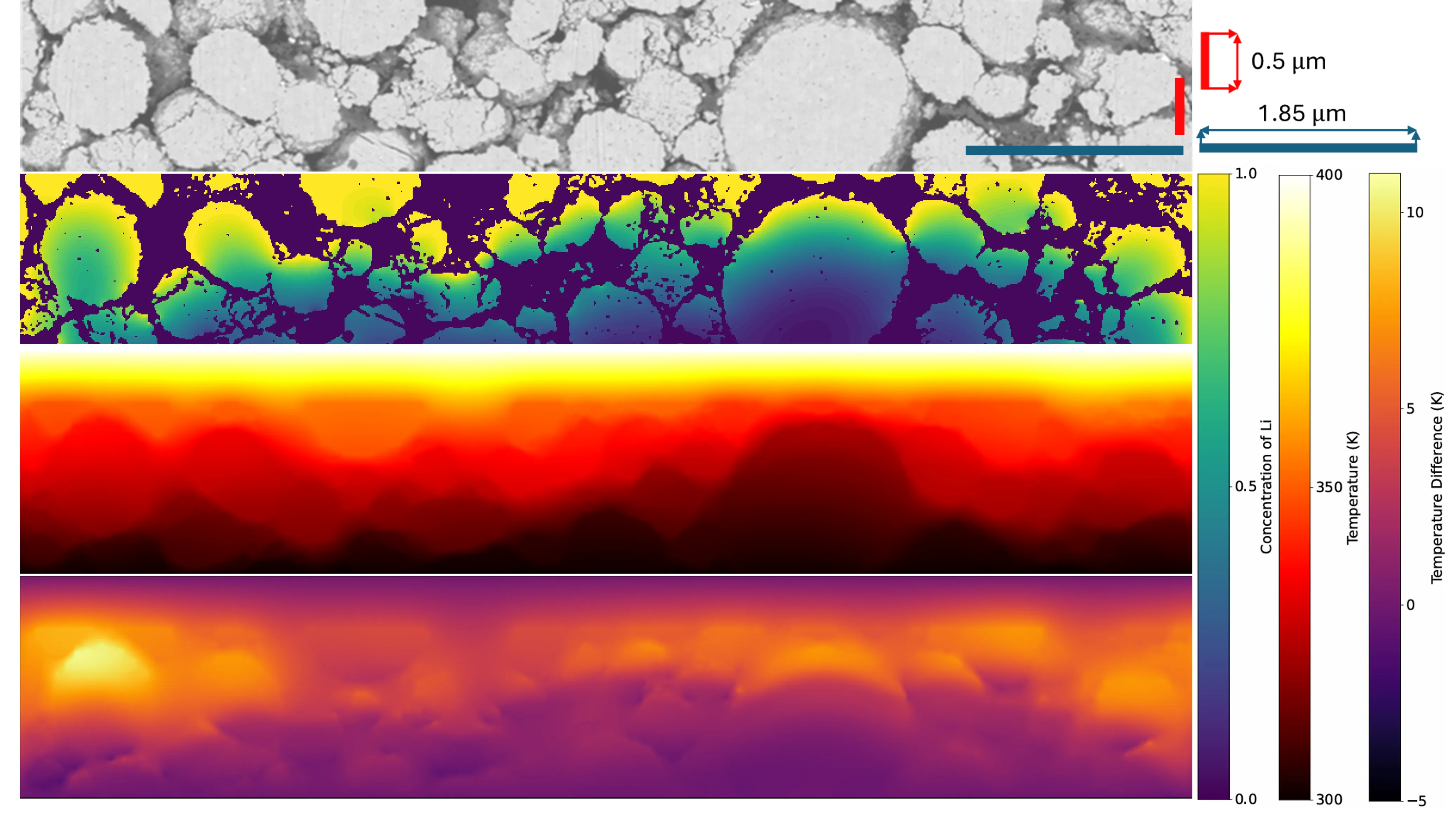
A lithium-ion battery is like a multi-story building where lithium ions live on every floor. When you charge the battery, the ions move from floor to floor, and the whole building warms up a bit. Usually, this heat dissipates evenly, like from underfloor heating. But sometimes one spot gets too hot, and then the whole building can go up in flames.
Scientists built a model that shows how heat spreads inside a battery. They found that during charging, three things change: the material's ability to conduct heat, its heat capacity, and the heat generated by the ion insertion process itself. These changes cause the heat to stop flowing evenly and instead gather into hot spots. These are especially strong at grain boundaries — the microscopic crystals that make up the material.
Previously, scientists thought that heat was carried by lithium ions rattling like maracas. But it turns out the real story is different: when ions insert, the charge distribution and the strength of bonds between atoms change. This alters thermal conductivity. Internal heat sources create thermal waves that collide and amplify each other, like ripples from two stones thrown into water. These collisions cause mechanical stress and destroy the material from within.
Now, knowing exactly how hot spots form, engineers can tweak the material's composition and grain structure to make heat spread evenly. This is especially important during fast charging, when the battery is under severe stress. A safe battery isn't just about good material: it's about smart architecture at the grain level.
The temperature in a hot spot inside a battery can rise by hundreds of degrees in a fraction of a second — faster than an oven on maximum heat.