Leakage current is an unwanted flow of electric current through an insulating layer or device, which ideally should block all current. It occurs when the insulation is imperfect, allowing a small amount of charge to pass through, often due to defects, material properties, or environmental factors like humidity. In electronics, leakage current is a critical parameter for transistors, capacitors, and other components, as it can lead to power loss, signal degradation, and reduced battery life in portable devices.
History
The concept of leakage current has been known since the early days of electrical engineering, but it became a major concern in the late 20th century as transistors shrank to nanometer scales, making quantum tunneling a significant issue.
How it works
Leakage current arises from several mechanisms, including quantum tunneling through thin insulating layers, thermal excitation of charge carriers over energy barriers, and conduction along surface contaminants or moisture. In semiconductor devices, for example, the gate oxide in a transistor can leak current when it is extremely thin, as electrons tunnel through it. The magnitude of leakage current depends on the material, the voltage applied, and the temperature, and it is often minimized by using high-quality insulators and careful design.
In practice
Leakage current is a key consideration in the design of low-power electronics, such as smartphones and IoT devices, and in high-voltageinsulation systems for power transmission.
Fun fact
In modern microprocessors, leakage current can account for up to 50% of total power consumption, even when the chip is idle, which is why engineers work hard to develop 'high-k' insulating materials to reduce it.
Units by system: SI: ampere · CGS: statampere · Planck: planck current · natural: electronvolt
A superconducting detector usually works like an honest ruler: absorb a photon, get a pulse whose amplitude is strictly proportional to the energy. This mode is convenient, but it has a ceiling: a weak signal easily gets lost in the amplifier noise.
Now imagine a swing.
In a ring accelerator, a beam of electrons circles millions of times. If the electrons are twisted like strands in a rope, their vortex motion should persist. But along the way, random jolts from imperfect magnets can disturb them.
Scientists have described how vortex motion changes under such perturbations.
A neuron transmitting a signal is like a tiny battery that quickly discharges and recharges. For nearly 70 years, it was believed that a special "potassium valve," opening with a delay, was responsible for the recharge phase. New work claims this current is a ghost.
Crystals glued to the outside and inside of a metal wall act as an invisible channel. One, receiving current, starts to tremble, and these vibrations, like ripples on water, spread out in all directions through the metal. The inner crystal catches this tremor and generates electricity again.
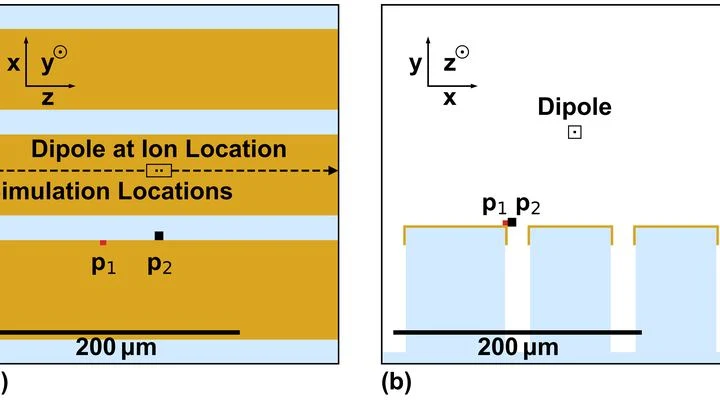
A quantum computer is like an orchestra where each ion is a musician and laser pulses are the conductor's baton. But if someone in the audience rustles, the delicate melody of quantum states goes off key.
An alpha particle is a helium nucleus that flies out when heavy atoms decay. When it hits a gallium nitride crystal, it deposits its energy and creates an electrical pulse. The pulse height tells you how much energy the particle had.
An ordinary phone battery breathes — not with air, but with contact. Inside a solid body, where there are no liquids, lithium presses against the electrolyte (the ion-conducting substance) during charging and pulls away during discharging, like a lung on inhale and exhale. This 'breathing' is not poetry but physics: each cycle creates and destroys the contact points through which current flows.
A lithium-ion battery is like a multi-story building where lithium ions live on every floor. When you charge the battery, the ions move from floor to floor, and the whole building warms up a bit. Usually, this heat dissipates evenly, like from underfloor heating. But sometimes one spot gets too hot, and then the whole building can go up in flames.
A quantum computer is like an orchestra, where each qubit is a musician playing their part. But every now and then, a cosmic ray bursts into the hall, and the violinist flinches, losing the rhythm. These particles from deep space pierce the chip, knock out extra electrons, and spoil the delicate quantum music.
A quantum computer in the lab resembles an orchestra: lasers play the role of bows, and ions are the strings. To play the desired melody, powerful radio signals are sent to the lasers: they set the rhythm and pitch. But part of this "music" escapes the stage.