Lithium is the lightest metal and a critical element in modern battery technology, prized for its high electrochemical potential. In the context of the provided titles, lithium is often compared to other materials like chromium to highlight its unique behavior in energy storage. Its tendency to form needle-like structures (dendrites) during charging is a major challenge, as these can short-circuit batteries and cause fires.
History
Lithium was discovered in 1817 by Johan August Arfwedson, but its use in batteries began in the 1970s with the work of M. Stanley Whittingham, followed by John B. Goodenough and Akira Yoshino, who developed the first commercial lithium-ion battery in 1991; the trio shared the 2019 Nobel Prize in Chemistry.
How it works
In a lithium-ion battery, lithium ions move from the anode to the cathode through an electrolyte during discharge, and back when charging. The anode is typically made of graphite that intercalates lithium, but using pure lithium metal as the anode could vastly increase energy density. However, uneven deposition of lithium during charging leads to dendrite growth, which researchers try to suppress with additives, coatings, or solid electrolytes.
In practice
Lithium-ion batteries power smartphones, laptops, electric vehicles, and grid storage, making lithium a cornerstone of the transition to renewable energy.
Fun fact
Lithium is so light that it floats on water, but it reacts violently with it, producing hydrogen gas and heat.
Inside a diamond anvil cell, squeezing a sample with a force millions of times greater than atmospheric pressure, a thin film of lanthanum meets hydrogen. The hydrogen comes from ammonia borane — a powder that, when heated, releases its hydrogen like a sponge releasing water.
In nuclear physics, a puzzle has long been nagging: why among elements lighter than bismuth, only technetium (No. 43) and promethium (No. 61) have no stable isotope at all? All their neighbors in the periodic table can boast at least one long-lived variant, but these two seem to fall out of the general pattern.
Through three minutes after the Big Bang, the Universe played its first symphony. It was the big bang nucleosynthesis — the formation of light nuclei, where each element sounded its own note, and the tempo was set by the expansion of space.
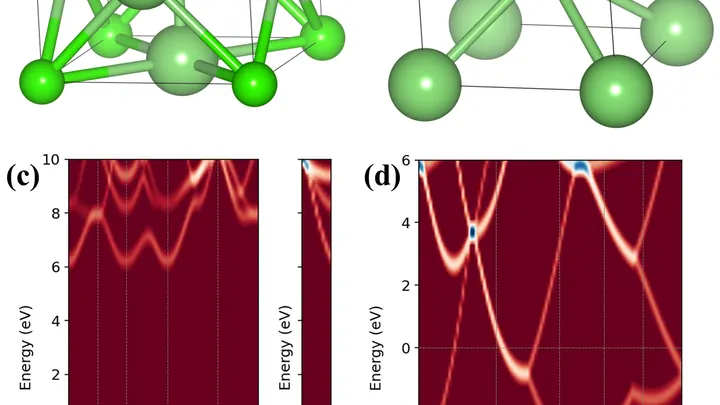
Some crystals behave like a switch: nudge the temperature or pressure, and they turn from a conductor into an insulator. This is called a metal–insulator transition (a change in the ability to conduct electricity).
A solid electrolyte is not just a crystal lattice: it’s a bustling metropolis for ions. Each act of conduction resembles a trip through the city: there are wide highways with low energy barriers, gridlocks in bottlenecks, and tricky detours where an ion can get stuck.
The Universe grows like a metropolis: galaxies skyscrapers are erected on an invisible scaffold of dark matter: its gravity pulling in construction material. Meanwhile, dark energy makes the city itself continuously expand.
The world's most accurate pendulum isn't a steel rod: it's a tiny atomic nucleus. The isotope thorium-229 has a special excited state: to nudge the nucleus into it, you need surprisingly little energy — about what an ultraviolet laser delivers.
The Universe is a genius chef, and the Big Bang is its perfect recipe. Hydrogen rose fluffy, helium melted tender, but lithium-7 seems oversalted: theory predicts three times more than astronomers find in the oldest stars. This imbalance, the 'lithium problem,' has spoiled cosmologists' appetite for decades.
Battery aging is like metal fatigue: a crack grows inside long before the part breaks. Usually, you only learn about the problem when capacity drops below 80%—but by then, the damage is irreversible.
Quantum vacuum resembles a sea, constantly rippling with tiny splashes. An electron in an atom moves in this sea, and its path slightly changes due to the waves. Previously, such corrections were accurately calculated only for hydrogen-like ions with a single electron. But in highly charged ions with several electrons, the picture becomes more complex.
A lithium-ion battery is like a multi-story building where lithium ions live on every floor. When you charge the battery, the ions move from floor to floor, and the whole building warms up a bit. Usually, this heat dissipates evenly, like from underfloor heating. But sometimes one spot gets too hot, and then the whole building can go up in flames.
An ordinary kitchen knife made of niobium would suddenly start conducting electricity with zero loss at −258 °C. That's how superconductivity works, and you can "switch it on" right at the metal's surface by blasting it with a laser in a nitrogen atmosphere.
A lithium battery is like a sandwich: two slices of bread are the electrodes, and the filling between them is the electrolyte, through which lithium ions shuffle back and forth. In conventional batteries, the filling is liquid, like a sauce, and it can leak or catch fire.
Lithium is like a thermometer dipped into a star's interior. This light element is destroyed at temperatures around 2.5 million degrees, so its abundance on the surface tells us how deeply the star's material has been mixed.
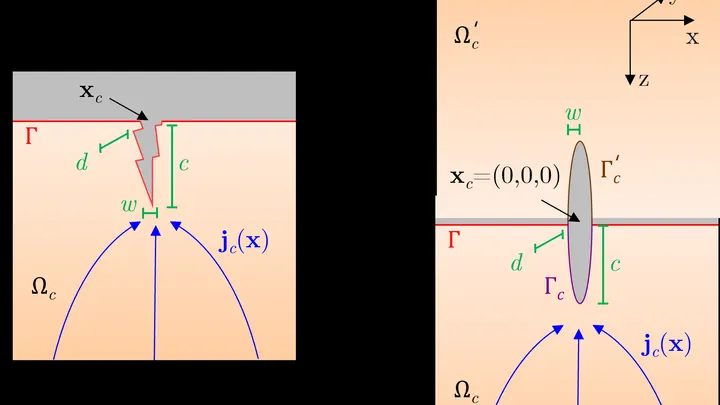
A metal filament as thin as a hair grows through the ceramic like a root through asphalt. In solid-state batteries, such filaments are called dendrites, and they appear when the charging current exceeds a critical threshold. The ceramic electrolyte is solid but brittle, like glass.
A lithium battery is like a house with a storage room: during charging, lithium goes inside; during discharging, it comes out. But if the storage room gets cluttered, some lithium stays inside forever. How much lithium returns depends on the metal the walls are made of.
The authors of the study took four metals: aluminum, magnesium, silver, and copper.
Batteries usually have two terminals — an anode and a cathode. Engineers are trying to remove the anode from solid-state batteries (with solid electrolytes) to make them lighter and more capacious. During charging, metal should deposit itself as a layer on the contact, and then vanish completely during discharge. But after a few cycles, capacity drops.
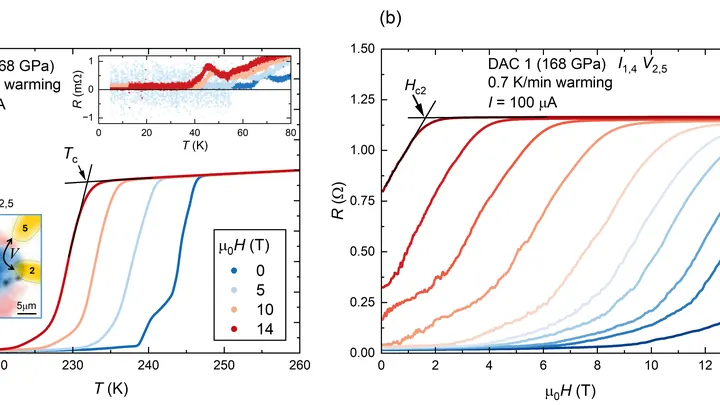
An ordinary wire heats up when current flows through it. A superconductor doesn't. But almost all known superconductors require either very low temperatures or enormous pressures, like those deep inside planets. Scientists have long searched for a material that avoids these extremes.
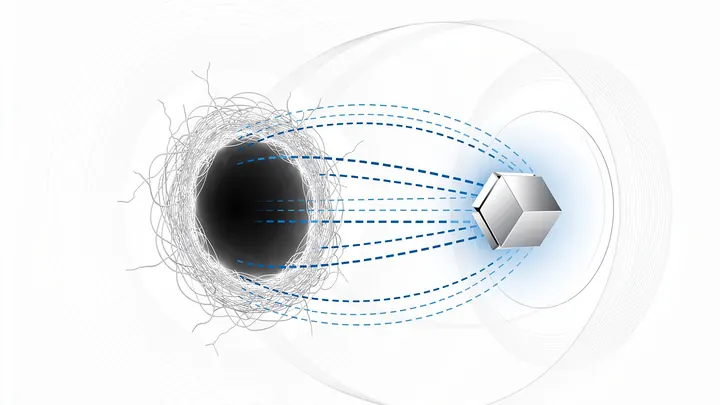
Lithium in a battery sometimes behaves like ivy on a building facade: instead of a uniform layer, it sprouts thin, sharp tendrils. These needles can pierce the separator inside the battery and cause a short circuit. So engineers are looking for ways to make lithium grow calmly.
One trick they've found is to put a thin silver film under the lithium.
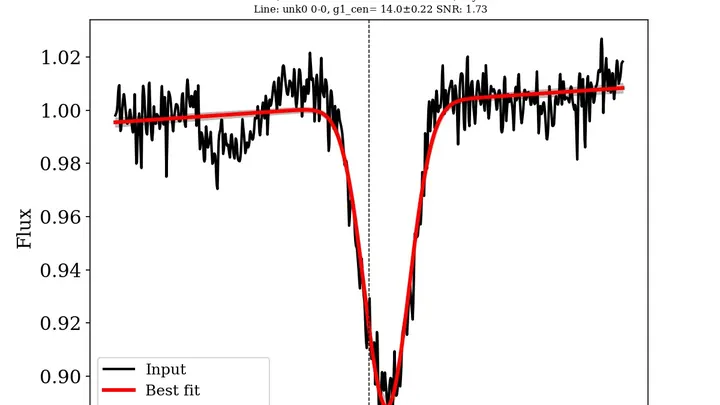
By breaking down the light of the 'Serpens' cluster with spectroscopy (a method that splits light into its component colors), astronomers found that stars start losing lithium as early as 35 million years — four times sooner than thought. This changes our understanding of how sun-like stars mature.
The cause is rotation.
A magnetic material can be compared to a crowd of tiny compasses. In an ordinary magnet, all the needles point in the same direction, and turning them all at once is no easy feat. Physicists have found a way to do this with an electric current.
In a lithium-sulfur battery, sulfur tends to dissolve and drift toward the other electrode — the battery loses charge within dozens of cycles. To hold the runaway in check, a separator film is placed between the electrodes. A standard polyethylene film lets lithium ions through, but sulfur molecules slip along with them.
Since the days of Galileo, it was believed that in a vacuum all bodies fall identically. Einstein elevated this to a principle: gravity travels at the speed of light and is the curvature of spacetime.
A crystal one atom thick is like a sheet of paper you can write on with electricity. Such a material promises to become the foundation for tiny, fast microchips. But before putting it into production, you need to know exactly what it's made of. And that's where the usual formula falls apart.
The classic BCS theory of superconductivity, developed by John Bardeen, Leon Cooper, and Robert Schrieffer, describes the mechanism by which electrons pair up into Cooper pairs and move without resistance.
In the first minutes after the Big Bang, the Universe was like a blazing hot stove. On it, according to the 'recipe' of the standard theory, hydrogen, helium, and a bit of lithium were supposed to cook. But telescopes see only a third of the lithium that this recipe calls for.
Electrons in a metal are like a crowd in a subway: each on their own, but at the slightest push, everyone moves at once. Physicists call this collective oscillation of the electron gas a plasmon. In superconductors, these oscillations are especially important because they reveal how electrons interact with each other.
Diamond is not just a gemstone. This crystal can conduct electricity when free charge carriers, electrons and holes, appear in it. But how fast do they move? In scientific papers, numbers vary by tens of times. One lab reports a mobility of 1000 cm²/(V·s), another 4000.
A piece of chromium exposed to air gets covered in invisible armor, an oxide film, within a minute. That film protects the metal from rust, but for a battery it's a disaster: the film blocks chromium ions, so no current flows.
Scientists mixed five metals — chromium, bismuth, copper, tin, and nickel.
A heavy ion beam in an accelerator is like a crowd of people shoving each other with elbows: the more people, the wider the crowd. Charged particles repel each other, and at currents above a few microamps the beam spreads and loses its shape.
For two atomic nuclei to fuse, they must overcome their fierce electric repulsion — like trying to bring two angry bulls together. Normally, only monstrous energy does the trick, as in stellar cores, where Hans Bethe explained fusion back in the 1930s.