How to Catch Gravity in Atomic Clocks express
A whisper in a roaring waterfall: that's roughly how physicists are hunting for the gravitomagnetic effect, the tiny influence of gravity on the rotation of particles. In highly charged ions, where electrons are stripped away almost completely, this effect should be more noticeable. But the atom itself creates an electric noise that drowns out the signal.
The authors broke this noise down into its components. The first nuisance is the selection rule: to feel gravity, you need an electron with a spin of at least 3/2 (like a top that spins fast enough). But such states are precisely the ones sensitive to the electric field inside the atom, which creates a background in spectroscopy — a method of studying matter through its light. The second nuisance is the interaction of the nucleus with electrons, producing a background 10¹⁸ times stronger than the signal. The third is residual noise after clever tricks. The fourth is nuclear polarization, which depends on the nucleus's shape, not its charge.
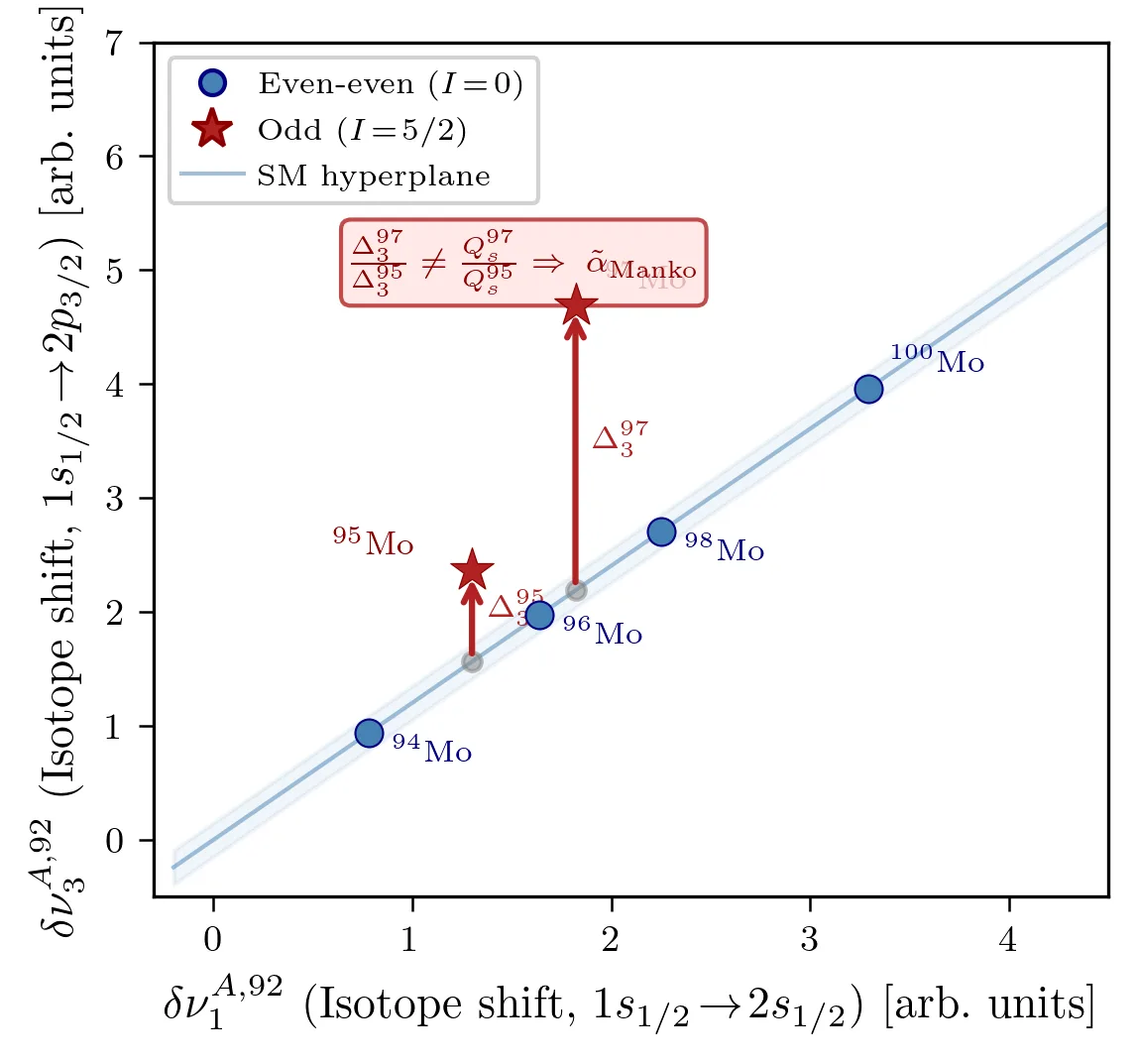
To separate the wheat from the chaff, the scientists propose a method called the 'King plot'. They take several isotopes of one element, atoms with the same charge but different weights, and compare shifts in three different transitions. This is like listening for a whisper on three frequencies: the waterfall noise changes predictably, so it can be subtracted. For a chain of molybdenum isotopes, this approach allows, for the first time, setting an upper bound on deviations from general relativity. The parameter χ (chi)—the ratio of gravitational charge to mass — should not differ from unity by more than 10⁸–10⁹ times. This opens the way to laboratory tests of gravity at the quantum level.
Original abstract
as written by the authors arXiv:2604.20717
We present a complete analysis of the angular momentum selection rules and electromagnetic backgrounds that constrain any spectroscopic search for the gravitomagnetic spin-quadrupole coupling in highly charged ions. A sequence of four barriers is identified: (i)~the Wigner-Eckart theorem mandates $$j \geq 3/2$$ electronic states for sensitivity to the rank-2 gravitomagnetic operator, excluding the deformation-immune $$j=1/2$$ states; (ii)~the nuclear electric quadrupole hyperfine interaction (HFS-E2) generates an $$\sim 18$$-orders-of-magnitude electromagnetic background in the required $$j=3/2$$ channel; (iii)~second-order HFS mixing between fine-structure levels leaves a residual $$\sim 10^{-6}$$ eV even after centroid extraction; (iv)~tensor nuclear polarizability (TNP), scaling with $$B(E2)$$ rather than $$Q_s$$, introduces an independent rank-2 background of $$\sim 10^{-12}$$ eV. We derive the algebraic conditions under which a multi-isotope, multi-transition Generalized King Plot can separate these backgrounds from the gravitational signal, and show that the minimum experimental topology requires three transitions and $$N_{\text{odd}} \geq N_{\text{bkg}} + 1$$ odd-spin isotopes with linearly independent nuclear parameters. For the molybdenum chain, this yields a first laboratory-derivable bound $$|\chi - 1| \lesssim 10^{8} - 10^9$$ on the gyrogravitational ratio, limited by current precision on nuclear quadrupole moments and transition rates. We quantify the experimental milestones needed to improve this bound by each order of magnitude, providing a roadmap for future searches.
The electric background inside an atom is 18 orders of magnitude (a billion billion times) stronger than the gravitational signal scientists are seeking. It's like comparing the weight of an ant to the weight of a mountain.
In Liu Cixin's novel 'The Three-Body Problem', a supercivilization uses multidimensional folds of space — the King plot method somewhat resembles an attempt to discern such subtle effects in our four-dimensional universe.