Hidden Magnet Polarity Brought to Light express
In a tiny magnet, information is encoded not in which way the arrow points, but in how the directions of its atoms alternate. In antiferromagnets, these arrows cancel each other out, so the material appears non-magnetic from the outside. The data is there, but you can't read it the usual way: the state is like a note written in invisible ink.
Physicists have found a way to make that ink visible. They brought the tip of a scanning probe close to the material's surface and illuminated it with infrared light. The light, concentrated at the tip, made electrons jump between energy levels. An electric current arose that changed direction depending on the hidden atomic order. They call this current the optical nonlinear anomalous Hall effect.
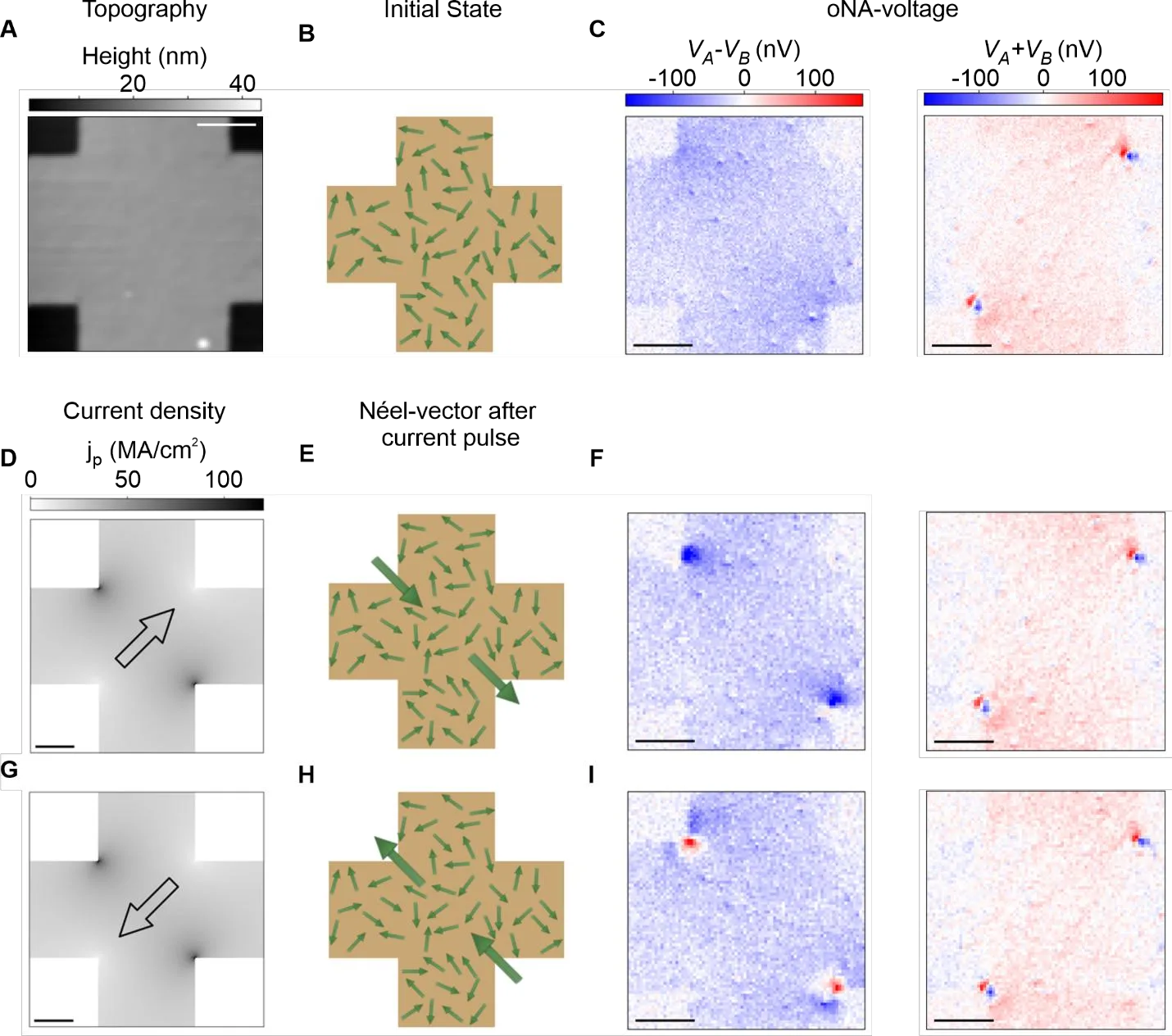
The experiment showed that this approach can not only read but also track the motion of magnetic domain walls. The scientists wrote information using a spin current and then read it out optically. The result is a full pair: electrical writing and optical reading.
Such memory does not generate external magnetic fields, so neighboring cells don't interfere with each other. Storage density could become very high, and switching could be faster than in conventional memory. The invisible note turns into readable code.
Original abstract
as written by the authors arXiv:2604.21802
Antiferromagnetic memories promise ultrafast, stray-field-free information storage. Yet perfect magnetic compensation conceals the information carrier itself: the sign of the N\'eel vector distinguishing two time-reversed states. Moreover, in future dense memories, the local polarity of N\'eel domains would need to be read out on the nanoscale. We make this hidden polarity visible in a fully-compensated, high-N\'eel-temperature, PT-symmetric antiferromagnet by driving interband electric-dipole transitions by mid-infrared near-fields confined at a scanning probe. The excitation generates a N\'eel-order-dependent quantum-metric photocurrent, a Hall-like signal reversing with N\'eel order, which we term the optical nonlinear anomalous Hall effect. This optically induced electrical readout maps opposite N\'eel polarities with sub-100-nm resolution at room temperature and, combined with spin-orbit-torque writing, reveals N\'eel-texture polarization and reversible domain-wall motion, establishing electrical-write/optoelectronic-read antiferromagnetic functionality.
Antiferromagnets don't attract paperclips, even though inside them every atom is a tiny magnet. Their net field is zero, so they don't demagnetize neighboring memory cells.