Data storage is the physical recording of information on a medium, and in the context of this knowledge base, it refers specifically to magnetic storage, where data is encoded as stable magnetization directions. This is the principle behind hard disk drives (HDDs), where each tiny magnetic region, or bit, is magnetized in one of two directions to represent a 0 or a 1. The stability of these magnetization directions is crucial: if they flip unintentionally, data is lost or corrupted. The field encompasses not just the media itself but also the read/write heads, the encoding schemes, and the error-correction algorithms that ensure data integrity over time.
History
The first practical magnetic data storage was the drum memory of the 1930s, but the modern hard disk drive was introduced by IBM in 1956 (the RAMAC). The key concept of using stable magnetization directions for binary data was established in the early 20th century with magnetic wire recording, but the specific technology of random-access magnetic disk storage evolved through the 1950s and 1960s.
How it works
A magnetic storage medium is a thin film of ferromagnetic material, typically a cobalt-based alloy. During writing, a magnetic head generates a strong local field that aligns the magnetization of a small region (a bit) in one of two directions. The bit remains stable because the material has high magnetic anisotropy—it prefers to be magnetized along a particular axis, and the energy barrier against flipping is much larger than the thermal energy at room temperature. Reading is done by a magnetoresistive sensor that detects the stray field from each bit, changing its electrical resistance accordingly.
In practice
Hard disk drives in computers, data centers, and archival systems; also magnetic tape for long-term backup and video storage.
Fun fact
The first hard disk drive (IBM 350, 1956) stored 5 million characters on fifty 24-inch platters, and its data density was about 2,000 bits per square inch—modern drives exceed 1 terabit per square inch, a factor of about 500 million.
Imagine a book with latches on its pages: you can only flip a page if you know how to click its edge. That is roughly how the mechanical metamaterial we are about to discuss works. Each cell is a small mass inside a larger one, connected by an elastic beam. The beam can sit in two stable positions, like a switch.
A person hunting for keys mentally runs through places where they might be. A bird that tucked hundreds of seeds into crevices in autumn retrieves them flawlessly in winter. How can a brain hold so many addresses when all birds have roughly the same number of neurons? The answer lies in geometry.
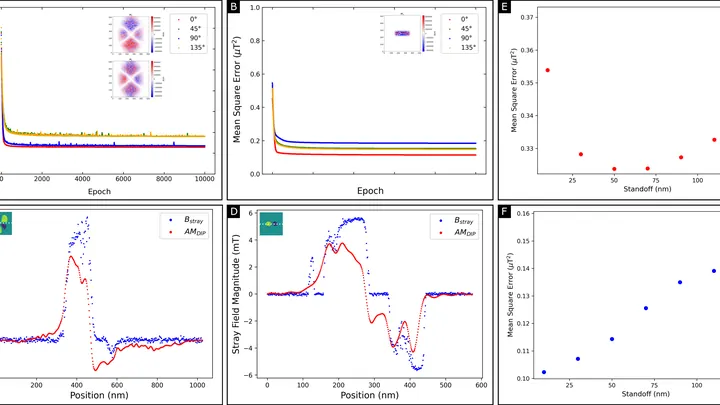
A magnetic film just tens of atoms thick stores information in tiny magnetic vortices. But you can't look inside and see these vortices directly: the instrument only senses the weak magnetic field around the film. Reconstructing the magnetization pattern from such a field is like guessing the shape of an invisible relief from its shadow on a wall.
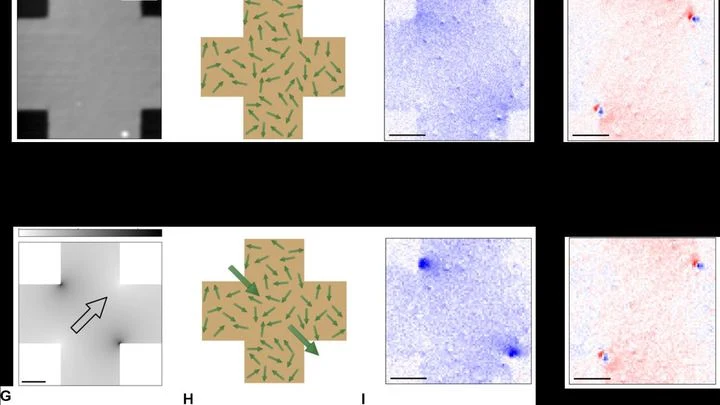
In a tiny magnet, information is encoded not in which way the arrow points, but in how the directions of its atoms alternate. In antiferromagnets, these arrows cancel each other out, so the material appears non-magnetic from the outside. The data is there, but you can't read it the usual way: the state is like a note written in invisible ink.
A white dwarf is what remains of a star like the Sun after it sheds its outer layers. What's left is a hot core the size of Earth but with a mass close to that of the Sun. A teaspoon of this material would weigh as much as a truck. Some of these stars have extremely strong magnetic fields — a billion times stronger than Earth's.
Inside a magnet, there are regions where all the atomic magnets point in the same direction. Between such regions lies a narrow transition zone where the magnetization direction gradually rotates. This zone is called a domain wall. Previously, it was considered massless: give it a push, and it stops immediately.
A hawk soars over a field, its wings tracing an intricate dance. Each flap, each tilt is not random but a combination of simple motions that can be broken down into components. Collective behavior in the air may seem intuitive, but behind it lies strict mechanics.
Scientists recorded the hawks' movements using cameras that track the position of every point on the wing and tail.
The brain is like a sprawling city: districts-regions communicate via streets-neural pathways. If traffic lights at an intersection fail, traffic grinds to a halt. Similarly, in the brain, when bundles of nerve fibers (white matter) malfunction, distant regions stop working in concert, and thought stalls.
In a pot of boiling soup, small bubbles churn, but gradually large-scale flows come to dominate. Something similar happens in cosmic plasma, where magnetic fields behave like tangled threads.