One Electron in Silicon: How to Catch and Flip a Spin express
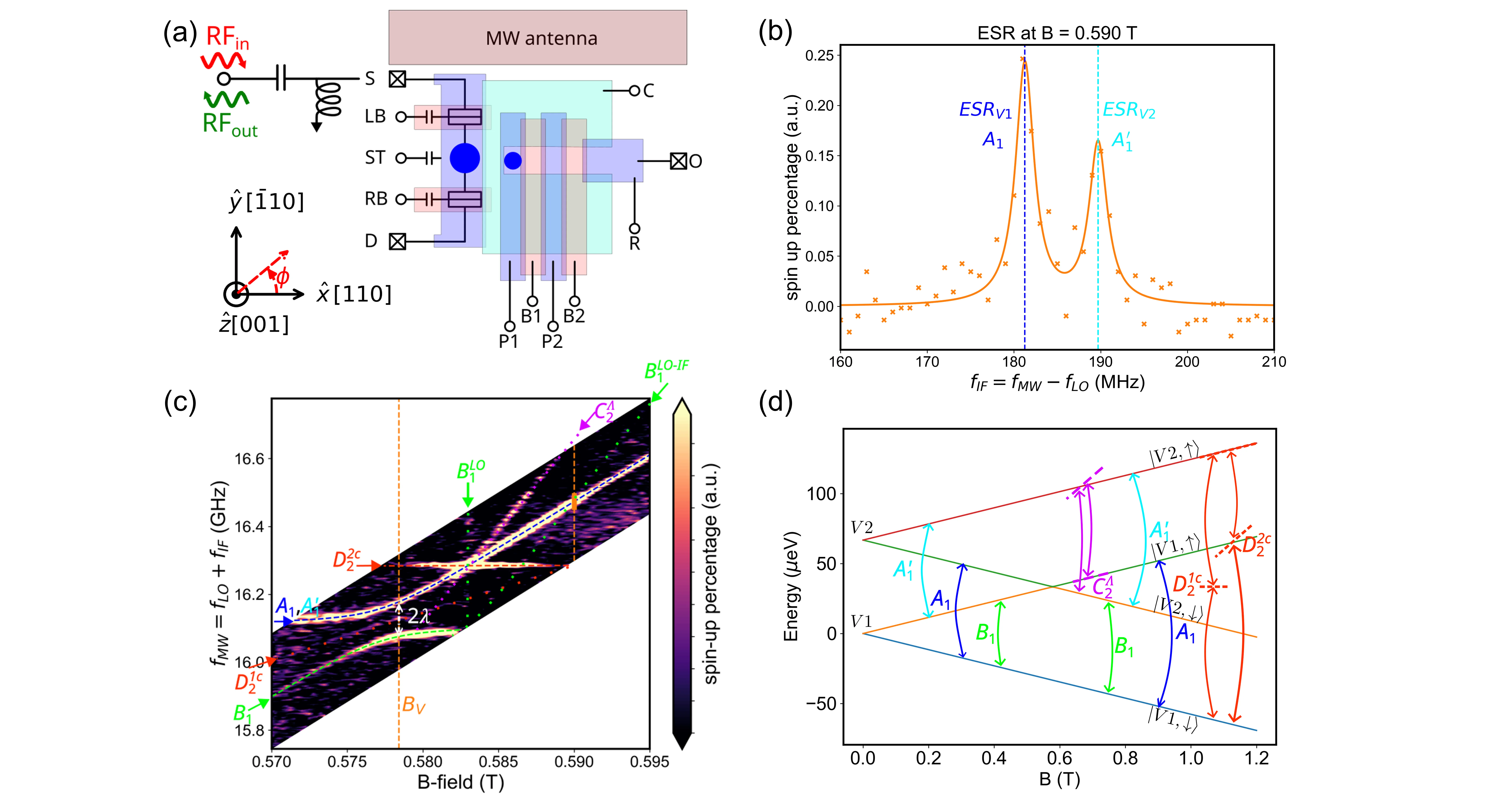
Silicon is the very material that powers the processors in every phone and laptop. Now, researchers have learned to trap a single electron in it and control its spin — a tiny magnet that can point 'up' or 'down'. It's like holding a spinning top: you can tilt and turn its axis, but here, instead of hands, you use an electric field.
A team of physicists measured how the electron's spin responds to electrical signals near a special point where two energy levels almost merge. They found that in this region, the spin rotation frequency increases dramatically. This happens because of mixing between states associated with valleys — special regions in silicon's energy structure where the electron can reside with different probabilities. Near the anti-crossing of levels, an electric field acts on the spin as effectively as a magnetic one.
To understand why the effect is so strong, the scientists measured how the difference between the two valley states depends on the direction of the magnetic field. For a field perpendicular to the device plane, the coupling between spin and valley was maximal. This agrees with a model where an effective field acts within the plane, mixing spin and valley states. It is this mixing that allows the electric field to flip the spin.
If we can learn to flip the spin of a single electron quickly and reliably with an electrical signal, we can build quantum bits without bulky magnets and microwave antennas. This is a step toward a quantum computer that fits on a regular chip.
The electron spin is so tiny that flipping it requires energy billions of times smaller than what is needed to heat a teaspoon of water by one degree.
In the TV series 'Devs', the quantum computer uses superconducting qubits, but silicon spin qubits might prove more practical for mass production.