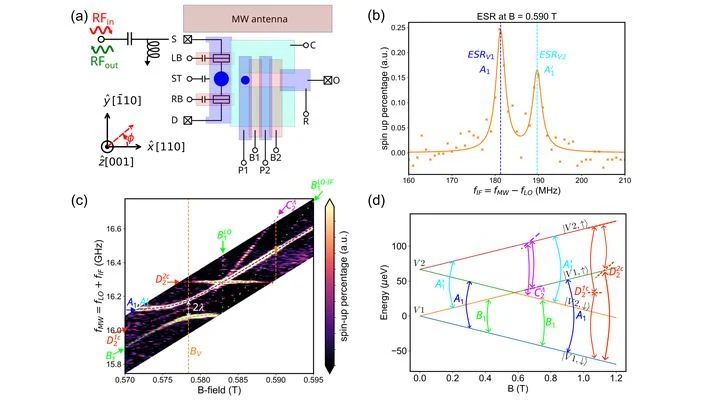
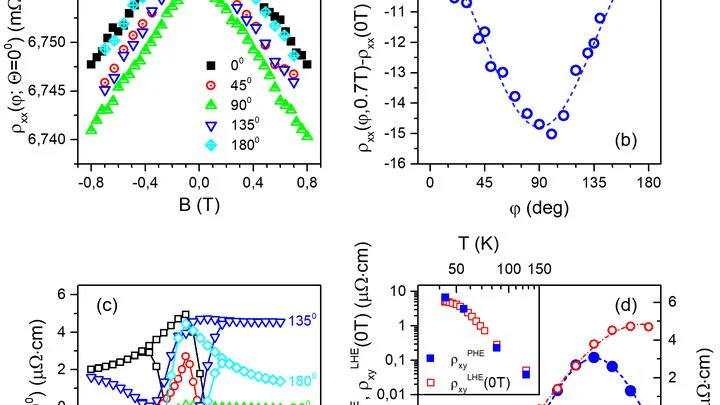
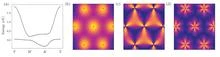
In semiconductorphysics, a valley is a local minimum in the conduction band (or maximum in the valence band) in momentum space. Electrons in a crystal can occupy states near these minima, and each valley represents a distinct set of electron states with specific momentum and effective mass. In materials like silicon or graphene, multiple valleys exist, and the valley degree of freedom — which valley an electron occupies — can be used as an information carrier, similar to electron spin. This has led to the field of valleytronics, which aims to encode and manipulate information using valley states.
History
The concept of valleys in semiconductors dates back to the 1950s, with early work on silicon's multi-valley band structure by Conyers Herring and others. The term 'valleytronics' was coined in the 2000s as researchers began exploring the valley degree of freedom for information processing.
How it works
The band structure of a semiconductor arises from the periodic potential of the crystal lattice. Electrons near a valley behave like free particles but with an effective mass that depends on the curvature of the band at that point. By applying external fields — electric, magnetic, or optical — one can selectively populate or read out electrons in different valleys. In materials like transition metal dichalcogenides (e.g., tungsten diselenide), the valleys are coupled to light polarization, allowing optical control of the valley population.
In practice
Valleytronics is being explored for next-generation electronic and optoelectronic devices, such as valley-based transistors and valley-polarized light emitters, which could offer faster and more energy-efficient computing.
Fun fact
In graphene, electrons in different valleys behave like they have opposite 'pseudo-spin', and this valley degree of freedom is so robust that it can be used to create topologically protectedstates that are immune to scattering.
In a pot of water, microscopic spheres, colloidal particles, are floating. Each sphere is coated with long polymer chains that look like a brush and carries an electric charge. If you get the temperature and solution composition right, the spheres start arranging themselves into ordered patterns — crystals.
A honeycomb made not of wax but of atoms is graphene — a flat crystal just one atom thick. Electrons in it are like runners at an intersection: they speed up here, slow down there, but never get stuck at the edge. Physicists call such a sheet "topologically trivial," meaning its edges are perfectly ordinary, with no special properties.
Now, let's knock out a single atom from the honeycomb.
Silicon is the very material that powers the processors in every phone and laptop. Now, researchers have learned to trap a single electron in it and control its spin — a tiny magnet that can point 'up' or 'down'. It's like holding a spinning top: you can tilt and turn its axis, but here, instead of hands, you use an electric field.
A mosaic floor made of many small tiles, each turned in a different direction. It seems that any pattern trying to cross such a floor would get scrambled and vanish. That's how people usually think about disorder in crystals: if atoms aren't arranged in a perfect lattice, delicate quantum effects should fall apart.
Two quantum dots are like two tiny pockets in a piece of silicon where an electron can sit, like a ball in a cup. When the pockets are far apart, each electron lives on its own, and its energy resembles the levels of a solitary atom.
You are counting sand grains falling in an hourglass, but each time the wind adds or removes a few. In the most sensitive cameras, the task is similar: you need to figure out how many "sand grains" (electrons) the sensor itself added, and how many came from light. This inherent sensor noise is called readout noise, and it hinders seeing weak signals — for example, the light of a distant star.
In a silicon crystal, a phosphorus atom holds an extra electron on two very closely spaced orbits. These orbits are like two neighboring floors in a building where the staircase is almost invisible. A short laser pulse in the mid-infrared range pushes the electron from the lower floor to the upper one, and it starts swinging between them like a pendulum.
Electrons in a conductor usually behave like a gas: they dart around chaotically, collide, and don't hold formation. But if you spread them far apart and cool them down, their mutual repulsion can force them into place, like attendees in an overcrowded hall who settle into every other seat.
Electronic charge is a tumbleweed that moves camp depending on energy. In tungsten selenide (WSe₂) crystals, this is seen with utmost clarity: at a bias of −1.4 V, near the K point of the Brillouin zone, the maxima of tunneling current sit in the centers of hexagons, where there are no atoms.