Quantum Bricks at the Crystal's Edge express
A fabric that stretches lengthwise but not crosswise. That's roughly how a semi-Dirac material works: electrons can move freely in one direction but barely budge in the other. Because of this unusual anisotropy, special tracks, one-dimensional channels, emerge at the edges of the two-dimensional crystal. Electrons race along them only along the perimeter, like water in a trough.
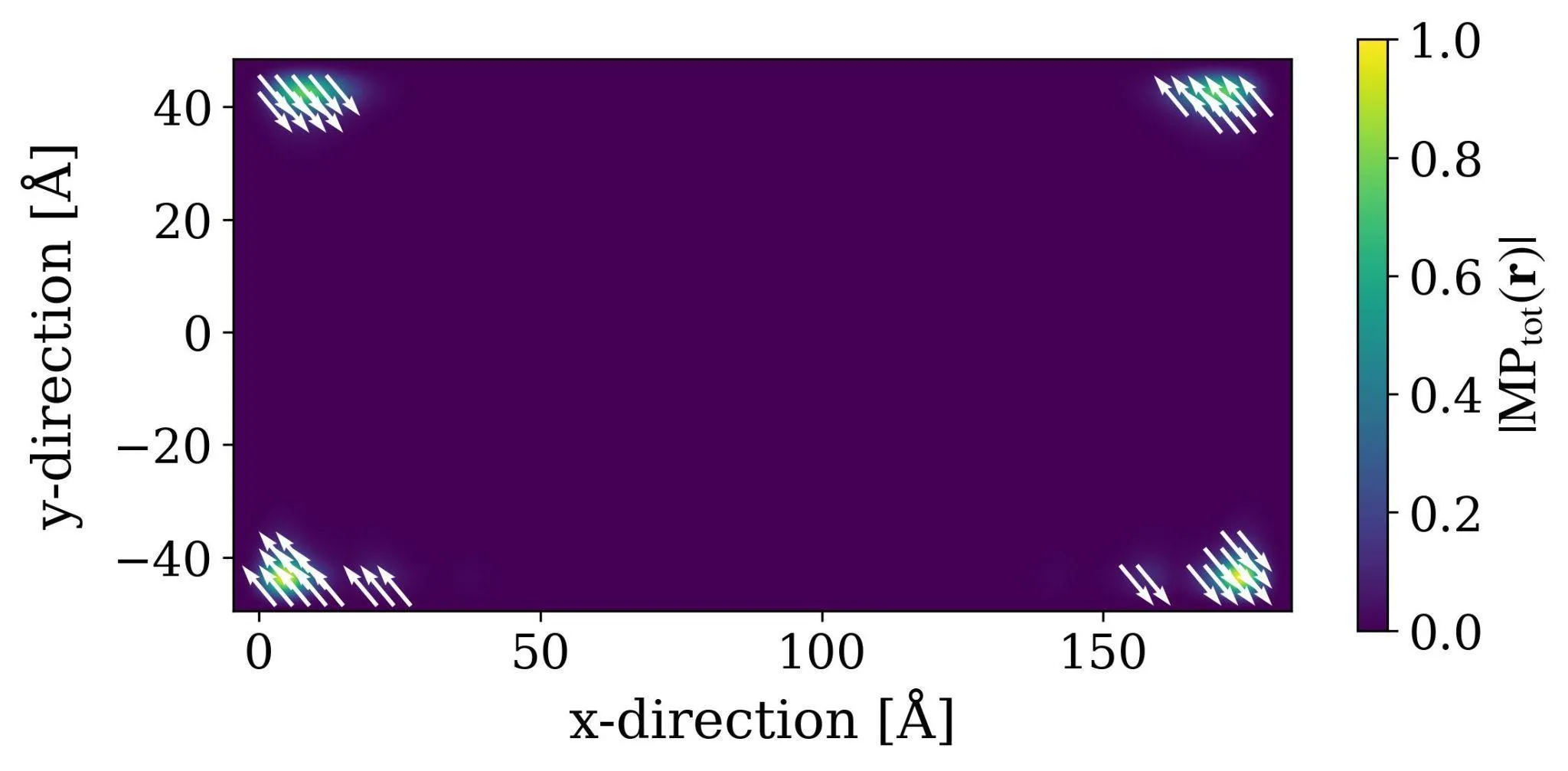
When such a crystal is placed against an ordinary superconductor (a material that conducts electricity without resistance) and a magnetic field is switched on, Majorana bound states are born at the sample's corners — particles that are simultaneously their own antiparticles. They sit at the corners like four buttons and are immune to disturbances: to destroy them, you'd have to flip the entire system, not just give it a nudge. This robustness is what makes them candidates for ideal memory cells in a quantum computer.
The authors of the study showed that obtaining such particles doesn't require carving out ultra-thin wires or twisting magnetic vortices. Simply take a suitable semi-Dirac material and place a superconducting layer on top. Two edges of the crystal act as independent one-dimensional superconductors, and their corner junctions become traps for Majorana modes. This simplicity promises the rapid emergence of real devices based on such materials.
Original abstract
as written by the authors arXiv:2604.22553
Proximity-induced superconductivity in low-dimensional systems offers a powerful pathway to engineer topological superconducting phases in, otherwise, non-superconducting systems. These exotic phases are of fundamental and technological interest due to the presence of robust zero-energy modes, the Majorana bound states. In this work, we propose a theoretical framework to realize Majorana bound states from the edge states of a two-dimensional semi-Dirac system. This anisotropic system, under specific conditions, can host non-chiral edge states that propagate only along particular edges, effectively forming separated one-dimensional channels. We show that the interplay between Rashba spin-orbit coupling and a Zeeman field on this setup provides the right conditions to get an effective p-wave pairing between the edge states by proximity with a s-wave superconductor. In finite geometries, each edge can independently undergo a topological phase transition into a one-dimensional topological superconductor and give rise to four zero-energy modes localized at the strip corners. At low energies, the edge states subspace admits a description in terms of coupled Kitaev chains, providing a clear picture of the origin, robustness, and tunability of the corner Majorana modes. Our results establish semi-Dirac materials as a natural platform for realizing Majorana modes in two dimensions without relying on engineered nanostructures, vortices, or crystalline higher-order topology.
Majorana particles are the only known candidates for 'ghost particles': they carry no charge and can only be detected indirectly, for example, through jumps in electric current under certain conditions.
In the series 'The Expanse', the alien protomolecule uses something akin to topological quantum states for instantaneous communication across space — science fiction, but Majorana particles do promise ultra-secure data transmission.