A two-dimensionalcrystal is a material in which the atoms are arranged in a regular, repeating lattice in just two dimensions, forming a sheet that is only one or a few atoms thick. These materials, such as graphene (a single layer of carbon atoms) and transition metal dichalcogenides, exhibit properties that are strikingly different from their three-dimensional counterparts. Because of their reduced dimensionality, electrons are confined to move in a plane, leading to unique electronic, optical, and mechanical properties. The study of two-dimensional crystals has opened up a new field of condensed matter physics, revealing phenomena like massless Dirac fermions in graphene and strongly bound excitons in semiconducting monolayers.
History
The field of two-dimensionalcrystals began with the isolation of graphene in 2004 by Andre Geim and Konstantin Novoselov, who used a simple method of peeling layers from graphite with adhesive tape. This groundbreaking work earned them the Nobel Prize in Physics in 2010.
How it works
In a two-dimensionalcrystal, the periodic potential of the lattice confines electrons to move only within the plane. This confinement alters the electronic band structure, often leading to a direct band gap in materials that are indirect in bulk form, making them efficient light emitters. The reduced screening in two dimensions also means that electron-electron interactions are much stronger, leading to the formation of tightly bound electron-hole pairs (excitons) that are stable even at room temperature. The lattice itself can also support unique vibrational modes, and the mechanical flexibility of these sheets allows them to be strained to tune their electronic properties.
In practice
Two-dimensionalcrystals are used in a wide range of applications, including high-speed transistors, flexible displays, photodetectors, and sensors. They are also being explored for use in quantum computing, energy storage, and as membranes for filtration.
Fun fact
Graphene, the most famous two-dimensionalcrystal, is about 200 times stronger than steel, yet it is so thin that a single gram could cover an entire football field.
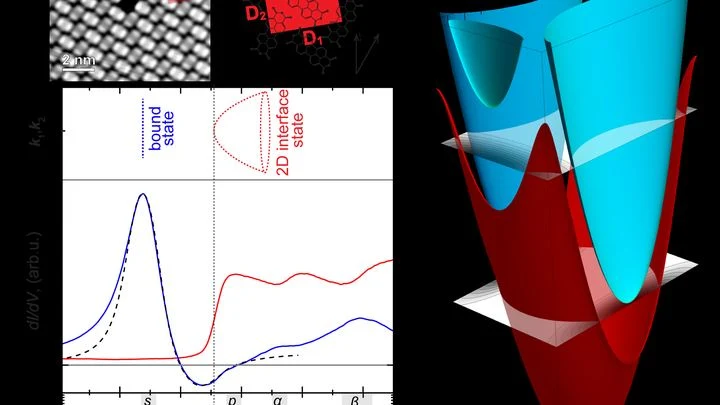
The triptycene molecule resembles a three-pointed star with rigid arms. When such stars are scattered on a lead surface, they spontaneously assemble into a pattern like a woven basket: triangles and hexagons alternate, and at each node sits not one star but a pair.
A deck of cards in which each card is slightly rotated cannot lie flat: the backs and faces will never align. But if the cards are flexible, they will start to adjust, shifting by fractions of a millimeter to find the perfect match. Something similar happens inside crystals when two thick layers of MoS2 or MoS2 with WS2 are stacked with a twist of 1–2 degrees.
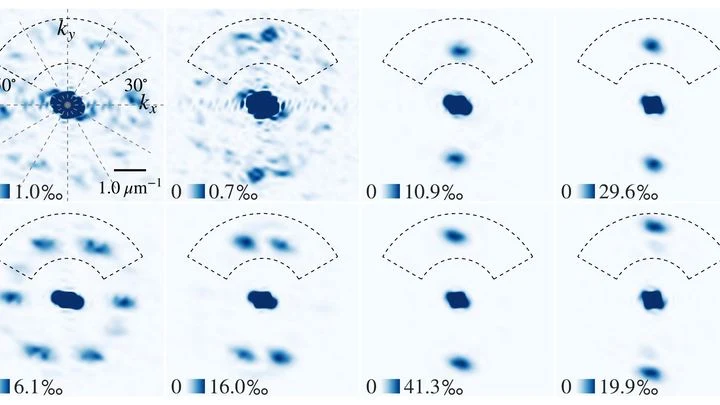
Two dancers on one stage: the triangle and the stripe. In a quantum gas of dysprosium atoms cooled to 62 nanokelvin, these two spatial structures have met for the first time in a single experiment. The gas is held in a trap shaped like a surfboard, and its atoms are among the most magnetic in the periodic table.
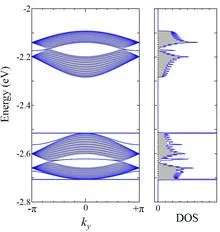
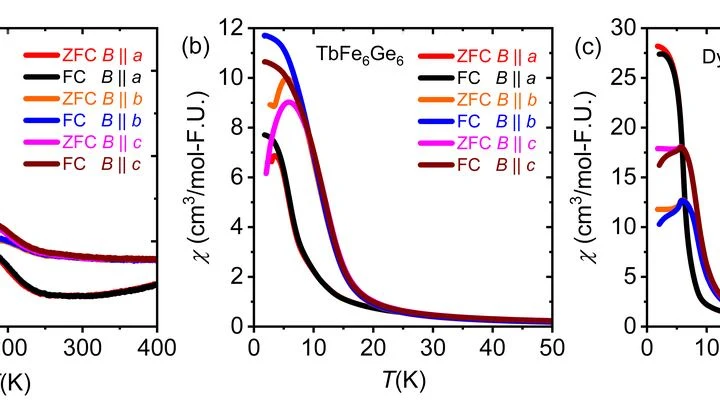
Inside a crystal, an invisible ballet unfolds: the magnetic moments of atoms, like dancers, sometimes align in unison, sometimes scatter in antiphase. The choreography is dictated by quantum exchange — music sensitive to the geometry of bonds.
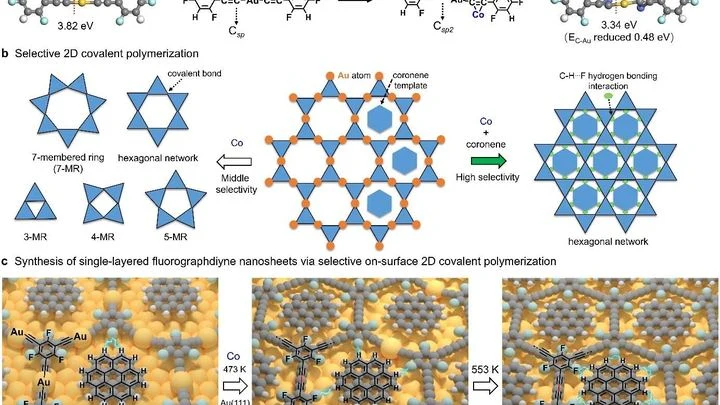
Crocheting, but instead of yarn you have individual molecules, and instead of a hook, a gold surface. Until now, attempts to knit such molecules into a smooth fabric ended in a tangle: the threads hooked where they shouldn't, and the pattern went awry.
A team of scientists has found a way to fix this.
Each electron is a tiny magnet. In a single-atom-thick layer of iron chloride, they all align in the same direction, like dancers in a perfectly synchronized routine. Nature usually avoids such order (that's high entropy), but quantum forces compel them to comply.
A crystal is like a row of soldiers on a parade ground: every atom is in its place, and electrons march through it in neat waves. An amorphous material is like a crowd at a train station, where there is no order, just a jostling throng. In such a crowd, an electron usually gets stuck quickly, like a person trying to push through a dense mass of people.
Tile a floor with identical triangles, and you get a boring repeating pattern. But what if you want the pattern to never repeat, yet use just one tile? For a long time, mathematicians were sure it couldn't be done: you'd need at least two different shapes. The famous Penrose mosaic is a case in point: rhombi with acute and obtuse angles arrange into an infinitely varied but strictly ordered pattern.
A crystal is like a city: if the streets are crooked, traffic jams. In a crystal, the streets are atomic rows, and the traffic is the flow of electrons. Any tiny imperfection, impurity, or atomic displacement makes electrons scatter. Scientists from several labs have learned to grow crystals so that the "streets" are almost perfectly straight.
The method is called horizontal vapor transport.
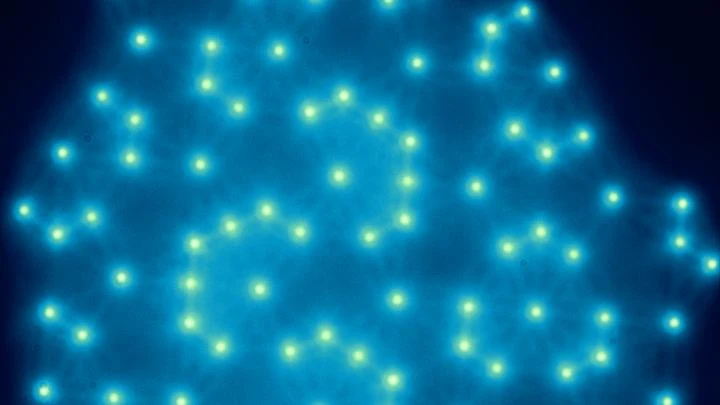
A flat crystal of charged atoms suspended in an electromagnetic trap behaves like a perfectly calm pond. The slightest breeze, and ripples spread across its surface. This 'pond' catches the splashes from dark matter particles and the ripples of spacetime — high-frequency gravitational waves.
A single-atom-thick sheet of tungsten telluride is like thin foil: electrons can't pass through because there's a band gap between their possible states, like a moat you can't jump across. Add two more layers, and the moat disappears; the material becomes a metal, and current flows. Add more layers, and the properties change again, as if someone is flipping modes with a single button.
A sheet of paper weighs almost nothing, but stack a hundred sheets and you get a noticeable pile. That's roughly what scientists did with a material that excels at converting one color of light into another, but only when it's just one atom thick. A single layer is like a single sheet: it works beautifully, but it's too thin to produce much light.
A wafer-thin film of organic molecules was grown on a silicon substrate. In this film, as if on a sheet of graph paper, tiny "pens"—artificial atoms — were laid out with the tip of a scanning tunneling microscope.
A superconductor is a material that, when strongly cooled, loses its electrical resistance: current flows through it without losses. Scientists took a layered crystal of PdTe2, similar to a stack of sheets of paper, and cooled it to temperatures below 1.8 kelvin (that's about -271°C).
Table salt makes food taste better in the kitchen, but in the lab it helps grow crystals just a few atoms thick. Scientists took tin selenide and, with the help of salt, grew ultra-thin flakes from it, so thin they're called two-dimensional. The salt acted as a separator: it kept the flakes from clumping together and made them lie flat on the substrate, like pancakes on a griddle.
A sheet of graphene one atom thick hangs in the air like a taut bedsheet. Heat waves, vibrations of atoms that physicists call phonons, ripple across it. Previously, it was thought that these waves quickly scatter due to strong interactions, and heat transfer is poor.
A sheet of graphene one atom thick is like a perfectly smooth tablecloth on which electron marbles roll. Place an electric barrier in their path, and usually they'll bounce back. But in graphene, it's different: under certain conditions, electrons pass through the barrier without even noticing it, as if the wall were made of mist.
An ultra-thin crystal made of tungsten and sulfur atoms resembles a perfect parking lot: every spot is taken, everything is neat. But sometimes an atom is missing — leaving a defect pit. If an exciton (a pair consisting of an electron and a 'hole' that carries light energy) falls into such a pit, it can get stuck and emit light differently than in a pristine area.
A crystal the size of half a matchbox was grown in a furnace, where a molten zone slowly crept along a rod, leaving perfectly ordered layers behind. Inside this crystal, copper ions sit at the nodes of a triangular lattice, but the triangles are slightly skewed, as if someone pressed on one corner. Each copper ion behaves like a tiny magnetic needle that can point up or down.
A tiny crystal flake rests on a substrate like an autumn leaf on a palm. It's thinner than a human hair, yet inside it quantum effects are simmering: superconductivity, magnetic order, quantum spin liquid.
Imagine a stack of pancakes where each pancake is magnetized, but the magnetization directions in adjacent pancakes are opposite. That's exactly how this new magnetic material is arranged: in each atomic layer, all magnetic moments — the atom's 'arrows'—point in one direction, while the next layer is magnetized in the opposite direction.