How to Catch the Elusive Asymmetry in Kaon Decays express
Two nearly identical pendulums are set in motion at the same time. One decays quickly, the other swings for a long time. At some point, their motions overlap, and in the combined picture, a subtle shift appears that would be invisible if you looked at each pendulum separately. This is roughly how interference works between two varieties of neutral kaons — particles that serve as a natural laboratory for studying the subtlest effects of the microcosm.
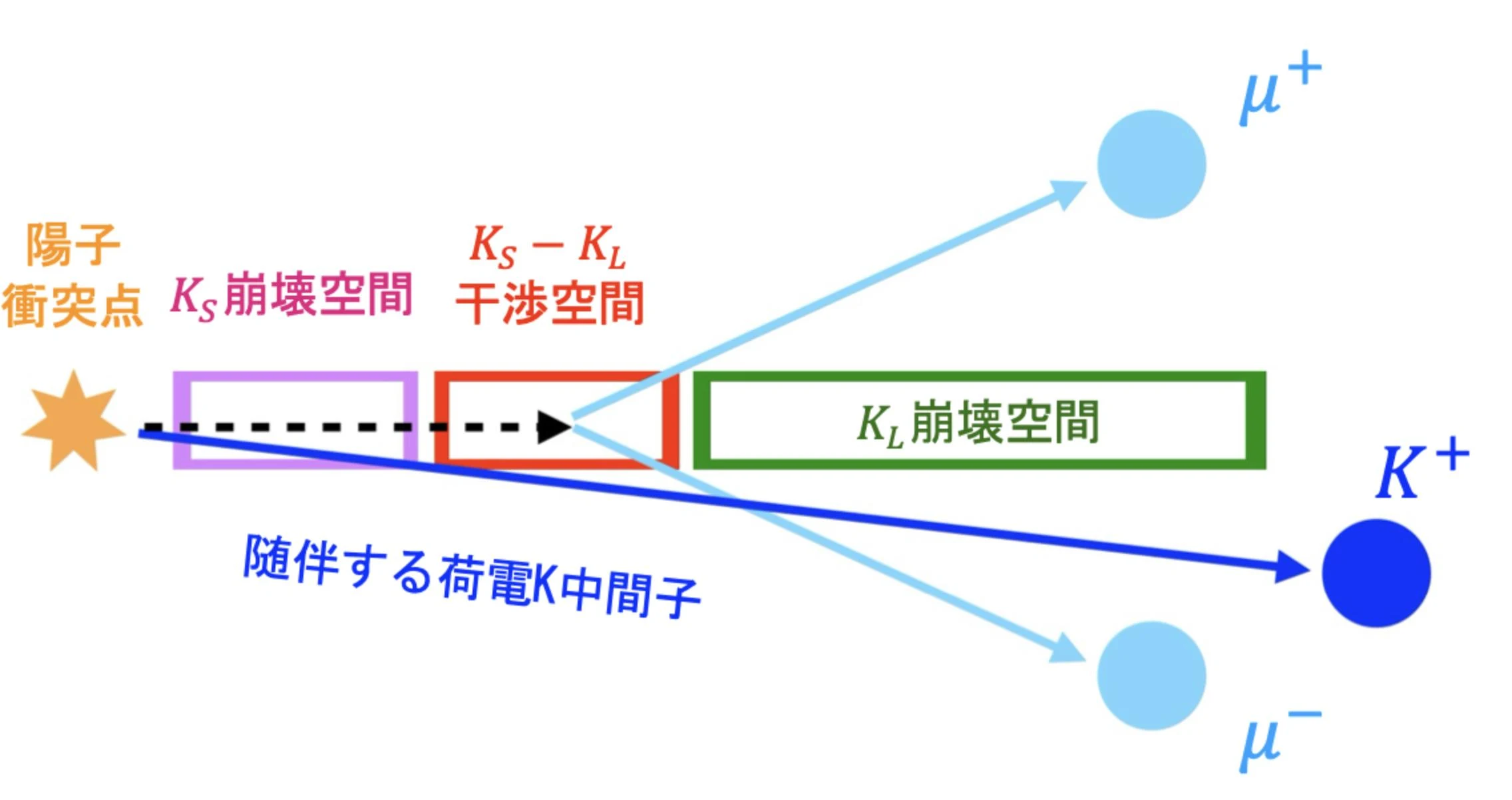
The short-lived kaon ($K_S$) and the long-lived kaon ($K_L$) are produced in proton collisions at the Large Hadron Collider. Their rare decays into a muon-antimuon pair are usually "noisy" due to two-photon exchange, like trying to hear a whisper in a reverberant hall. But when both kaons exist simultaneously and their wave functions overlap, an interference term emerges. It acts like a highly sensitive microphone aimed directly at the source of CP violation — the very asymmetry between matter and antimatter without which our world would not exist.
The key point is that the interference signal is directly related to the parameter $|A^2\lambda^5\bar\eta|$—a combination of numbers describing quark transformations. This allows us to probe the deepest layers of theory, bypassing interfering effects. The analysis shows that at the LHCb experiment, by the end of the High-Luminosity LHC run, this quantity can be measured with a precision of about 35% of the Standard Model prediction. Furthermore, the method will resolve a long-standing dispute over the sign of one of the decay amplitudes of $K_L \to \gamma\gamma$—an ambiguity that has plagued the cleanliness of predictions for decades.
Thus, the interference of two ephemeral particles becomes a precise tool. It lets us hear the faintest whisper of the Universe about its own asymmetry — the very shift that first appeared in the superposition of two pendulums' motions.
The difference in lifetimes between $K_L$ and $K_S$ is colossal: the long-lived kaon lives 600 times longer than the short-lived one. If $K_S$ lived for one second, $K_L$ would last a full ten minutes.
In Neal Stephenson's novel "Anathem," scientist-monks study quantum interference to understand the fundamental structure of reality — much like physicists using kaons to probe the mysteries of CP violation.