The Oxygen Key to Superconductivity express
A layered cake of atomic planes of nickel and oxygen: that's how bilayer nickelates are built. Two such planes are separated by a spacer layer. If an oxygen atom sits in that spacer, it acts as a bridge: it links the layers and triggers a state in which electrons move without resistance. If oxygen is absent, the bridge collapses, and magnetic ripples, spin-density waves, emerge in the material.
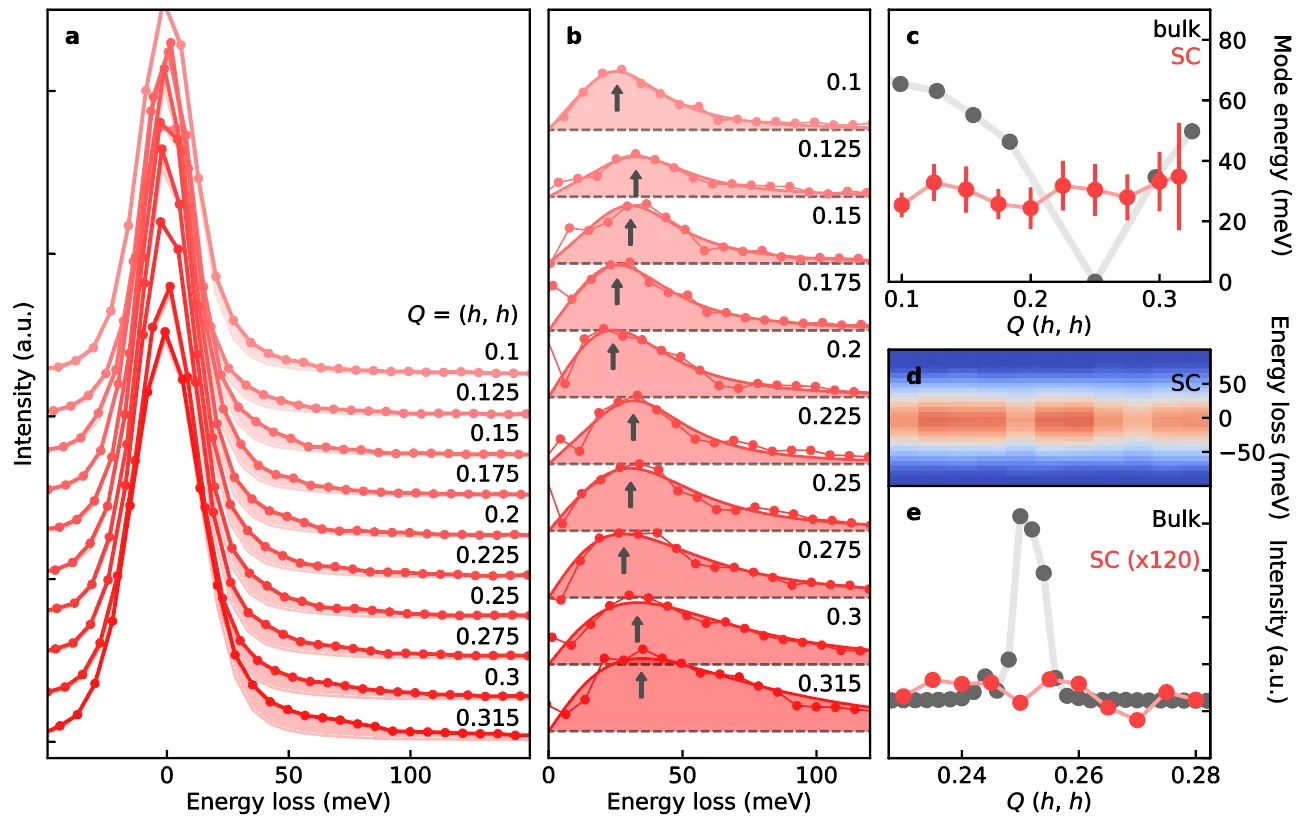
Researchers examined thin films of La₂PrNi₂O₇ using resonant X-ray scattering. They compared two samples: one with a full set of oxygen atoms (superconducting), the other with oxygen vacancies. In the first, as expected, superconductivity was present and spin-density waves were absent. In the second, the opposite happened: magnetic order switched on, and superconductivity vanished.
Spectroscopy at the nickel and oxygen absorption edges revealed that the electronic structure along the vertical axis differs between the two cases. Superconducting regions look like neatly stacked piles, while in oxygen-deficient zones the interlayer coupling weakens and order breaks down. It turns out that oxygen stoichiometry is not just a technical detail but the main lever controlling the material's properties.
Spin-density waves can be imagined as a row of soldiers who periodically change the direction they're looking. In nickelates, such 'drilling' of electron spins prevents them from flowing freely, so superconductivity is suppressed.
In Peter Watts's novel Blindsight, superconducting organisms use magnetic fields to communicate — perhaps similar mechanisms will someday be found in exotic life forms.