The Donut Universe: How a Simple Shape Explained the Birth of the Cosmos ✛ ✎ ✦
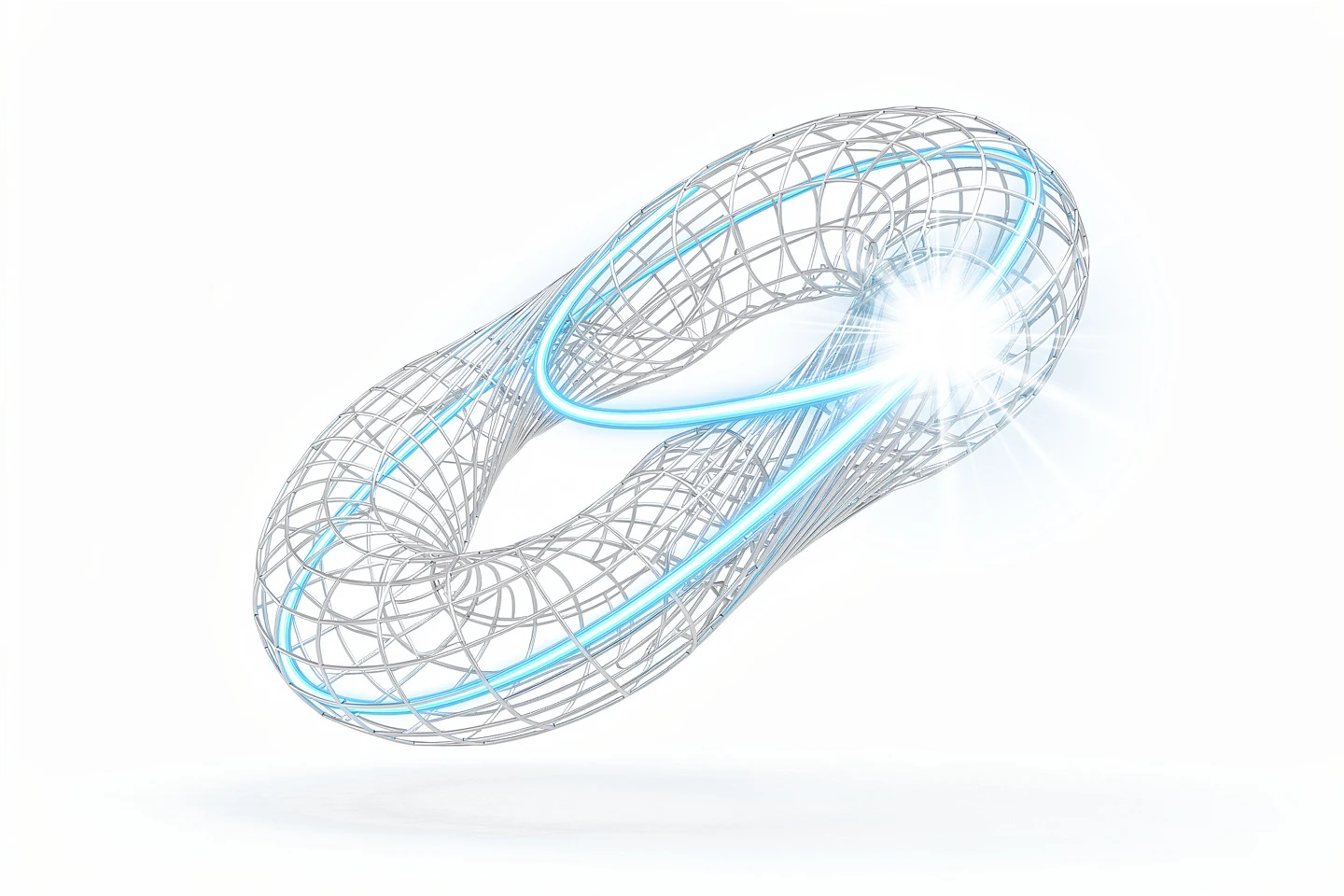
The Universe could have been born from 'nothing' during the quantum Big Bang, like a soap bubble — suggested Hawking. But calculations yielded a tiny world that would instantly collapse into a point.
The way out was found by geometry. Replace the familiar sphere with a three-dimensional donut. Thanks to its hole, the donut offers many ways to loop around: you can thread a loop through the hole, or wrap around the outside. Each such loop represents a distinct quantum birth path. When physicists summed up these possibilities, long inflation — superfast expansion — turned from a rarity into a near inevitability. Thus, Guth's idea gained firm support.
Unexpectedly, in the calculations, the Riemann zeta function emerged — a mysterious staircase into the world of prime numbers. It turned out that a donut-universe almost certainly inflates by a factor of $10^{108}$. Gravity and spacetime curvature don't distort the overall picture, and ancient light (cosmic microwave background) carries the echo of that birth.
In the calculations, the Riemann zeta function unexpectedly popped up — a mysterious mathematical construct linking the distribution of prime numbers to the fabric of the Universe.