Torus Universe: How Quantum Cosmology Predicts Large Inflation ✛ ✎ ✦
Context
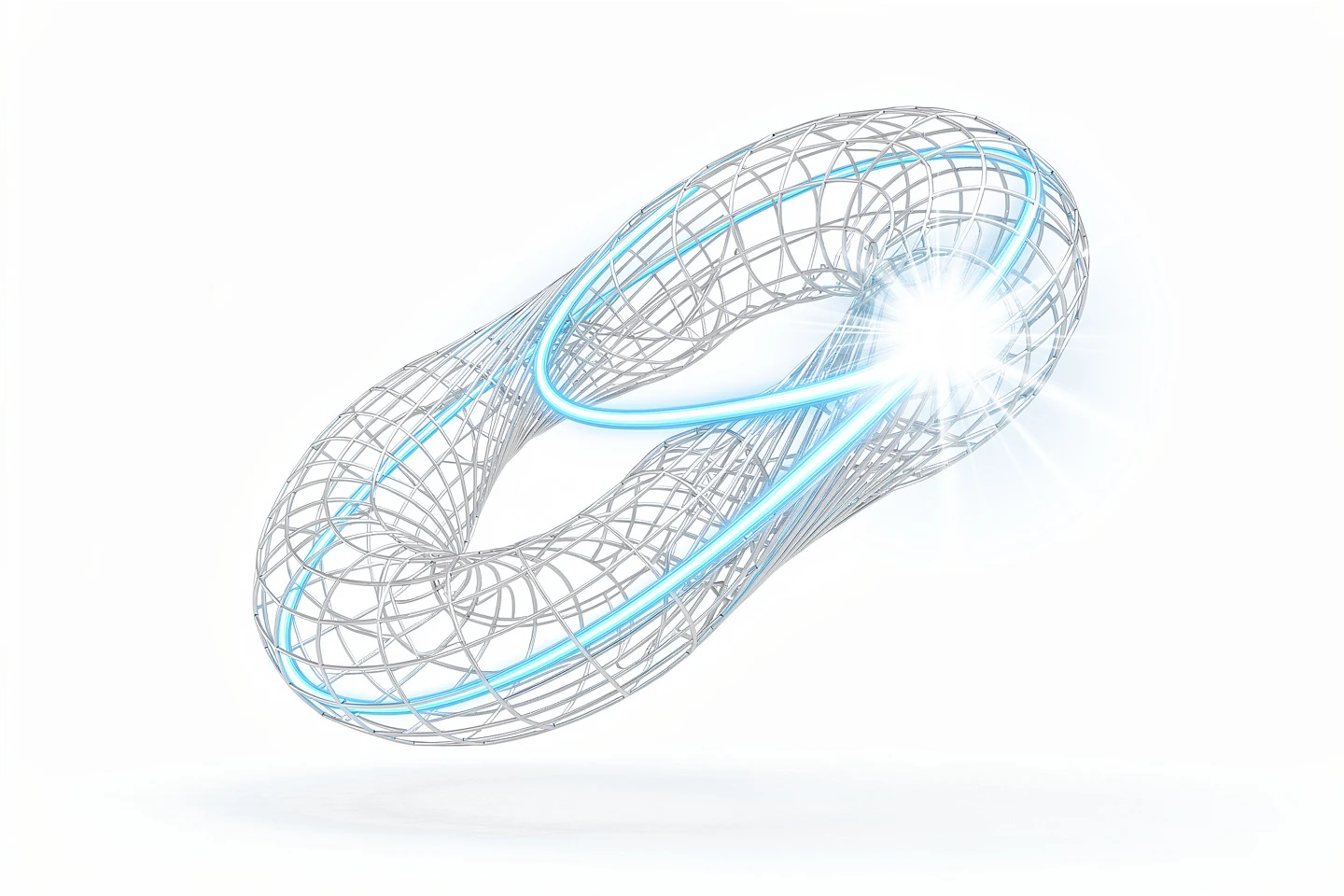
The quantum birth of the Universe is described by a wave function satisfying the Wheeler–DeWitt equation. In the famous Hartle–Hawking approach, this wave function is constructed as a sum over four-dimensional geometries with no boundary in the past. For slow-roll inflation on a three-dimensional sphere, such formalism exponentially favors a tiny Universe with a negligible number of e-folds of expansion, contradicting cosmic microwave background data. This contradiction, known as the inflation probability problem, has long cast a shadow on quantum cosmology. However, if space has the topology of a torus, the infinite group of geometry rearrangements radically changes the result.
Methods
The work uses a minisuperspace approximation, where the Universe metric is described by several functions of time, including the volume T and the modular parameters of the torus—angles and ratios of circumferences. The Einstein–Hilbert action with a slow-roll inflation scalar field reduces to geodesic motion on an auxiliary space with a metric that includes the symmetric space h₃ of the SL(3,R) group. Solutions with zero volume in the past are regularized by a complex rotation of the time coordinate, similar to the iε prescription in quantum field theory, yielding smooth “no-boundary” saddle points. Summing over all torus fillings is equivalent to constructing a Poincaré series for the maximal parabolic subgroup and leads to a spectral decomposition in terms of GL(3) automorphic forms. Integration over the moduli is performed with the invariant Petersson measure.
Results
The main result is that the norm of the Hartle–Hawking wave function for T³ is proportional to M⁴ₚ/V(φ∗), where V(φ∗) is the inflaton potential at the start of inflation. This follows from the constant term in the spectral decomposition and differs dramatically from the exponential exp(24π² M⁴ₚ/V) for S³. The probability distribution over the number of e-folds N ceases to be catastrophically sharp: dP = 2ε_V exp(-2ε_V N) dN, where $ε_V$ is the slow-roll parameter. Using the observational constraint $ε_V$ ≲ 2·10⁻³, the average number of e-folds is ⟨N⟩ ≈ 250, and the probability of obtaining N > 60 exceeds 79%. This is fully consistent with Planck and BICEP/Keck data. Also computed are corrections to the CMB angular power spectrum due to torus modulus fluctuations; their relative magnitude is about 10⁻⁶, which is below cosmic variance.
Implications
The work radically changes the landscape of quantum cosmology: it shows that the birth of the Universe does not have to favor small worlds. The topology of space becomes a dynamical parameter, not a fixed background. The connection with the theory of automorphic forms opens the way to precise calculations that were previously impossible. The infinite-dimensional group SL(3,Z) generates arithmetic chaos in the wave function, manifested through the zeros of the Riemann zeta function—this is the first example of a physical embodiment of the Langlands program in cosmology. The spectral decomposition gives a complete set of basis states, turning quantum cosmology into a branch of representation theory.
Future development
In the future, similar methods are expected to be applied to other topologies and dimensions. It is natural to consider inflation on spaces of positive curvature with more general rearrangement groups, such as SL(d,Z). There is hope to derive from first principles which topology is realized in our Universe, based on the integration contour in the gravitational path integral. Active debates about the Lorentzian contour may be resolved precisely by taking topological sums into account. A practical direction is the search for observationally accessible predictions: inhomogeneities violating the statistical isotropy of the CMB, or Casimir effects on horizon scales.
Impact
The results will impact quantum gravity, inflation phenomenology, and CMB data analysis, as well as inspire interdisciplinary research at the intersection of general relativity and number theory.
Next steps
Next steps include a detailed analysis of anisotropic signatures in the CMB from toroidal topology and computation of the full covariance matrix. It is also important to investigate which integration contour is actually realized in quantum gravity.
Key open problems
The work is directly connected to unsolved problems in quantum cosmology: the measure problem in inflation, the interpretation of the wave function of the Universe, and the question of initial conditions. It also sheds light on the role of complex saddle points in gravity and, possibly, on the nature of dark energy through topological corrections.
The knowledge machine's view
This section is addressed to the author of the paper and their colleagues. Neighbouring works were found by meaning-based search across our archive, not by word overlap. We do not review: we show the field around the work.
What the work does
The paper examines the quantum birth of a Universe with the topology of a three-dimensional torus in the Hartle–Hawking approach. Summing over all torus fillings is reduced to a spectral decomposition in terms of automorphic forms of GL(3), yielding a power-law dependence of the wave function norm on the inflaton potential. A distribution over the number of e-folds is obtained, consistent with observational data.
Where its strength is
The work demonstrates that the topology of space can drastically alter the predictions of quantum cosmology, turning exponential suppression into a power law and solving the problem of the probability of inflation.
Where it could go next
- It might be interesting to compare the obtained e-fold distribution with approaches where inflation arises from quantum chaos; in our archive there is a nearby work exploring the connection between chaotic dynamics and the birth of the inflationary phase.based on: How Quantum Chaos Gives Rise to Inflation arXiv:2608.01165v1
- Nearby there is a study in which eternal inflation is considered through the 'cosmic bellows' mechanism, which may provide additional context for interpreting probabilistic predictions in multicomponent models.based on: Cosmic Bellows: How Eternal Inflation Resurrects the Universe from the Ashes arXiv:2605.15374v1
- It may be useful to look at the connection with quantum corrections to inflation discussed in a neighboring work, to assess how robust the results are to modifications of the potential.based on: Cosmic Inflation with a Quantum Correction arXiv:2607.20654
Worth trying
- Check whether the power-law behavior of the wave function norm persists when quantum corrections to the inflaton potential are taken into account.
- Consider how the e-fold distribution changes if eternal inflation effects are included via the 'cosmic bellows' mechanism.
- Investigate whether the suppression of small e-folds can be linked to chaotic dynamics in the pre-inflationary stage.
Why this may matter
The work paves the way for reconciling quantum cosmology with observations, showing that the topology of the Universe may be a key ingredient for obtaining a realistic cosmology without fine-tuning.
Nearby works in our archive
- How the Universe Became Smooth: Unraveling the First Momentssimilarity 0.65
- How Quantum Chaos Gives Rise to Inflationsimilarity 0.64
- Cosmic Bellows: How Eternal Inflation Resurrects the Universe from the Ashessimilarity 0.64
- The Universe as a Quantum Fogsimilarity 0.64
- Cosmic Inflation with a Quantum Correctionsimilarity 0.64
- The Universe Heats Up on Vorticessimilarity 0.63
The closest work in the archive sits at 0.65 by meaning — the usual level for our corpus.
The modular group SL(2,Z), which plays a key role in string theory, is generalized here to SL(3,Z), and the physical answer is expressed through the zeros of the Riemann zeta function — one of the most mysterious functions in mathematics. Thus, the distribution of galaxies may be encoded in prime numbers.
The idea of a toroidal Universe echoes Arthur C. Clarke's story “The Wall of Darkness” (1949), where the heroes discover they live on the inner surface of a torus, and with the concept of “compactified dimensions” from science fiction.
Key numbers
- average number of e-folds: 250
- slow-roll parameter constraint: ε_V ≤ 2·10⁻³
- order of CMB correction: 10⁻⁶
- probability N>60: ≈79%
- typical C*: ≥2×10¹¹