Popular

Bryce DeWitt

1923-2004 · quantum gravity, quantum field theory, cosmology
American theoretical physicist, one of the pioneers of quantum gravity. Together with John Wheeler, he derived the Wheeler-DeWitt equation—the fundamental equation of quantum cosmology. Made contributions to gauge theories, effective action, and quantum field theory in curved spacetime.

Biography

Born in California. Studied at Harvard, received his PhD under Julian Schwinger. Worked at the Princeton Institute for Advanced Study, then at the University of North Carolina, and later at the University of Texas at Austin. Member of the National Academy of Sciences of the USA. Also known for work on the interpretation of quantum mechanics (he renamed Everett's many-worlds to 'many-worlds' and actively promoted it).

Key discoveries

💡 He and his wife Cécile DeWitt-Morette were a famous couple of physicists. Together they founded the summer school in theoretical physics in Les Houches, which became a breeding ground for Nobel laureates.
Quote: "The laws of physics must be such that a physicist can discover them."
Links in the knowledge graph 1
Related tags
spacetime curvatureentropy
Related laws
Wheeler-DeWitt equation
Related scientists
Jacob BekensteinKarl SchwarzschildJoseph WeberEmmy NoetherWilhelm WienLudwig BoltzmannKip ThorneCharles Bennett

Related articles

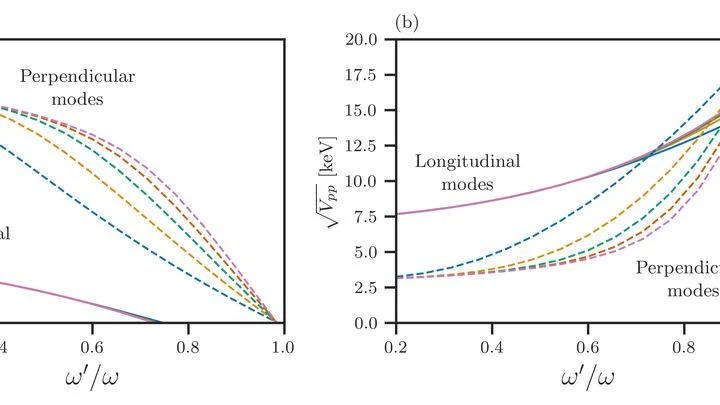
Speed Outsmarts the Laws of Heat Engines

A heat engine made of quantum particles, flying almost as fast as light, perceives temperature in a whole new way. Einstein’s effects make the hot even hotter and the cold even colder, boosting useful work and bypassing the classical barrier. Speed becomes a thermodynamic trump card.
arXiv:2508.11554 · 2025-08-15

How Acceleration Turns Vacuum into a Hot Bath

A particle thermometer accelerated through vacuum heats up, and the way it reaches equilibrium depends on the field type and dimensions. Intriguingly, it heats faster than it cools, mimicking the Mpemba effect. This asymmetry provides a fingerprint to identify the Unruh effect.
arXiv:2509.05756 · 2025-09-06

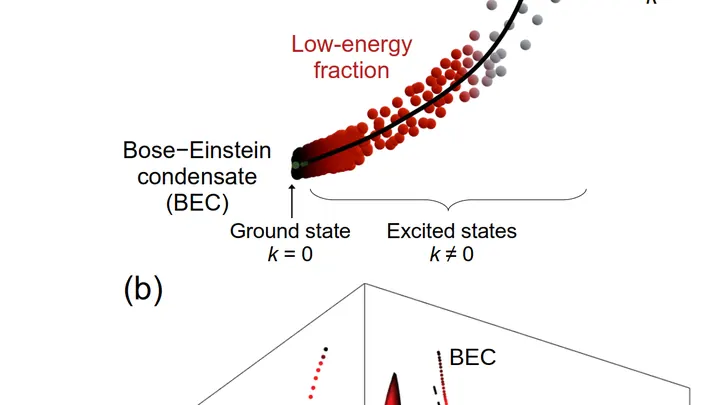
Time from Disorder: How Atoms Revealed an Internal Clock

Scientists split a cloud of atoms and, by tracking rising disorder, ordered events in one half without seeing the other. This confirms that time emerges from internal changes. Such an approach will help us understand how time flows in black holes and right after the Big Bang.
arXiv:2509.07745 · 2025-09-09

Quantum Bounce: A Universe Without Singularity

Classical gravity theory predicts that the universe was born from a singularity—a point of infinite density. New research shows that quantum effects replace this moment with a smooth bounce. In a model of space closed like a ball, a special energy, akin to a spring, makes it contract and expand. Phy
arXiv:2603.06481 · 2026-03-06

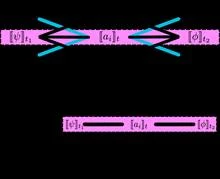
The Singularity That Never Was: How Quantum Tango Erases the Beginning of the Universe

In quantum cosmology, the Big Bang singularity turns out to be a mirage. Using relational time emerging from entanglement between subsystems of the universe, physicists have shown: the probability of zero volume is strictly zero. The Page-Wootters formalism transforms a static wave function into an
arXiv:2605.06093v1 · 2026-05-07

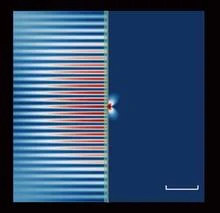
Quantum Tremor of Parallel Worlds: Gravity on a Laboratory Table

A new theoretical work unites quantum mechanics and general relativity, showing that two parallel atomic lasers, unperturbed in the classical world, begin to diverge under the influence of quantum fluctuations of spacetime. Vacuum tremors of the metric give rise to an irreducible spread of trajector
arXiv:2605.11035v1 · 2026-05-11

How a Timeless World Gains a Past and a Future

A new study shows that timeless equations are not flawed. They resemble a film reel where each frame exists independently, with no direction. But when a clock emerges within the system—like turning on a projector—the film starts rolling forward, and the familiar flow of time appears.
arXiv:2605.17935 · 2026-05-18

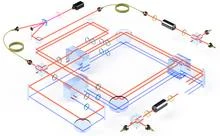
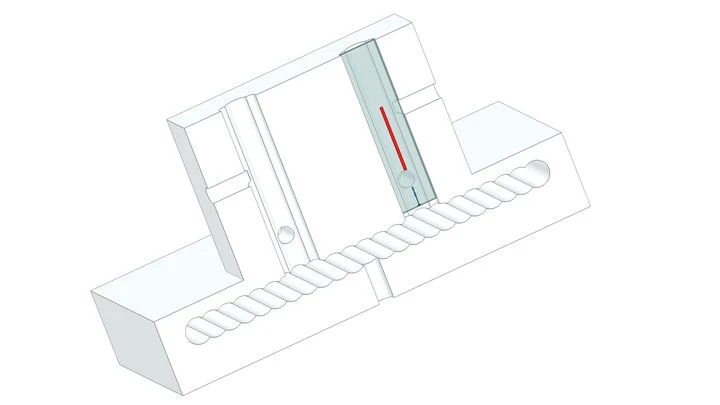
Laser Detector in Two Places: How to Hear a Quantum Field

Scientists have designed an experiment where a laser beam simultaneously passes through two clouds of ultracold atoms, mimicking a detector that is in two places at once. After the beams reunite, the difference in their signals is measured — it will reveal how the quantum field responds to a split r
arXiv:2605.21595 · 2026-05-20