The central limit theorem (CLT) is a cornerstone of probability theory. It states that the sum (or average) of a large number of independent, identically distributed random variables, regardless of their original distribution, tends toward a normal (Gaussian) distribution. This explains why the Gaussian appears so often in nature, from measurement errors to biological traits.
History
The first version was proved by Pierre-Simon Laplace in 1810, building on earlier work by Abraham de Moivre. The modern formulation is due to Aleksandr Lyapunov in 1901.
How it works
The theorem requires that the variables have finite mean and variance. As the number of variables increases, the distribution of the standardized sum converges to the standard normal distribution. The rate of convergence depends on the shape of the original distribution; symmetric distributions converge faster than skewed ones.
In practice
Underlies statistical inference, quality control (e.g., control charts), and the justification for using normal approximations in fields from finance to psychology.
Fun fact
The CLT works even for discrete distributions like the Poisson or binomial, which is why coin flips and dice rolls produce bell-shaped histograms when repeated many times.
A handful of coins drops onto a table — heads and tails land wherever they please. The same goes for an instantaneous snapshot of a quantum chain: in some places a particle is present, in others it is not. But behind the disorder lurks a precise angle.
In this work, a chain of particles closed into a ring was considered. It was divided into four arcs: two were measured, two were left untouched.
When two heavy nuclei collide in an accelerator, a tiny fireball of quark-gluon plasma is born — a special state of matter where quarks and gluons are not confined inside particles. As it expands and cools, the emitted particles often come out "spinning"—their spins align along the beam direction.
In the first fractions of a second after the Big Bang, the Universe underwent inflation — a monstrously rapid expansion that smoothed out all irregularities. But amid this cosmic smoothness, one "wrong" note could have been hidden: quantum fluctuations of the axion field.
Imagine a cookbook that gets rewritten from generation to generation. One day, the borscht recipe receives a secret ingredient from a pastry chef, and from that moment, the taste remembers not only ancestors but also a neighbor. In the Standard Model of evolution, genes behave the same way.
A stable system behaves like a ball in a bowl: give it a push, and it rolls back to the bottom. The spread of possible trajectories, uncertainty, shrinks over time. But the speed depends on the slope of the bowl's walls. In complex systems, this 'bowl' has sections of varying steepness.
Quantum chromodynamics is the theory that describes how quarks and gluons assemble into protons and neutrons. In its equations, there is a strange angle, the parameter θ (theta).
Gravitational signals from dying massive stars are whispers reaching us from the most violent laboratories in the Universe. Einstein predicted these gravitational waves over a century ago, but only today, with detectors like LIGO, are we beginning to hear them.
In the infinite river of integers, where whirlpools of primes swirl, mathematicians have been sifting sand for centuries in search of golden nuggets — the zeros of L‑functions. These enigmatic objects, discovered by Riemann in 1859, act like an invisible hand governing the distribution of primes.
A huge sheet of paper lies on the table. A cartographer tries to fit all conceivable landscapes onto it: mountain ranges, tangled gorges, endless plains. Each landscape is a finitely generated group, and the map is its Cayley graph, a graphic portrait of the group, where vertices are elements and edges are connections between them.
The frost pattern on a windowpane doesn't spread uniformly: it sprouts branches, captures new areas, sometimes sealing off voids. This growth is not a smooth expansion but a series of leaps. This image resonates surprisingly with a mathematical model devised by Charles Loewner a century ago.
Biological complexity has long eluded us: you can count genes, cells too, but how do you grasp the organization of the proteome itself — a multi-thousand ensemble of proteins woven from carbon, oxygen, and hydrogen?
Imagine a huge orchestra where every musician plays at their own tempo, yet together they create a single rhythm. Scientists studying the brain or laser networks often face a similar picture: thousands of neurons or oscillators each pulse on their own, but the whole crowd needs to be observed at once.
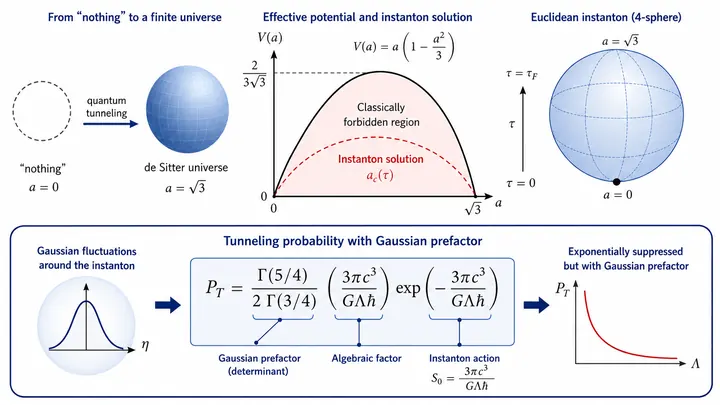
Quantum nothingness resembles water in a pot just before boiling. From time to time, a bubble spontaneously swells up — but not of steam, but of an entire universe. Such a bubble doesn't collapse; instead, it inflates into spacetime, triggering its own Big Bang. The only question is how often this happens.
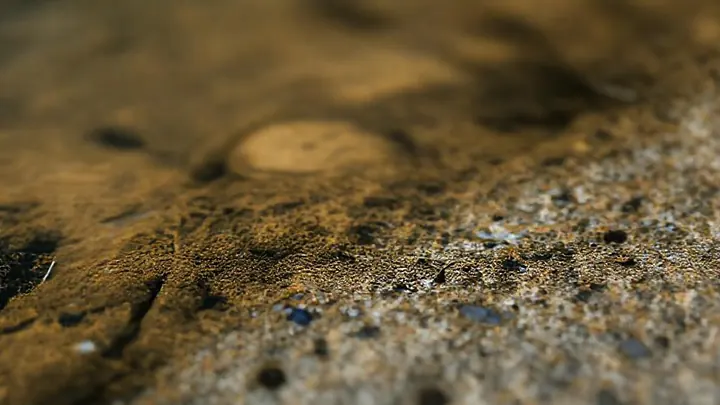
The shape of a riverbed precisely follows the equation describing the growth of a universe with negative curvature. In the lab, water flowing over sand spontaneously carves a cross-section that matches the solution for the Anti-de Sitter model.
A river tends toward a shape that maximizes bottom friction.
The quantum birth of the Universe is like a game of dice, where the chance of rolling a six is catastrophically small. The formalism of Hawking and Hartle, an elegant recipe for a world born from timelessness, has spent decades predicting that a universe like ours is fantastically improbable.
A stone falls into a pond, and ripples spread across the water. But if the stone is very small and the water is not quite ordinary, the ripples pass right through it, as if it weren't there.
Two galaxy clusters collided like two swarms of bees flying through each other. One of them is the famous "Bullet." After the collision, the hot gas, which makes up most of the ordinary matter, slowed down and stayed in the center, while the galaxies, like small dense pebbles, flew on.
Toss a handful of sand on the floor: there are few large grains, many medium ones, and even more tiny ones. This skew, where small events are common and large ones are rare, is described by a power law. It shows up in city sizes, earthquake magnitudes, and citation counts of scientific papers.
A neuron in the brain is like a person handing out business cards at a crowded conference. At first, making acquaintances is easy, but as the address book fills up, each new contact requires more effort: there's little room left. The authors based their model on this 'crowding' rule: the more incoming connections a neuron already has, the harder it is to form another one.
The assembly of a virus shell is like fastening a button: protein blocks must interlock in the correct order, and thermal fluctuations act like trembling fingers. With weak binding, the trembling helps find the right position — the shell closes faster.
Quantum entanglement works like a leash: it ties particles together, but the length of this tether is strictly limited. In a chain of particles, heat plays the role of an impatient dog tugging at the leash — the hotter it gets, the shorter the distance over which the connection holds.
On the surface of a tiny sphere, electrons line up in patterns that look like ripples on water. Physicists have long noticed that this simple picture describes the behavior of quantum systems with surprising accuracy. But why it works has remained a mystery. The authors of a new study have unraveled the mathematical mechanism behind this model.
The Social Laser theory describes society by borrowing the inner workings of a laser. People, like atoms in a crystal, absorb streams of information and become charged by it. When the number of those charged with a single idea outweighs the indifferent, even a weak signal (a post, a call to action) makes everyone act as one.