Torus Universe: A Quantum Jackpot for the Big Bang ✛ ✎ ✦
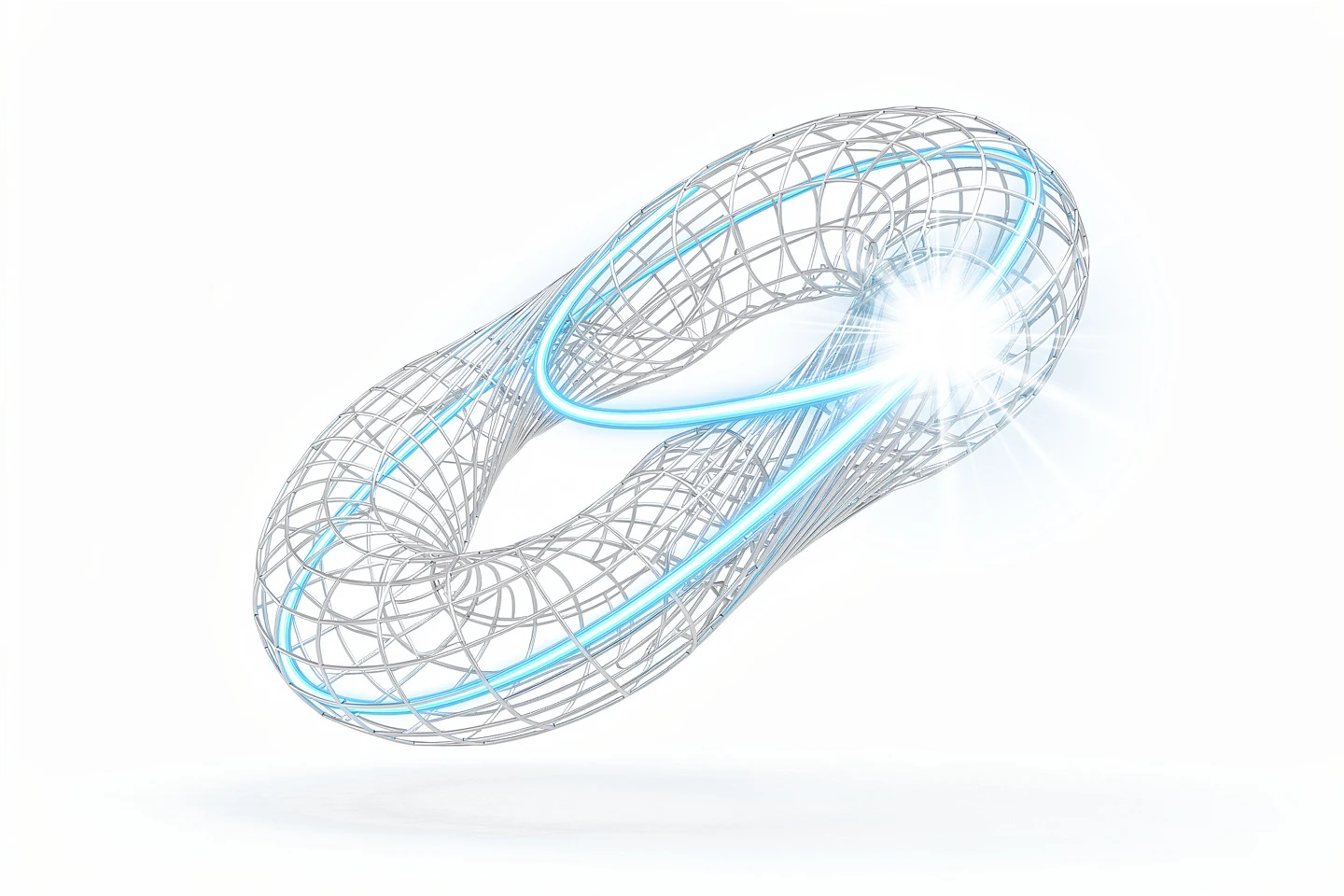
The quantum birth of the Universe is like a game of dice, where the chance of rolling a six is catastrophically small. The formalism of Hawking and Hartle, an elegant recipe for a world born from timelessness, has spent decades predicting that a universe like ours is fantastically improbable. The wave function on a sphere S³ exponentially crushes the probability of prolonged inflation: the more e-folds of expansion, the slimmer the chance. This contradiction eroded trust in the quantum description of the Big Bang and remained a nagging paradox for cosmologists.
When the sphere was replaced by the torus T³, space gained a topological spring. The key to this rebirth is the group SL(3,Z): all integer 3×3 matrices with unit determinant. This infinite symmetry means the same parameters can be obtained in countless ways. When contributions are summed, a miracle occurs: the exponential penalty exp(–$M_P^4$/V) is replaced by a gentle power law ~ $M_P^4$/V. Mathematically, this involves constructing a Poincaré series from automorphic forms. In the musical metaphor: the single note of the sphere becomes a chord of the torus, and the loudest harmonic sings a long inflation. The norm of the wave function is now (Ψ,Ψ) ∝ $M_P^4$/V(φ*), where V(φ*) is the inflaton potential. The probability of birthing a suitable universe is no longer an exponential trifle but simply inversely proportional to the field energy.
The distribution of e-folds is no longer catastrophically sharp. It takes an exponential form: dP = 2ε_V exp(-2ε_V N) dN. Here $ε_V$ is the slow-roll parameter of the inflaton, known from the pioneering work of Guth; Planck data constrain it to < 0.002. Plugging in gives a mean N ≈ 250 and a 79 percent probability of obtaining more than 60 e-folds. The torus universe makes the inflationary jackpot almost inevitable. Quantum cosmology finally meets observations: the cosmic microwave background from Planck and the search for gravitational waves by BICEP/Keck no longer contradict the theory.
The work turns the notion of the quantum beginning upside down: topology is not a silent witness but a full-fledged participant. The connection with automorphic forms pulls cosmology into the orbit of the Langlands program — the grand bridge between number theory and geometry. Perhaps the distribution of matter in the Universe is encoded in prime numbers. This suggests that quantum gravity may have an arithmetic core. Looking ahead: exploring other topologies and dimensions; precise predictions will require numerical simulation of quantum fluctuations on the torus. Debates over the integration contour in the gravitational path integral, Lorentzian or not, may well be resolved by topological sums. And most importantly: the statistical isotropy of the cosmic microwave background might be broken by a weak anisotropy — a trace of the torus shape. That is our chance for direct observational confirmation.
In string theory, the modular group SL(2,Z) rules; here its three-dimensional cousin SL(3,Z) makes its debut. And the physical answer is expressed through the zeros of the Riemann zeta function, as if the distribution of galaxies is dictated by prime numbers. The nearest zero: ~14.1347i, and numbers like these govern quantum corrections to the shape of the Universe.
In the story 'The Wall of Darkness' (1949), Arthur C. Clarke sent his heroes on a journey through a torus universe, where the edge of the world loops back on itself. Today, we test this geometry not with our feet but by gazing at the sky — through the subtle ripples of the cosmic microwave background.