A Nuclear Diary for Protons express
A pot of boiling soup bubbles away, and you'd love to know how hot individual droplets are inside. But you can only dip your thermometer at the edge, where things are calmer. Laser fusion is a bit like that: a powerful laser pulse hits a target, creating a cloud of fast protons. You can only catch them for measurements once they fly out, having already lost some energy.
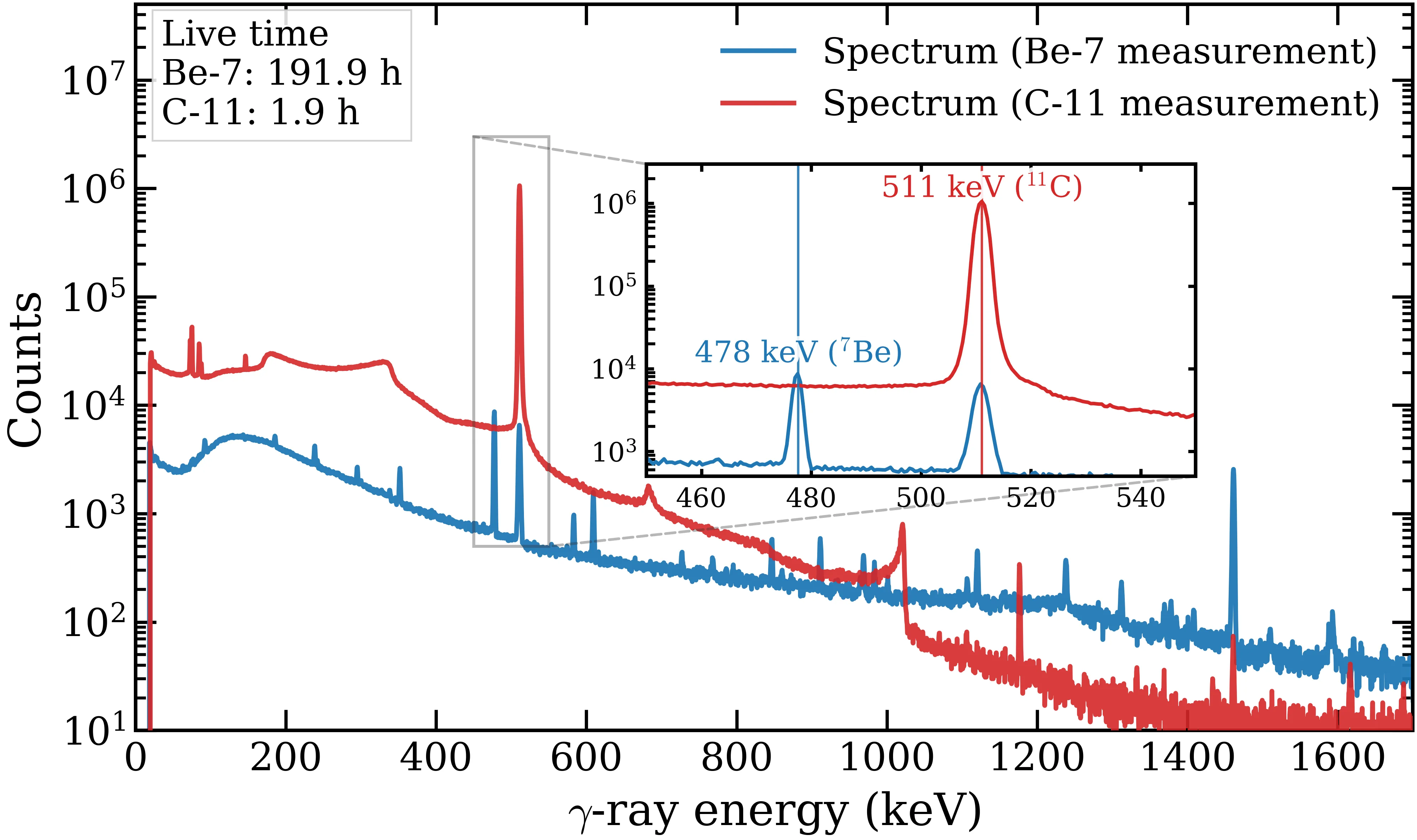
The authors of a new study found a way to peek inside the 'pot.' They turned the target itself into a measuring device. The target contains boron — the same element found in borax and eye drops. When a fast proton slams into a boron nucleus, it sometimes produces radioactive carbon-11, and sometimes beryllium-7. These newborn atoms don't live long and emit characteristic radiation that can be counted after the shot. The more energetic the protons, the more carbon-11 is produced relative to beryllium-7. It's a kind of radioactive 'scale' for energy.
By collecting data on isotope yields, the physicists built the proton energy spectrum. It fits an exponential decay: the higher the energy, the fewer particles. They also pinned down the number of key fusion reactions where a proton splits boron into three alpha particles. Previously, this number was estimated indirectly; now it's measured via a side channel with known accuracy.
So the target has gone from a passive lump to a nuclear diary. It records the history of every proton strike. And if experimenters used to be like cooks tasting soup only from the surface, now they can scoop right from the thick of it.
Original abstract
as written by the authors arXiv:2605.09191
The energy distribution of energetic protons inside a solid target is a key quantity governing nuclear reaction yields and energy deposition in high-intensity laser-driven fusion, including nonthermal proton--boron (p--B) schemes and proton fast ignition. Yet it has remained inaccessible to conventional particle diagnostics, which detect only ions escaping the target and are perturbed by intense plasma electromagnetic fields. Here we establish a quantitative diagnostic that uses nuclear activation reactions occurring within the target itself as an internal probe of the in-solid proton energy distribution. Applied to laser-driven p--B fusion experiments on the kJ-class laser, the method reconstructs an exponential-equivalent in-solid proton energy distribution from the absolute yields of $$^{11}\mathrm{C}$$ and $$^{7}\mathrm{Be}$$ produced via $$\mathrm{^{11}B(p,n)^{11}C}$$ and $$\mathrm{^{10}B(p,\alpha)^{7}Be}$$, and yields the absolute number of $$\mathrm{^{11}B(p,2\alpha)^{4}He}$$ reactions through a side-channel analysis with propagated cross-section uncertainties. This work opens a quantitative window onto the in-solid proton dynamics that drive nuclear reactions in laser-driven fusion experiments.
Carbon-11, born inside the target, is used in medicine for PET scans: it accumulates in tumors and lights them up on the scanner.
In the novel 'The Martian,' an astronaut uses a radioisotope thermoelectric generator for warmth — a similar principle of converting nuclear energy into heat, except in the paper the proton energy is measured, not used.