Proton structure calculation refers to computational methods used to determine the internal properties of protons, such as their magnetic moment, charge distribution, and the arrangement of quarks and gluons inside them. These calculations are crucial for understanding the fundamental forces of nature, particularly the strong nuclear force described by quantum chromodynamics (QCD). Since protons are not point-like particles, their internal structure affects how they interact with other particles, making these calculations essential for interpreting experiments in particle physics, nuclear physics, and astrophysics.
History
The first lattice QCD calculations of hadron properties were performed in the 1980s, but accurate results for the proton's structure have only been achieved in the last two decades with the advent of more powerful supercomputers and improved algorithms.
How it works
The most powerful approach is lattice QCD, where spacetime is discretized into a grid, and the equations of QCD are solved numerically on this lattice. This allows researchers to compute properties like the proton's mass, magnetic moment, and charge radius from first principles. However, these calculations are extremely computationally intensive, requiring supercomputers. Recent advances also include using machine learning techniques to accelerate these calculations or to extract information from the lattice data more efficiently. The calculations involve simulating the interactions of quarks and gluons, which are the fundamental constituents of the proton.
In practice
Proton structure calculations are used to interpret results from particle accelerators like the Large Hadron Collider, to predict cross-sections for nuclear reactions in astrophysics, and to design experiments for future facilities like the Electron-Ion Collider.
Fun fact
The proton's magnetic moment is one of the most precisely measured quantities in physics, yet its calculation from QCD remains a major challenge, with recent lattice QCD results requiring careful handling of systematic uncertainties.
Two nuclei with the same number of particles but different neutron skin shapes collide at speeds close to the speed of light. Ruthenium-96 and zirconium-96 are like twins, one with a slightly thicker coat. This difference changes how particles carry charge in the fireball of the collision.
The proton is not a solid ball but a tiny prison. Inside it, three quarks are locked up, and the gluon field keeps them from escaping — something like invisible threads that only grow stronger if the quarks try to move apart.
The proton is not a monolithic ball. It is a seething cloud of quarks and gluons that constantly appear and vanish. Parton distribution functions help describe this picture: they show the probability of encountering a quark or gluon with a certain energy inside the proton.
At accelerators, by smashing heavy nuclei, physicists briefly create a quark-gluon plasma — a state of matter where quarks and gluons are not confined inside particles but are free. For a long time, it was imagined as a gas, but experiments showed it's an almost perfect liquid.
Atomic nuclei are not always like billiard balls. Some are elongated, like cigars, others are flattened. But xenon-129 resembles a potato — a bumpy triaxial ellipsoid.
A firework bursts, and one point explodes into four sparks at once. That's how the Z boson, the particle that carries the weak force, behaves when it decays into four charged leptons (electrons or muons). The process is extremely rare: for every million Z bosons produced, only about five decay this way.
A drop of cream in a glass of milk. Shake it, and the fat doesn't spread evenly: it clumps into denser blobs that move differently from the rest of the liquid. Quarks inside mesons, tiny particles that live for mere fractions of a second, behave in much the same way.
A meson consists of a quark and an antiquark, and they are rarely equals.
A pot of boiling soup bubbles away, and you'd love to know how hot individual droplets are inside. But you can only dip your thermometer at the edge, where things are calmer. Laser fusion is a bit like that: a powerful laser pulse hits a target, creating a cloud of fast protons.
If you try to break a proton apart and pull out a quark, you're in for a surprise. Ordinary forces, like the electric force, weaken as particles fly apart. Here, it's the opposite. The farther a quark gets from its neighbors, the harder it's pulled back.
The outer crust of a neutron star is like a layered cake, where each layer is a strictly defined filling. It's a crystalline lattice of atomic nuclei immersed in a sea of electrons. The deeper you go, the stronger the pressure, and the heavier the nuclei that can exist there without falling apart.
The proton looks like a solid ball, but inside it's a hive of activity: quarks exchange gluons — the particles that bind them together. Gluons pop in and out of existence, and their distribution within the proton is not just a curious detail but a key to predictions at the Large Hadron Collider.
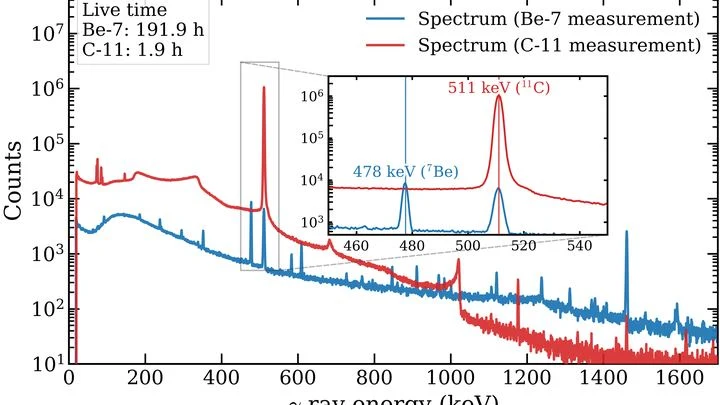
Inside the Sun, invisible nuclear transformations occur every second. One of them is the birth of boron-8: a beryllium-7 nucleus captures a passing proton and momentarily becomes a new element. This step kicks off a chain that ends with the emission of a neutrino — a particle capable of passing straight through Earth.
The atomic nucleus is not just a ball of protons and neutrons. Inside it, like a tiny magnet, there is its own distribution of magnetization. Until now, it has been difficult to see: nuclei live for tiny fractions of a second, and their magnetic field is weak. Now physicists at CERN have found a way to look inside.
An atomic nucleus isn't always round. It can stretch out like a melon or flatten like a pumpkin. And its size depends on this shape — just as the size of a pie depends on the shape of the dough.
Scientists calculated the shapes and sizes of nuclei of berkelium isotopes — a heavy element produced in reactors.
The proton is not a smooth ball but a tangle of smaller particles in constant motion. To peek inside, physicists fire electrons at protons and watch how they bounce off. The new machine, the Electron-Ion Collider, will do this with unprecedented accuracy.
Scientists have run simulations to see what would happen if data were collected at different energies.
Ten microseconds after the Big Bang, the Universe resembled a pot of boiling broth. Floating in it were quarks and gluons — the particles that would later assemble into protons and neutrons. As the broth cooled, at some point the quarks clumped together into lumps — the very protons and neutrons that make up all visible matter.
Neutrinos are the most elusive of all known particles. Every second, trillions of neutrinos from the Sun fly through your body, but you never notice: they barely interact with matter. To catch even one, physicists build giant detectors — pools of water or liquid argon deep underground.
Electrons — tiny particles in molecules — constantly maneuver, avoiding collisions like passengers during rush hour. To calculate their behavior, scientists set a personal distance rule: a mathematical function that indicates how close one electron can get to its neighbor.