An X-ray Snowstorm Around a Black Hole express
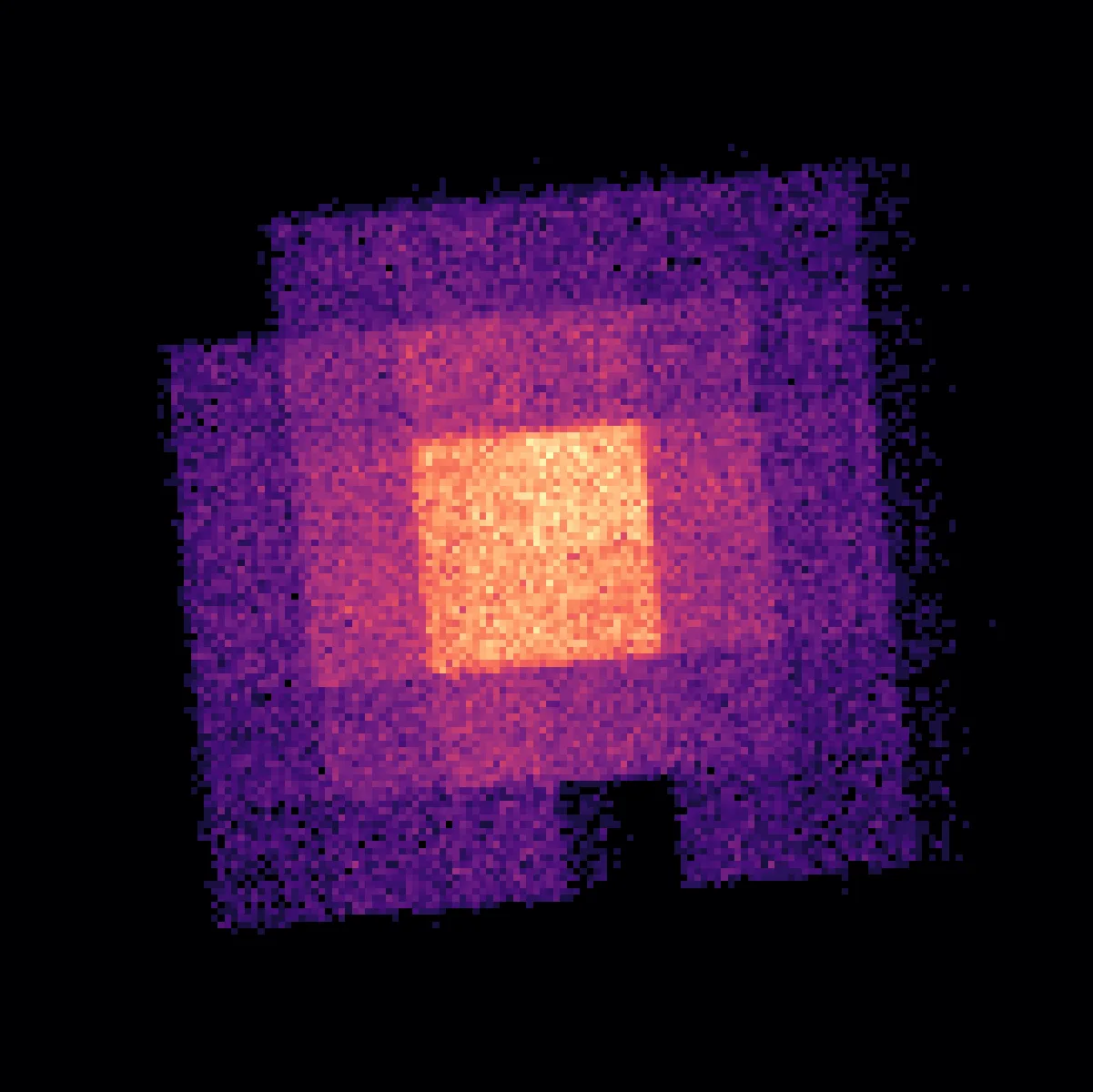
The XRISM X-ray telescope spent 170,000 seconds staring at the core of galaxy Cygnus A — one of the most powerful radio sources in the sky. At its center lurks a supermassive black hole that sucks in matter and heats it until it glows in X-rays. The instrument caught light from iron atoms that had lost electrons. This line at 6.4 keV acts like a beacon: its broadening reveals how fast the gas is spinning.
Instead of one beacon, the telescope saw two. The first, broad one is smeared by motion at 3400 km/s — like a car on a roundabout zooming past, its engine note shifting in pitch. This gas whirls just 0.1–0.17 parsecs from the hole (800–1400 gravitational radii, where gravity already calls the shots). The second beacon, narrow, trembles at 440 km/s — like a car on the far side of the roundabout, 6–10 parsecs out. That is likely a dusty torus — a thick ring of gas and dust encircling the hole.
The scientists noticed something odd: the iron absorption edge is redshifted relative to the emission lines. This means that the material along our line of sight is moving toward us at 470 km/s. Possibly this is an opposing wind of infalling gas, or a difference in motion between the near and far sides of the rotating torus. A third, barely detectable signal from iron ions with no significant motion (speed below 80 km/s) comes either from the torus's outer rim or from the narrow-line region — another gas cloud farther from the center.
In this way, the X-ray spectrograph, with unprecedented clarity, mapped the black hole's neighborhood, where matter spirals inward before its final plunge into the unknown.
Original abstract
as written by the authors arXiv:2605.16766
We detail the spectral analysis of a 170 ks XRISM Resolve observation of the core of Cygnus A. The high spectral resolution of Resolve have enabled us to probe the inner accretion region of Cygnus A by analyzing the 6.4 keV Fe K$$\alpha$$ line complex. We find that it consists of two Keplerian broadened components. (1) A broad component with a velocity dispersion of $$3400^{+800}_{-600}$$ km s$$^{-1}$$ and (2) a narrow component of $$440^{+60}_{-50}$$ km s$$^{-1}$$. For an inclination of $$50^{\circ}-85^{\circ}$$, constrained by VLBI, we find that the broad component arises from a distance of $$\sim 0.1-0.17$$ pc ($$800-1400$$ gravitational radii) and the narrow component from $$\sim 6-10$$ pc ($$50,000-80,000$$ gravitational radii) from the central black hole depending on the inclination angle. Our result suggests that the origin of the broad component is consistent with the broad line region and the narrow component from the torus of Cygnus A. We also find a potential emission line possibly from intermediate ionized Fe XVII with a very low dispersion ($$<80$$ km s$$^{-1}$$) that originates from either the outer edge of the torus or the narrow line region. Finally, we find that the Fe K edge is redshifted compared to the Fe K$$\alpha$$ line components, suggesting a line of sight bulk velocity of $$470 \pm 100$$ km s$$^{-1}$$. Such a shift may be due to an inflowing wind or relative motion between the two components originating from the near and far side of an inflowing torus, respectively.
If our planet were moving at 3400 km/s, it would circle the Earth in 12 seconds.
In Poul Anderson's novel Tau Zero, a starship accelerates so hard that the external universe shifts blue and red from Doppler effects — a similar effect helps astronomers measure gas speeds around black holes.