L. Gu

5 articles · 30 co-authors · latest: 2026-08-08
493 citations · h-index 10 · 69 papersData: Semantic Scholar

We have retold 5 papers by this author. most often about: multi-messenger astronomy, neutron star, neutrino. 30 co-authors across our retellings.

Links in the knowledge graph
HEP Experiment2026-02-111 minarXiv:2602.11138express
How to Catch a Rare Signal in a Sea of Data
The MicroBooNE detector is a large tank of liquid argon that catches particles flying through it. When a particle passes, it leaves a trail of charge and a flash of light. These trails combine into a three-dimensional picture of the event, as if the particle were drawing its path in a transparent cube.

HEP Experiment2026-03-131 minarXiv:2603.13593express
Neutrinos in Argon: How Ghost Particles Give Away Their Secrets
Neutrinos are tiny particles that zip through Earth, barely noticing it. In the MicroBooNE experiment, they are caught in a tank of liquid argon. When a neutrino strikes an argon nucleus, it produces an electron and protons, like splashes from a stone thrown into water.
High Energy2026-05-162 minarXiv:2605.16766express
An X-ray Snowstorm Around a Black Hole
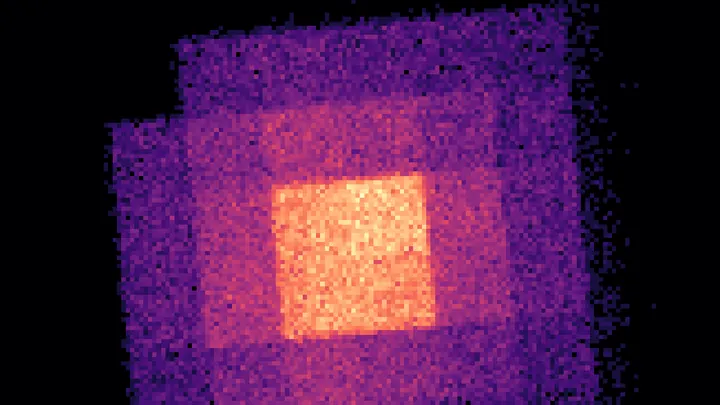
The XRISM X-ray telescope spent 170,000 seconds staring at the core of galaxy Cygnus A — one of the most powerful radio sources in the sky. At its center lurks a supermassive black hole that sucks in matter and heats it until it glows in X-rays. The instrument caught light from iron atoms that had lost electrons.
Energy Under the Microscope: Catching Millionths
A chamber the size of a small truck is filled with liquid argon at minus 186 degrees Celsius. When a particle flies in, it knocks electrons off argon atoms, and those electrons drift toward the walls, tracing a three-dimensional picture of the event.
Galaxies2026-08-082 minarXiv:2608.08094express
X-ray Signatures of Iron in Galaxy Clusters
The hot gas in galaxy clusters shines in X-rays, and a significant portion of that light comes from iron atoms that have lost many electrons. These atoms leave characteristic bright lines in the spectrum, like fingerprints. Astronomers use them to determine the temperature, density, and motion of the gas.