Tiny black holes that refuse to evaporate express
A sugar cube weighs about a gram. But a black hole that could hide inside such a cube would weigh as much as a small mountain — billions of tons. Yet even such tiny things, born in the first instants after the Big Bang, should have vanished long ago. They were consumed by their own radiation, like an ice cube on a scorching skillet, except instead of water, energy flew away.
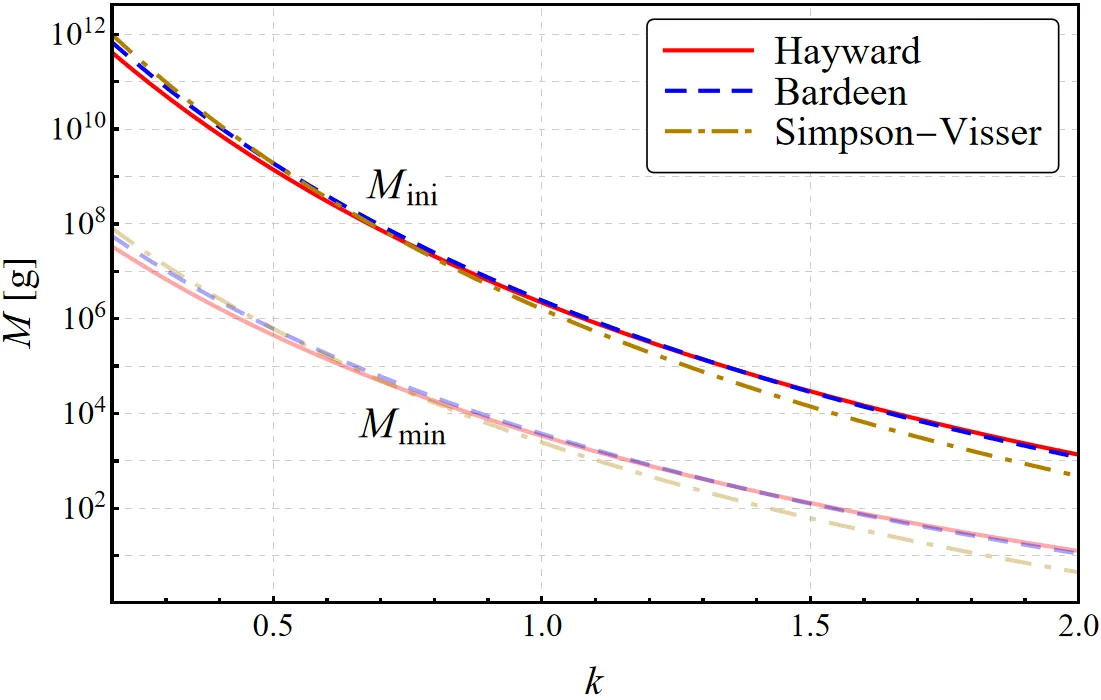
In a new study, physicists propose replacing the ordinary black hole with a 'regular' one — without an infinitely dense point at its center. Instead, there is a smooth, albeit extremely dense, core. Such a hole radiates more faintly and melts more slowly. And after losing half its mass, a 'memory effect' kicks in: the hole seems to freeze, holding on to its remnants. It resembles a person who loses things in a hurry but, noticing an almost empty pocket, starts to cherish every little item.
The authors tested three models of such 'smooth' holes. It turned out that holes with masses from one million to one hundred million tons (like a small cloud) could make up all of dark matter — the invisible substance that keeps galaxies from flying apart. And this does not violate calculations of nuclear reactions in the early universe.
So tiny, almost eternal clumps of space might be the very missing cement of the cosmos we have been seeking for half a century. And if they exist, their traces might still be trembling in the cosmic microwave background.
If a black hole with a mass of one million tons were compressed to the size of an atomic nucleus, its density would exceed that of a neutron star by trillions of times.
In Dan Simmons' novel 'Hyperion', there are 'time tombs' surrounded by anti-entropy fields — something akin to the memory effect that slows down disappearance.