Neutron Stars with a Secret 'Doughnut' Inside express
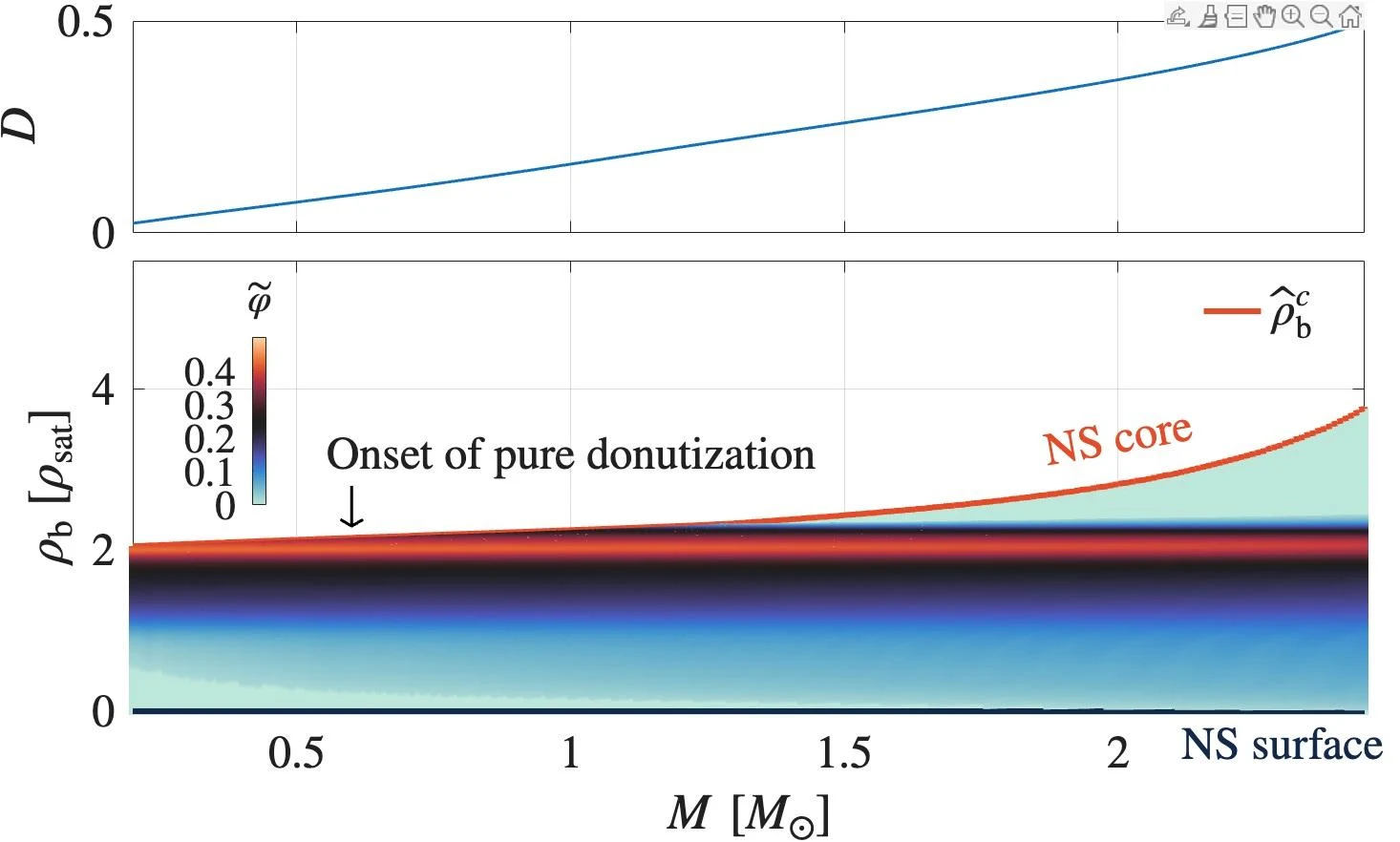
Neutron stars are super-dense spheres of the remnants of exploded stars. Some of them we see as pulsars — cosmic lighthouses sending out radio bursts. What's inside them long remained a mystery. Physicists assumed that hidden fields could affect their structure, but it was believed that if the field is short-range, its effect is negligible. A new calculation overturned this idea. It turned out the field doesn't spread evenly but gathers into a ring — a real invisible doughnut, enclosed in an intermediate layer. This 'filling' changes the internal pressure so that the neutron star mimics a quark star — an object where matter has fused into a quark soup. From the outside, in binary system observations, the impostor is unnoticed. But most astonishing: the same star can have two different masses simultaneously, like two states in one body. The discovery explains anomalies in neutron star sizes, and the mystery predicted by Fritz Zwicky and discovered by Jocelyn Bell Burnell has deepened further.
The 'doughnut' effect allows a neutron star to exist in two stable states with different masses at once, as if two different objects coexist in a single body.