Neutron stars are the collapsed cores of massive stars that exploded as supernovae. They pack more mass than the Sun into a sphere about the size of a city, making them the densest visible objects in the universe. Their interiors are not a simple soup of neutrons; instead, they are expected to contain a rich variety of exotic states of matter, from a solid crust of neutron-rich nuclei to a possible core of deconfined quarks. The structure is often described in layers, like an onion, with each layer governed by different physics.
History
Neutron stars were first proposed by Walter Baade and Fritz Zwicky in 1934, shortly after the discovery of the neutron. The idea that they might contain exotic states of matter, including quark matter, developed in the 1970s and 1980s as theoretical understanding of quantum chromodynamics advanced.
How it works
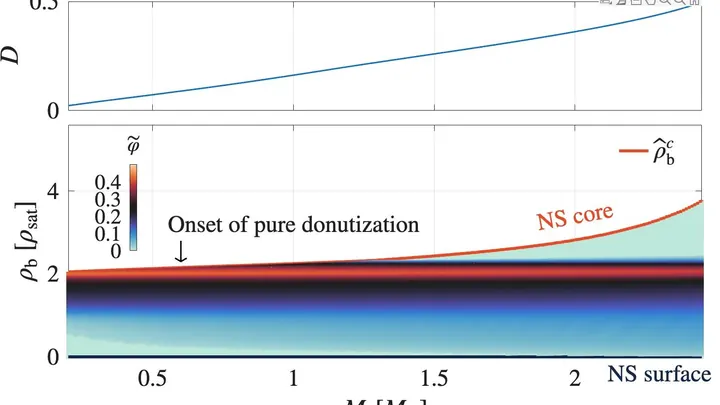
The immense gravitational pressure at the surface forces electrons and protons to combine into neutrons, creating a neutron-rich environment. Deeper inside, the pressure becomes so extreme that atomic nuclei are squeezed together into unusual shapes, forming what is called 'nuclear pasta' — structures resembling gnocchi, spaghetti, and lasagna. This pasta phase is thought to exist in the inner crust. At the very core, densities may be several times the nuclear saturation density, where neutrons might overlap completely and transition into a fluid of quarks or other exotic particles. The behavior of these layers, including superfluidity and superconductivity, affects how the star cools and how its rotation changes over time.
In practice
Studying neutron star interiors helps calibrate models of nuclear matter used in understanding heavy-ion collisions and the behavior of matter at extreme densities, which has applications in nuclear physics and astrophysics.
Fun fact
A teaspoon of neutron star material would weigh about a billion tons on Earth.
The atomic nucleus is usually pictured as a dense ball where protons and neutrons are mixed together. But in some isotopes, neutrons can stick out far beyond this ball, forming a diffuse shell — a neutron halo. This is especially common in nuclei with many more neutrons than protons.
A massive star exhausts its fuel, and its core collapses in a fraction of a second. A supernova is born, along with a brief but powerful shower of neutrinos. These particles barely interact with matter, so they fly away freely, carrying information about the catastrophe.
For thirteen billion years, light battled through cosmic emptiness. It bent around massive galaxy clusters that, as Einstein predicted, acted as giant lenses — amplifying and distorting the distant glow. In 2023, the NIRSpec instrument on the James Webb Space Telescope captured this light and spread it into spectra.
In nuclear physics, the belief long reigned that two neutrons cannot form a bound state — they attract too weakly and immediately fly apart. However, on the surface of neutron-rich nuclei, where the matter density drops to a thousandth of normal nuclear density, the situation changes dramatically.
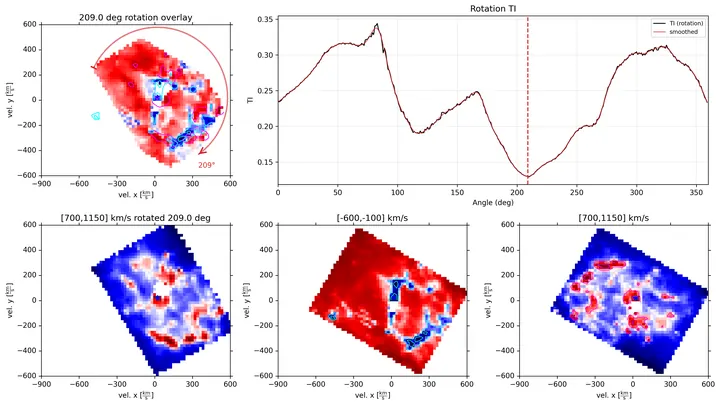
The James Webb Space Telescope JWST has peered into the heart of supernova remnant SNR 0540-69.3 — what remains after a massive star died in a neighboring galaxy. Inside, amid the flying debris, astronomers saw a clear pattern: glowing clumps and voids arranged in a symmetric design.
A hot infant and a cold adult — the same neutron star looks different. Just born in a supernova explosion, it is scorching hot at tens of billions of degrees. But as time passes, it cools, contracting like cooling metal. For the star PSR J1012+5307, this transition means an almost twofold reduction in radius.
Previously, Uranus and Neptune were considered ice giants because of assumed thick layers of frozen water, methane, and ammonia. New calculations paint a different picture: deep inside them hides an ocean of hot magma, which under immense pressure has absorbed a colossal amount of hydrogen.
Neutron stars are super-dense spheres of the remnants of exploded stars. Some of them we see as pulsars — cosmic lighthouses sending out radio bursts. What's inside them long remained a mystery. Physicists assumed that hidden fields could affect their structure, but it was believed that if the field is short-range, its effect is negligible.
A pot of boiling porridge, where instead of grains there are layers of oxygen and silicon, and the fire beneath is about to go out, and the star will collapse in on itself. Until now, astrophysicist cooks have used a simplified recipe: they assumed that bubbles and eddies in the porridge obey one and the same average temperature throughout the depth.
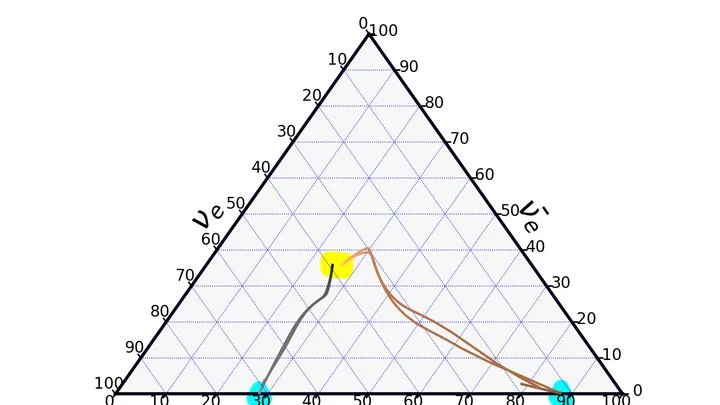
A pot of soup simmering with three ingredients. The chef adjusts the proportions on the fly, and the progress is tracked by the position of a point on a triangular scale. That's roughly how physicists tackle neutrinos from a supernova explosion.
Deep inside a massive star, before it explodes, layers sit on top of each other like the layers of an onion. Sometimes two adjacent layers, the carbon and oxygen layers, mix together. It's like how layers of broth and vegetables in a pot of soup blend when you stir them with a spoon.
A neutron star is the dead core of a star that once exploded, compressed to the size of a city. If a normal star is nearby, the neutron star siphons matter from it like a vacuum cleaner. This matter falls onto the surface and forms a crust — a solid layer of neutron-rich atomic nuclei.
Neutrinos are tiny particles that barely interact with matter. They pass straight through a star like bullets through fog. When a massive star is gearing up to explode, its core contracts, temperatures soar, and neutrinos start streaming out.
Long before that, Fritz Zwicky predicted that a supernova explosion gives birth to a tiny neutron star. Years later, Jocelyn Bell Burnell caught its pulses, discovering pulsars.