Nuclear shell structure refers to the arrangement of protons and neutrons into discrete energy levels within the atomic nucleus, analogous to electron shells in atoms. When a shell is completely filled with a certain 'magic number' of nucleons (2, 8, 20, 28, 50, 82, 126), the nucleus becomes exceptionally stable. This stability manifests as higher binding energy per nucleon, longer half-lives, and a higher abundance of such isotopes in nature. The shell model explains why certain nuclei are more stable than others and predicts the properties of exotic, short-lived nuclei far from stability.
History
The nuclear shell model was developed independently by Maria Goeppert Mayer and Hans Jensen in 1949, who shared the Nobel Prize in Physics in 1963 for this work. Their key insight was the strong spin-orbit coupling that correctly predicted the magic numbers.
How it works
The nuclear shell model treats each nucleon as moving independently in a mean potential created by all other nucleons. Adding a spin-orbit coupling term to the potential splits the energy levels and reproduces the observed magic numbers. Nucleons fill the lowest available energy levels according to the Pauli exclusion principle. When a shell is closed, the nucleus has a spherical shape and is resistant to deformation, making it harder to add or remove nucleons. This leads to the 'islands of stability' predicted for superheavy elements, where closed shells are expected to confer extra stability.
In practice
The shell model is essential for predicting the stability and decay modes of isotopes used in nuclear medicine, for understanding nucleosynthesis in stars, and for guiding the search for new superheavy elements in accelerator experiments.
Fun fact
The magic number 126 is thought to be the next 'island of stability' for superheavy elements, and researchers are actively trying to synthesize nuclei with that many neutrons to test the shell model's predictions.
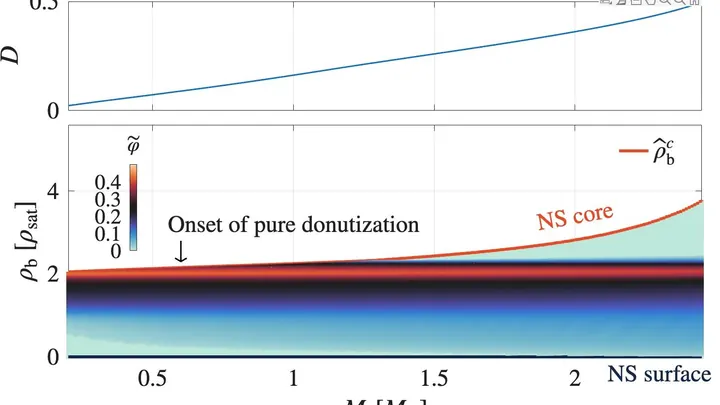
A neutron star is what remains after a massive star explodes. Its matter is compressed so tightly that a teaspoonful would weigh billions of tons. Under such conditions, protons and neutrons can rearrange, and new particles (hyperons, similar to neutrons but containing a 'strange' quark) can appear.
The atomic nucleus is not a bag of marbles but an ordered structure where protons and neutrons fill shells, much like electrons in an atom. When a shell is filled, the nucleus becomes especially stable, and the number of particles is called magic. For calcium with 20 protons, the classic magic neutron numbers are 20 and 28.
In nuclear physics, a puzzle has long been nagging: why among elements lighter than bismuth, only technetium (No. 43) and promethium (No. 61) have no stable isotope at all? All their neighbors in the periodic table can boast at least one long-lived variant, but these two seem to fall out of the general pattern.
A solid under a microscope is not a monolith at all. In glass, polymer, or solidified resin, atoms are arranged randomly, and as a result, the material's properties vary from point to point. On large scales, we are used to describing them with smooth fields, like temperature or pressure in a room. But when you zoom down to a few atomic layers, that smoothness disappears.
At the center of every atom lies a nucleus — a dense ball of protons and neutrons. These particles don't just crowd together randomly; they fill strict energy levels, much like floors in a skyscraper. When a floor is completely filled, the nucleus becomes especially stable — physicists call this a magic number.
The atomic nucleus is not just a jumble of protons and neutrons. The particles inside arrange themselves in layers, like spectators in a stadium: the lower rows are filled, and each new proton or neutron looks for a spot on a higher tier. When a row is completely filled, the nucleus becomes especially stable — physicists call this a magic number.
Two pendulums on a shared string trade motion: push one, and the second starts swinging, and a moment later the first gets a push back. In a thorium-229 atom, energy flows nearly loss-free between the electron shell and the nucleus.
In nuclear physics, the belief long reigned that two neutrons cannot form a bound state — they attract too weakly and immediately fly apart. However, on the surface of neutron-rich nuclei, where the matter density drops to a thousandth of normal nuclear density, the situation changes dramatically.
Neutron stars are super-dense spheres of the remnants of exploded stars. Some of them we see as pulsars — cosmic lighthouses sending out radio bursts. What's inside them long remained a mystery. Physicists assumed that hidden fields could affect their structure, but it was believed that if the field is short-range, its effect is negligible.
A pot of boiling porridge, where instead of grains there are layers of oxygen and silicon, and the fire beneath is about to go out, and the star will collapse in on itself. Until now, astrophysicist cooks have used a simplified recipe: they assumed that bubbles and eddies in the porridge obey one and the same average temperature throughout the depth.
In the standard picture, black holes are the undisputed density champions: all their matter is squeezed into a single point. Imagine the entire mass of Mount Everest packed into a grain of salt. But physicists have found a theoretical trick.
An ordinary atomic nucleus is like a tight ball: protons and neutrons are packed closely together. But some light nuclei, such as helium-6, are different. Two neutrons seem to step aside and form a dilute cloud around the nucleus — called a halo.
A handful of modeling clay with one ball stuck far off to the side becomes loose and stretched out. That's roughly how the beryllium-11 nucleus is built: a single neutron dangles at the periphery, forming a "halo" around the dense core.
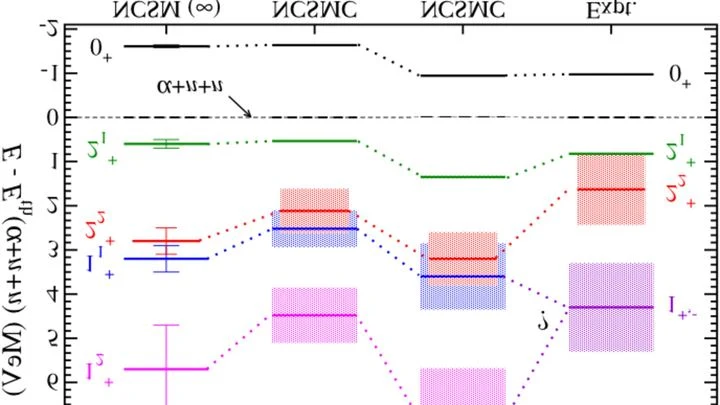
Physicists used a new method to bypass mathematical hurdles and precisely calculate the shape of this nucleus.
Long before that, Fritz Zwicky predicted that a supernova explosion gives birth to a tiny neutron star. Years later, Jocelyn Bell Burnell caught its pulses, discovering pulsars.
An atomic nucleus usually has a well-defined shape — elongated like a melon or flattened like a pumpkin. But silicon-30 behaves differently: it seems unable to make up its mind.