Solar Flare: The Boiling Starts Before the Stove Is Turned On
In a pot on the stove, water starts to churn from the bottom long before the whole thing boils. Bubbles of steam rise from the base even though the burner itself hasn't heated up yet.
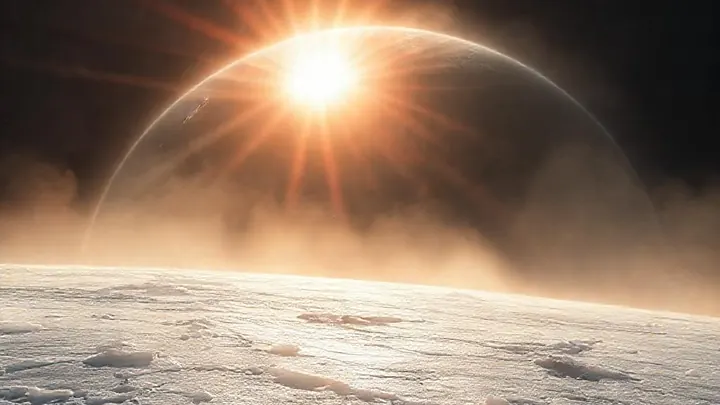
The visible surface layer of the Sun from which most light is emitted.The photosphere is the visible surface of the Sun, the layer from which most sunlight escapes into space. It is not a solid surface but a thin shell of plasma, about 500 kilometers thick, where the Sun becomes transparent to visible light. This is the region we see when we look at the Sun, marked by sunspots, granulation, and other surface features.
The term 'photosphere' was coined in the 19th century as astronomers began to understand the Sun's structure. Early telescopic observations by Galileo and others revealed sunspots on this layer, but its physical nature was clarified only with the development of spectroscopy.
Below the photosphere, the Sun is opaque because plasma absorbs and re-emits photons. At the photosphere, the density drops enough that photons can finally stream freely outward. The temperature here is about 5,500°C, and the layer emits a continuous spectrum that defines the Sun's color and brightness.
The photosphere is the primary target for solar telescopes, which study its magnetic fields, sunspots, and granulation to predict space weather and understand stellar activity.
The photosphere is so thin compared to the Sun's radius that if the Sun were the size of Earth, the photosphere would be thinner than a sheet of paper.