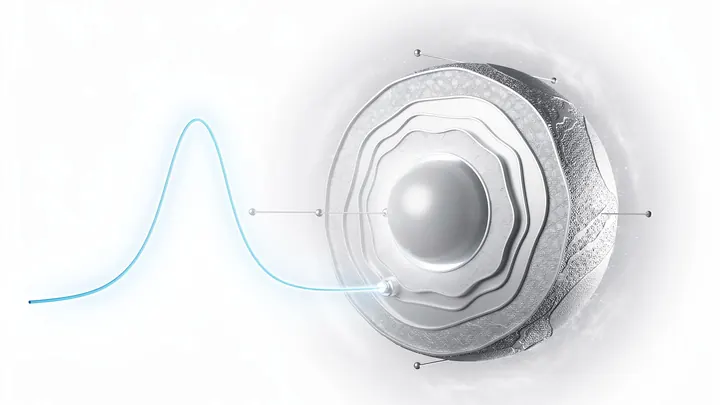
A colloquial term for a state of matter where quarks are not confined within hadrons, as in a quark-gluon plasma. This is an extreme state of matter that existed in the early universe just after the Big Bang, and can be recreated in particle accelerators by colliding heavy ions at relativistic speeds. In this state, quarks and gluons move freely over distances larger than the size of a proton.
History
The concept of quark-gluon plasma was proposed in the 1970s, and first experimental evidence was obtained at CERN in 2000, followed by more detailed studies at RHIC and the LHC.
How it works
Under normal conditions, quarks are permanently bound inside protons and neutrons by the strong nuclear force. At temperatures exceeding about 2 trillion kelvin, the energy density becomes so high that the confinement breaks down, and quarks and gluons form a plasma. This transition is analogous to how ice melts into liquid water, but for the fundamental constituents of matter.
In practice
Studying quark-gluon plasma helps physicists understand the strong force and the early evolution of the universe, and it is a key research area at particle accelerators.
Fun fact
The temperature of quark-gluon plasma created at the LHC reaches about 5.5 trillion kelvin, making it the hottest matter ever created in a laboratory.
At the heart of a dying star, as its core collapses into a neutron sphere, an invisible storm is born. Trillions of neutrinos, particles that barely interact with matter, race through the scorching plasma. There are so many of them that they begin to influence each other, changing their 'flavors' (electron, muon, tau) like chameleons.
An old factory where instead of machines there are atomic nuclei, and neutrino radiation seethes all around. When a massive star exhausts its fuel, its core compresses a hundredfold, and the temperature skyrockets to billions of degrees.
In accelerators like the Large Hadron Collider, heavy nuclei collide at enormous speeds. For an instant, quark-gluon plasma (QGP) is born — a state of matter where quarks and gluons float freely, just like in the first microseconds after the birth of the universe.
This plasma is not just hot.
In the conventional Heisenberg picture, spins at low temperatures are supposed to line up in a strict pattern. But there are crystals — like pyrochlore — where geometry has its own way. Each ion sits at a vertex of a tetrahedron, and the main interaction enforces a rule: two spins point inward, two outward.
In the quantum world, particles can merge into a single liquid that flows without friction. One of its most mysterious forms is the fractional quantum Hall liquid. In it, electrons or atoms move as a single vortex, and their charge splits into fractions, like a pie cut into perfectly equal slices.
When a massive star runs out of fuel, its core collapses under its own weight. A black hole forms — a region where gravity is so strong that even light can't escape. For a long time, it was thought that a point of infinite density, a singularity, lurks at the very center.
The core of a neutron star can be likened to a taut string of super-nuclear density. Sound traveling along it is the oscillation of pressure, whose speed $$c_s$$ betrays the stiffness of matter. New research shows that this cosmic string does not hum monotonically.
The proton is not a solid ball but a seething cloud of quarks and gluons. Each particle carries its own bit of rotation, but if you add up all the bits, you don't get the full proton spin. Part of the rotation seems to hide in the cloud's slowest inhabitants: those carrying only a tiny share of the total motion.
A laser strikes a target, and a cloud of plasma, accelerated to hundreds of kilometers per second, shoots into the chamber. The chamber isn't empty: it's filled with a tenuous gas that plays the role of the cosmic medium. The plasma slams into this gas like a speedboat hitting still water, shoving it aside.