How a Particle Vanishes in Hot Matter express
An ice cube in hot tea melts strictly at zero degrees. But what if the ice is made of subatomic particles and the tea is scorching nuclear matter? The authors studied the rho meson, a particle made of a quark and an antiquark that lives for just 4×10⁻²⁴ seconds, and searched for its 'melting temperature'.
It turns out that the rho meson disappears later the stronger its quarks hold on to each other. This strength is measured by the decay constant — a number that shows how easily the meson turns into photons. The larger the constant, the stronger the bond and the higher the temperature at which the meson ceases to be whole. For the ground state of the rho meson, this temperature is about 1.8 trillion degrees (157 MeV in physicists' units).
For excited states, when quarks oscillate more strongly, the effect almost disappears. This is like a string: a tightly stretched one breaks at a strictly defined force, while a loose one breaks under almost any force. The scientists applied an isospectral transformation — a clever mathematical trick that changes the decay constant without touching particle masses. This tuned the model to the experimental value and predicted that the transition from ordinary matter to plasma is smooth, like melting butter, not ice.
The work is important for understanding the first moments after the big bang, when the entire universe was quark-gluon plasma. Today, such plasma is created in accelerators by colliding lead or gold nuclei, and we observe mesons being born and dying in it. By controlling their 'melting temperature,' we better understand how the early universe cooled and why we are made of protons and neutrons rather than free quarks.
Original abstract
as written by the authors arXiv:2605.31280
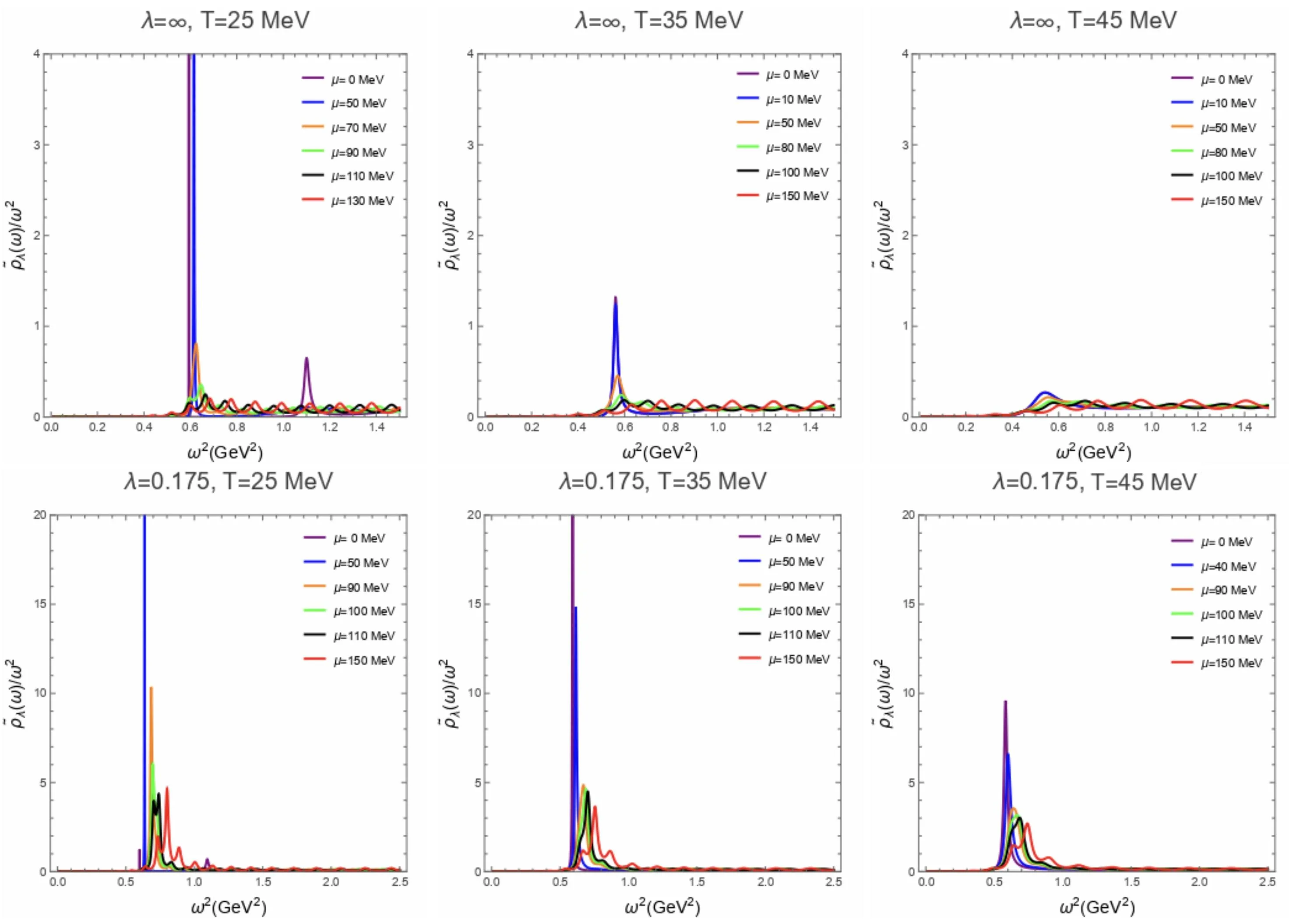
We study the thermal behavior of the $$\rho$$ meson using the isospectral family of the softwall AdS/QCD model. By computing spectral functions at finite temperature and chemical potential for different members of this family, we isolate the effect of the ground-state electromagnetic decay constant $$f_1$$ on the melting temperature $$T_m$$ of the $$\rho(770)$$ meson. A clear monotonic increase of $$T_m$$ with $$f_1$$ is found, supporting the interpretation of $$f_1$$ as a key scale controlling quarkonium dissociation. For excited states, the same qualitative trend appears but is strongly suppressed as the radial quantum number increases. Using the isospectral parameter to fix $$f_1$$ to its experimental value ($$226$$ MeV) yields a holographic model whose spectral function gives a melting temperature $$T_m = 157$$ MeV and a smooth crossover from confinement to deconfinement. The thermal mass shows a mild decrease near the critical point, while the width grows monotonically. Our results demonstrate that the isospectral transformation provides a controlled way to adjust ground-state decay constants without altering the mass spectrum, enabling precise studies of medium effects on vector mesons.
The melting temperature of the rho meson is about 100,000 times higher than the temperature at the center of the Sun, but in earthly experiments it is reached for tiny fractions of a second.
In Dan Simmons' novel 'Hyperion', 'quark plasma' is mentioned as a weapon capable of dissolving any matter.