The zeroth law of thermodynamics states that if two systems are each in thermal equilibrium with a third, they are in thermal equilibrium with each other.
Thermodynamics begins with the zeroth law because it was recognized later than the first and second, but turned out to be more fundamental. It was formulated by Ralph Fowler in 1931. The essence: thermal equilibrium is transitive. If coffee in a thermos and the air in the room have the same temperature, and the air in the room has the same as a book on the shelf, then the coffee and the book also 'agree' on temperature.
History
Although the idea of temperature is as ancient as observations of cooling, the formalization of the law occurred in the 20th century. Ralph Fowler in 1931, while discussing the principles of statistical mechanics, called this postulate 'zeroth' because it logically precedes the first and second laws, formulated earlier. The term quickly caught on.
How it works
The law underlies all thermometry and calorimetry. Without it, the concept of temperature would be undefined. Limits of applicability: the law holds for macroscopic systems in equilibrium. In non-equilibrium processes, for nanoscale objects, or in strong gravitational fields, refinements may be needed.
In practice
A thermometer works precisely because it reaches equilibrium with the object being measured, and we read the common temperature.
Fun fact
Thermometers appeared long before formal thermodynamics. Galileo created a thermoscope as early as 1593, not knowing that it embodied the zeroth law.
A thin film of neodymium nickelate, fifteen nanometers thick, sits on a neodymium gallate substrate. Below one hundred eighty kelvin it behaves as an insulator: electrons are locked inside their atomic cells and cannot move freely.
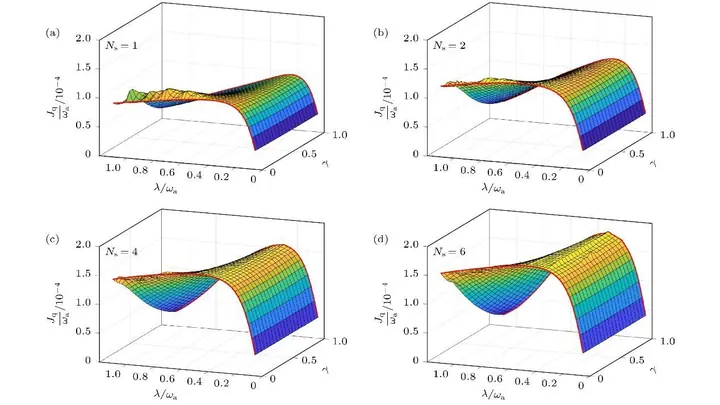
Inside an ultracold chamber, two atomic clouds collide: a few dozen cesium atoms acting as the working fluid, and thousands of rubidium atoms serving as the heat reservoir.
Graphene, a sheet of carbon just one atom thick, can change its magnetic properties the way water changes shape: sometimes flowing, sometimes freezing into ice. In a new study, physicists peered inside this process for the first time using a sensor the size of a needle tip.
Drop a pebble into a pond, and ripples spread across the water. In much the same way, any body, even the tiniest, perturbs the gravitational field around it. In empty, cold space, these perturbations, like ripples on a calm surface, make two nearby objects always repel each other.
In the quantum world, a fact becomes objective when its value is imprinted on many independent fragments of the environment, like a notice posted on hundreds of bulletin boards across the city. Each copy alone adds no new information, but it changes the rules of the game for anyone trying to erase that information.
It all started with stretching. In the first fractions of a second, the universe ballooned — physicists call this inflation. Then the rapid expansion gave way to a phase where the field's energy converted into ordinary particles.
In a crystal, heat travels on waves. Atoms vibrate, and these vibrations, called phonons, carry energy from the hot edge to the cold one. For a long time, it was believed that if phonons hit resonance (their frequencies exactly match) and can exchange energy, heat would flow like an avalanche. It turns out that's not the case.
The Kerr-NUT black hole is not just a cosmic vacuum cleaner. It's a solution to Einstein's equations where the hole has mass, rotation, and a strange NUT parameter. This parameter behaves like a magnetic charge for gravity: seemingly invisible, yet it alters the properties of surrounding space.
A pot of boiling water is covered with two lids — an inner and an outer one. The thermometer under each shows its own temperature, but their harmonic mean (a special averaging method where you add the reciprocals) always remains unchanged. Heat seems to obey an invisible rule.
In a glass of water, oil gathers into droplets: that's equilibrium separation dictated by chemistry. But there are systems where order arises not from rest but from a constant flow of energy.
At the centers of many galaxies lurk supermassive black holes. One of them, Sagittarius A* at the heart of the Milky Way, has become a testing ground for a new idea. The authors of the work took Einsteinian gravity and added an unusual electromagnetic field to it.
Textbooks divide particles into two camps: bosons love to crowd into the same state, fermions absolutely refuse. But nature allows a third option. Anyons are quasiparticles whose behavior lies somewhere in between. They can 'remember' how they were exchanged and obey a nonstandard exclusion principle.
Our universe isn't just expanding: it's doing so faster and faster. It's like raisin bread dough in the oven: the raisins move apart, and the farther they've already separated, the faster they continue to recede. The strange force pushing the cosmos apart is called dark energy. Most scientists think it's constant, like a permanent spring built into the very fabric of space.
Tea in a cup cools quietly on the table. But if you zoom past at near-light speed, the thermometer will read higher — even though no one heated the tea. Calculations confirm: the needle will creep up.
A century ago, physicists split into three camps.
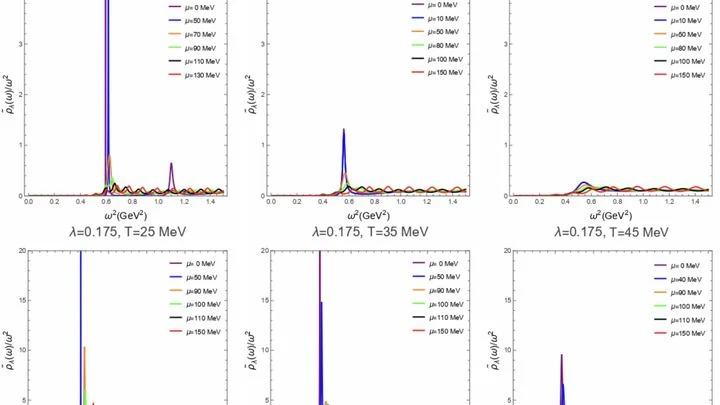
An ice cube in hot tea melts strictly at zero degrees. But what if the ice is made of subatomic particles and the tea is scorching nuclear matter? The authors studied the rho meson, a particle made of a quark and an antiquark that lives for just 4×10⁻²⁴ seconds, and searched for its 'melting temperature'.
If you stick two identical thermometers into a pot of hot water, they'll both read the same, and we relax, thinking the temperature is measured correctly. But in a rarefied gas heated to millions of degrees, this trick stops working.
Physicists have mastered an elegant mathematical trick that lets them translate gravitational equations into the language of electricity. This method — double copy — works like a kind of dictionary: it replaces the complex geometry of curved spacetime, described by high-dimensional tensor fields, with the simpler rules of…
A pot of soup forgotten on the stove cools to room temperature. It seems everything has come to rest. But if you look inside with a quantum magnifying glass, you'll find that water molecules haven't frozen: they continue their dance. It's just that now the dance is steady, not turbulent like when boiling.
Since time immemorial, physicists have dreamed of tunnels piercing the cosmos — wormholes, capable of connecting far-flung corners of the Universe in an instant.
A pot of water on the stove eventually settles down: the temperature evens out, the liquid stops boiling. Physicists call this thermal equilibrium — a state where energy is distributed in the most probable way.
On the surface of a tiny sphere live two invisible fields, like two kinds of ripples on a soap bubble. These fields don't just oscillate on their own: they constantly influence each other, like musicians playing in unison. In a new study, physicists derived exact equations that describe how this ripple changes over time, heats up, and descends into chaos.
A stone falls into a pond, and ripples spread across the water. Similarly, a black hole resting in the void may encounter a gravitational wave or a cloud of gas. It does not remain indifferent: its surface (the event horizon) bends slightly, like a stretched membrane under the weight of a drop.
Water can be ice, liquid, or steam. Physicists call these states phases. In theory, each phase has its own measure — a way to describe how likely it is. But not every measure you can imagine occurs in nature. Some phases are real, while others are just mathematical illusions.
Scientists have found a simple criterion that separates reality from mirage.
A quantum system can possess a property called magic. It's not about tricks: it's a measure of how hard it is to reproduce its behavior on a classical computer. Ordinary states, known as stabilizer states, are easy for a computer to handle. But states with magic leave it stumped.
Light and atoms, like dancers, can move in sync or out of step. When their interaction is anisotropic (that is, direction-dependent) the dance gets trickier. In a new study, physicists considered a model where many atoms (qubits) collectively interact with an anisotropic light field, and each component is connected to a thermal reservoir.
According to ordinary mechanics, an electron in an atom should spiral into the nucleus and crash into it, like a surfer losing speed and falling off the board. But atoms live for billions of years. Because space isn’t empty. Even in absolute vacuum, an invisible electromagnetic sea ripples — the zero-point field. Its waves continuously nudge the electron.
A hot chain of atoms lined up in a row behaves like a tiny black hole. Such a chain is a series of particles, each resembling a tiny magnet. At normal temperatures, the little magnets flip randomly, but when cooled, they align in a uniform order. Physicists have discovered that when heated, this simple system reproduces the strange properties of black holes.
Water in a pot, when heated, doesn't boil: it turns into ice. That's roughly how ultracold atoms behave in an optical lattice — a light-based crystalline grid that holds atoms in place. Scientists simulated this system on a computer to understand how order changes as temperature rises.
In the 19th century, James Clerk Maxwell imagined a tiny demon. It knows the speed of every gas molecule and opens a door: fast ones to the left, slow ones to the right. This creates a temperature difference without expending energy, seemingly violating the laws of physics.
A hot coffee cools by radiating invisible light. To maintain temperature, it must receive exactly as much light back. This silent trade of photons is what we feel as steady warmth.
Tiny particles that look like flowers can do two things at once: heat up and tell you how hot they are. This isn't science fiction: it's the result of working with nanoparticles made of cobalt ferrite, a magnetic material that responds to magnetic fields.
Quantum devices usually live inside cryostats — giant thermoses where temperatures are colder than deep space. An erbium ion trapped in a tiny well on a silicon chip breaks that mold.
An ice core from Antarctica is a time machine that recorded the climate for 130,000 years straight, year after year, with no gaps. Air bubbles trapped in the ice preserve the carbon dioxide of those ancient eras.
The usual way to freeze a living cell is like trying to put a spacesuit on it: you first need to get a protective substance inside, but while it's crossing the membrane, the cell can burst from salt imbalances or get poisoned by the chemicals.
Water in a glass cools, ice melts, and a kettle heats the stove: that's how the world works: heat always flows from hot to cold. This is the second law of thermodynamics, a law that has never been broken.
Water always flows downhill, and heat from hot to cold. That's what энтропия dictates. But the quantum world finds loopholes.
Physicists made light particles interact with hot and cold environments in an uncertain sequence — like a flipped coin that hasn't landed yet.
Ordinary light scatters in all directions, but physicists turned it into something like a conveyor belt — a one-way stream that doesn't turn back. To do this, they sent two counter-propagating beams through a cloud of Rydberg atoms, bloated to the size of a tiny dust speck.
Quantum entanglement is a fragile resource. Heat a system, and thermal fluctuations will tear the delicate threads of correlations: at a sufficiently high but finite temperature, the Gibbs state of a local Hamiltonian becomes separable, that is, representable as a probabilistic mixture of products of local states.
Two telescopes look at the same Universe and see different expansion rates. Local measurements from supernovae give 73.04 ± 1.04 km/s/Mpc, while cosmic microwave background data within the standard model predict 67.36 ± 0.54.