An antiquark is the antimatter counterpart of a quark, carrying the same mass but opposite charge and other quantum numbers. For every quark flavor (up, down, charm, strange, top, bottom), there exists a corresponding antiquark with opposite electric charge and opposite color charge. Antiquarks are fundamental constituents of antimatter particles, such as antiprotons and antineutrons.
History
The concept of antiquarks emerged from the development of the quark model in the 1960s, with Murray Gell-Mann and George Zweig independently proposing quarks in 1964. The existence of antiquarks was confirmed experimentally shortly thereafter through deep inelastic scattering experiments.
How it works
In particle physics, quarks and antiquarks bind together via the strong force to form hadrons. A meson consists of one quark and one antiquark, while a baryon contains three quarks and an antibaryon contains three antiquarks. When a quark and an antiquark meet, they annihilate, converting their mass into energy, typically producing photons or other particles.
In practice
Antiquarks are studied in high-energy particle accelerators, such as the Large Hadron Collider, to probe the structure of matter and test the Standard Model of particle physics.
Fun fact
Protons contain a sea of virtual antiquarks that constantly fluctuate in and out of existence, contributing to their internal structure.
Stated relations:opposite to →quark · part of →hadron
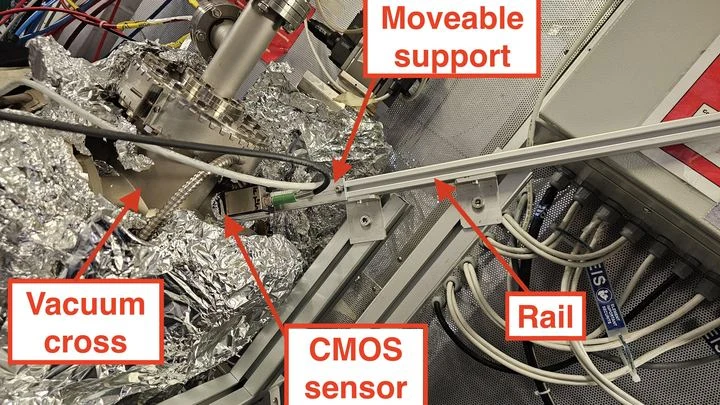
The antiproton beam hits the plate, and each impact bursts into a shower of charged particles. In the GBAR experiment at CERN, this picture is captured not by a sophisticated detector but by an ordinary industrial camera without a lens, pressed against the vacuum window from the outside.
The antiproton is the mirror twin of the proton: same mass, but negative charge. When it hits matter, it usually annihilates instantly — disappearing in a burst of energy upon colliding with an atomic nucleus.
In the first moments after the Big Bang, matter and antimatter should have been created in equal amounts. But today, everything around us is ordinary matter, and antimatter is almost nowhere to be found. Where did it all go? The standard answer: a tiny imbalance in favor of matter wiped out almost all antimatter.
In the first moments after the Big Bang, the universe was a searing 'soup' of particles. As it cooled, phase transitions occurred — much like water turning to ice. At one such moment, magnetic monopoles of dark matter could have been born: tiny clumps of field with a single magnetic pole.
Two teams pull a rope with equal force in opposite directions — the rope doesn't move, and the net force is zero. That's how many antiferromagnets behave: the magnetic moments of atoms are aligned oppositely and cancel each other out.
Light falling into a black hole carries information — for instance, the path a photon took. The horizon (the surface from which nothing returns) responds by changing its entropy — a measure of disorder, akin to the number of shuffled pages in a book.
A giant tank of ultrapure water sits deep underground in Japan. Its walls are lined with thousands of light-sensitive sensors that catch faint flashes — the traces of ghostly particles passing through the water.
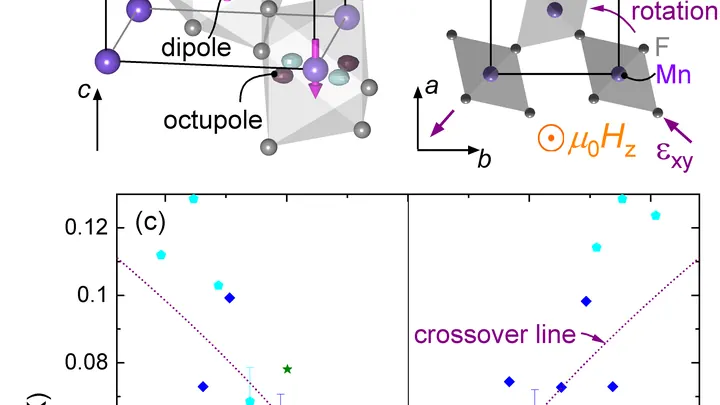
In a manganese fluoride crystal, atoms are lined up like soldiers in formation. But within this formation lies a hidden pattern: the magnetic moments of the atoms point in opposite directions, and the pattern itself changes when the crystal is rotated.
Two metal plates in a perfect vacuum attract each other. Even Richard Feynman compared emptiness to a boiling foam: particle pairs are born and immediately vanish, creating the Casimir effect. If the plates are asymmetric, they also start to twist — that's a vacuum motor.
But rotation doesn't require oddly shaped parts.
We’re used to time flowing only forward. But quantum laws let it become like a coin showing heads and tails at once.
Take a particle with its own spin — its intrinsic rotation. In a magnetic field, it spins like a top. Send this particle through a device where two opposing magnetic flows fight each other — and it will start moving into the future and the past at the same time.
In a dark laboratory where superconducting chips are cooled to thousandths of a kelvin, a qubit spins under the influence of a magnetic field. A regular qubit rotates in one direction. An antiqubit, its mirror twin, rotates in the opposite direction. Together they form a pair that senses the field twice as sharply as any ordinary pair.
Two vessels of water at different temperatures are separated by a thin partition. As long as the partition is intact, each vessel lives its own life: in one, the water is hot; in the other, it's icy. But once the partition is removed, the temperatures begin to equalize, and eventually both vessels reach the same state.