Nuclear matter is the theoretical concept of matter in its most basic, nucleonic form — a uniform, infinite fluid of protons and neutrons (collectively, nucleons) interacting via the strong force, without the complications of atomic structure or electromagnetic fields. In reality, this idealized state is approached in the cores of atomic nuclei and, more dramatically, in the interior of neutron stars, where densities reach several times that of an ordinary atomic nucleus. Understanding nuclear matter is central to nuclear physics and astrophysics: it determines the masses and radii of neutron stars, the dynamics of supernova explosions, and the synthesis of heavy elements in stellar environments.
History
The concept emerged in the 1930s with the discovery of the neutron and the realization that nuclei behave like dense drops of a quantum liquid. The term 'nuclear matter' was formalized in the 1950s by Keith Brueckner and others, who developed the Brueckner theory of nuclear many-body systems.
How it works
At its core, nuclear matter is governed by the strong nuclear force, which binds nucleons together at short distances (about 1 femtometer) but becomes repulsive at even shorter ranges, preventing collapse. The key property is the equation of state — the relationship between pressure, density, and energy — which is extremely difficult to derive from first principles because the strong force is non-perturbative. Instead, physicists model it using effective interactions, many-body theories, or lattice QCD, and constrain these models by comparing predictions to observations of neutron star masses, radii, and cooling rates, as well as laboratory experiments with heavy-ion collisions.
In practice
Nuclear matter models are essential for interpreting gravitational-wave signals from neutron star mergers (like GW170817) and for designing experiments at heavy-ion colliders such as the Relativistic Heavy Ion Collider (RHIC) and the Large Hadron Collider (LHC), where nuclear matter is created and studied in the lab.
Fun fact
At the densities found in neutron starcores, nuclear matter may transition into exotic phases like quark matter, where individual nucleons dissolve into a sea of free quarks.
A neutron star is what remains after a massive star explodes. Its matter is compressed so tightly that a teaspoonful would weigh billions of tons. Under such conditions, protons and neutrons can rearrange, and new particles (hyperons, similar to neutrons but containing a 'strange' quark) can appear.
An interpreter gets distracted by every rustle in the hall, and a one-hour meeting stretches into two. A neutron star compresses a solar mass into a sphere the size of a city, and the matter in its core is denser than an atomic nucleus. Physicists cannot probe its structure in the lab: the required pressures are unattainable.
A white dwarf is the former core of a star like the Sun, squeezed down to the size of Earth. A teaspoon of its material would weigh several tons. A neutron star is an even denser remnant: a city the size of Manhattan, but with more mass than the Sun.
A cosmic "caliper" will soon measure a neutron star to within a hundred meters. For an object a couple dozen kilometers across, that's like measuring the thickness of a human hair from a kilometer away.
A neutron star is the remnant of an exploded supernova.
Water in a glass looks continuous, but it's made of molecules. Similarly, physicists have long described the matter inside a neutron star as a uniform soup of protons and neutrons. But real neutron stars are not soup. They are a dense crowd of particles where each neutron feels its neighbors.
The authors of the new work abandoned the uniform picture.
A handful of sand in your fist: the grains press against each other, and your hand can't squeeze any further. Ordinary matter behaves similarly. But in a neutron star, compression is billions of times stronger — atoms are crushed, electrons are squeezed into protons, and nearly all space is filled with neutrons.
A heaping teaspoon, and the scale reads a billion tons. That's roughly what a teaspoon of neutron star matter would weigh if you could scoop it up and put it on a scale. Such objects are born after a supernova explosion: the star's core collapses into a sphere the size of a city, and the density exceeds that of an atomic nucleus.
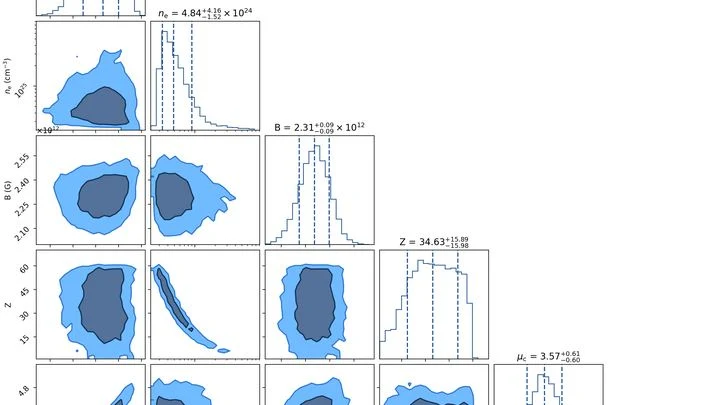
The interiors of neutron stars are a realm of degenerate matter. Here, protons condense into a superconducting condensate, threaded by quantum vortices. Imagine tiny magnetic tops: each carries a quantum of magnetic flux and glides through the electron fluid.
An atomic nucleus is not just a ball of protons and neutrons. It has a shape, and that shape can change. The tin-116 nucleus was long considered almost perfectly spherical: it has 50 protons — a 'magic' number that usually gives a nucleus spherical symmetry. But a new ultra-precise measurement showed otherwise.
Neutron stars — remnants of supernovae — are among the densest objects in the Universe. Their central density exceeds nuclear density many times over, and gravity is surpassed only by black holes.
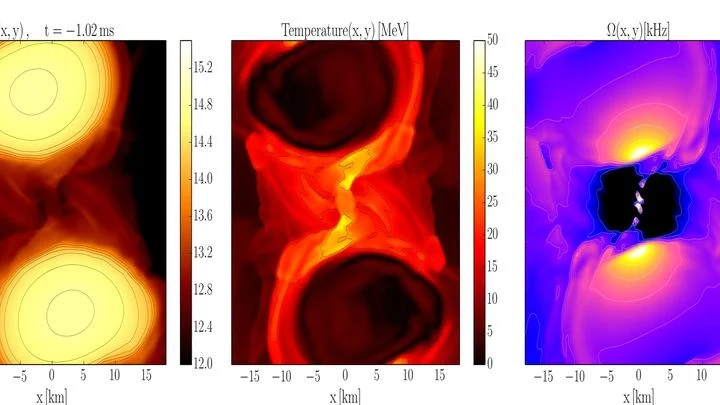
When two superdense stars circle in a tight dance, the space around them shudders. This shudder, gravitational waves, is caught by giant detectors on Earth. But deciphering the signal is tricky: you need to figure out what exactly you're dealing with — a pair of black holes or neutron stars.
Neutron stars are cosmic 'ice cubes' of unimaginable density: a tablespoon of their material would outweigh Mount Everest. It was a mystery what lay in their cores: ordinary neutron matter (a giant atomic nucleus) or exotic quark matter, where particles are not bound into neutrons.
In 2017, detectors picked up a tremor in space — gravitational waves from the merger of two neutron stars. Telescopes immediately found a flash of light: a cosmic explosion astronomers dubbed a kilonova. In that fiery cauldron, it turned out, the heaviest elements of the periodic table are born — gold, platinum, uranium.
In the searing plasma of the newborn Universe, when space itself still rang with the echo of the Big Bang, objects may have emerged that challenge gravity itself. Not ordinary black holes — but electrically charged giants, astrons.
An atomic nucleus is like a droplet with a thin coating — a neutron 'skin.' Inside the droplet, protons and neutrons are mixed evenly, but on the outside, like the froth on milk, a layer forms where neutrons are noticeably more abundant.
The crust of a neutron star is not just a solid shell. Under pressures of billions of tons per square centimeter, atoms lose their electrons, and the remaining nuclei arrange into a rigid crystal lattice, reminiscent of a honeycomb, but made of matter a trillion times denser than steel.
A neutron star is the remnant of an exploded star, compressed to the size of a city. On its surface, a thermonuclear fire sometimes erupts: accumulated gas explodes like a giant hydrogen bomb. After the burst, ash remains — a mixture of heavy elements that rises to the surface and forms a hot atmosphere.
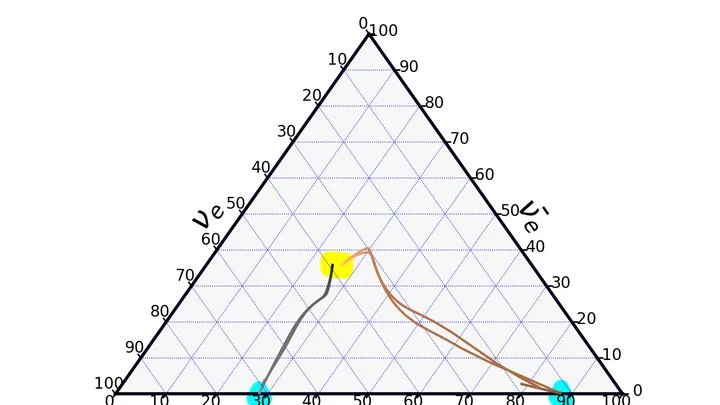
A pot of soup simmering with three ingredients. The chef adjusts the proportions on the fly, and the progress is tracked by the position of a point on a triangular scale. That's roughly how physicists tackle neutrinos from a supernova explosion.
If an atomic nucleus is a family, then in an ordinary helium house live two protons and two neutrons, holding hands tightly. Now imagine that one family member is an oddball who loves to wander far from home.
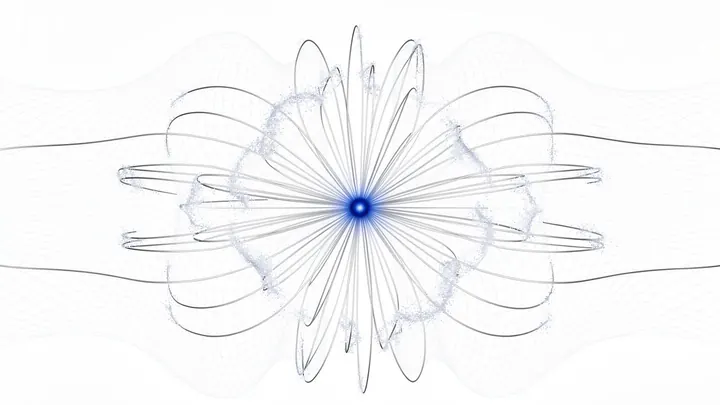
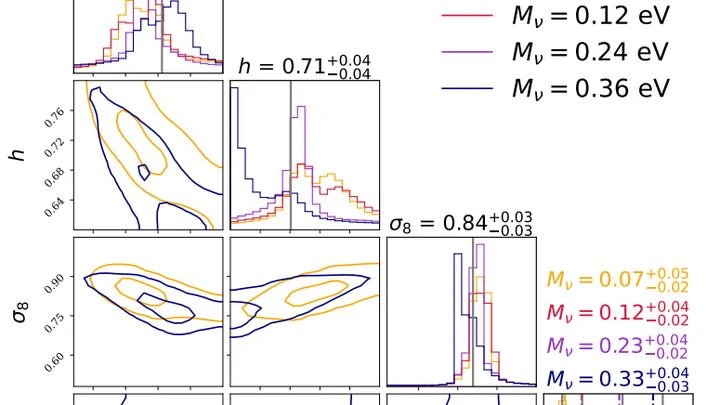
The Universe is a colossal web of invisible dark matter and galaxies, stretched by the expansion of space. Neutrinos, nearly intangible ghost particles, barely cling to the threads, but their collective mass subtly shifts the tension of the entire network.
When a massive star explodes as a supernova, its material slams into the surrounding shell of cosmic dust and gas, like an invisible fur coat. The impact spawns myriads of neutrinos, ghostly particles that zip through planets without swerving.
Inside a neutron star, matter is squeezed so tightly that a teaspoon of its material would weigh as much as a mountain. We can't directly see what happens to particles under such conditions, but stars tell us about themselves through gravitational waves and light when two such stars merge.
A neutron star is a sphere the size of a city, but it weighs as much as one and a half Suns. Inside such a sphere, matter is so compressed that a teaspoon of it would weigh billions of tons. But physicists don't fully know what this matter is made of.
Inside a neutron star, matter is compressed to unimaginable densities. Previously, scientists speculated about its exact makeup, cycling through possible equations linking pressure and density. The new method tosses out guesswork: it directly ties the measurable mass and radius to the internal structure.
Two telescopes look at the same Universe and see different expansion rates. Local measurements from supernovae give 73.04 ± 1.04 km/s/Mpc, while cosmic microwave background data within the standard model predict 67.36 ± 0.54.