The decay constant of a meson quantifies the intrinsic strength of its coupling to the vacuum, which in turn determines how readily the meson can decay into lighter particles such as photons. It is a fundamental parameter in particle physics, appearing in the theoretical expressions for decay rates and branching ratios. For example, the decay constant of the pion is a key input in calculations of weak interactions and in tests of the Standard Model.
History
The concept was introduced in the 1950s and 1960s as part of the development of current algebra and the theory of strong interactions, with the pion decay constant being a central quantity in the work of Gell-Mann, Lévy, and others.
How it works
In quantum field theory, a meson is a bound state of a quark and an antiquark. The decay constant measures the amplitude for the meson to annihilate into the vacuum, effectively setting the scale of the meson's coupling to the weak or electromagnetic currents. A larger decay constant implies a stronger overlap between the meson's wavefunction and the point-like annihilation vertex, leading to a higher probability of decay into photons or other particles.
In practice
Decay constants are used to predict and interpret experimental results in particle accelerators, such as the measurement of rare meson decays to test the Standard Model and search for new physics.
Fun fact
The pion decay constant is approximately 130 MeV, a value that sets the scale for the strength of the strong force in low-energy processes.
Units by system: SI: s1 · CGS: s1 · Planck: t p1 · natural: ev
When a ψ(2S) particle decays into a proton and an antiproton, two different mechanisms act simultaneously: the strong interaction, like glue holding quarks together, and the electromagnetic one, like light pushing charges apart. Their contributions add up with a certain phase shift.
A perovskite solar cell is like a young athlete: it performs brilliantly at first, but tires with age. Over eight hours, its performance drops noticeably, with no visible cause like cracks or dust. Scientists took one cell and recorded its performance at 0, 90, 280, and 480 minutes of its life.
In a quiet room, you can hear the faintest whisper. Likewise, in the hydrogen atom, the lightest of all, an uninvited guest is easier to spot. That guest could be the Z' boson, a mediator particle of a new force predicted by many unification theories. The Standard Model already has its own mediator — the Z boson.
In 2021, the LHAASO observatory registered gamma quanta with energies above a petaelectronvolt from sources like the Crab Nebula — a supernova remnant with a pulsating neutron star at its heart.
A false vacuum is not just a supercooled liquid, but a quantum hologram, ready to spring to life under the right projection. Its decay is described by the tunneling of a quantum field from a metastable minimum, and the classic calculation via Euclidean instantons is as elegant as a still life under spotlights.
A ball sits in a pit. It won't roll out on its own: it needs a push. But in the quantum world, a particle can leak through a barrier without extra energy. This trick is called tunneling.
In the microscopic world of the strong interaction, nature's most powerful glue, quarks never wander alone. Over large distances, they stick together into the protons and neutrons we know. But under extreme compression, like in the depths of a neutron star, this glue creates far more exotic forms of matter.
The universe is like a vast warehouse where a strict inventory was taken long ago. The cosmic microwave background is an ancient record of everything in stock 380,000 years after the big bang. According to it, the fraction of matter in the cosmic 'budget' (the parameter Omega_m) is known with high precision.
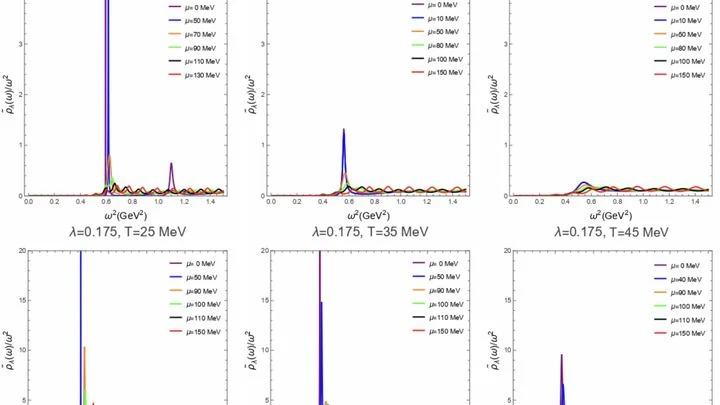
An ice cube in hot tea melts strictly at zero degrees. But what if the ice is made of subatomic particles and the tea is scorching nuclear matter? The authors studied the rho meson, a particle made of a quark and an antiquark that lives for just 4×10⁻²⁴ seconds, and searched for its 'melting temperature'.
A firework bursts, and one point explodes into four sparks at once. That's how the Z boson, the particle that carries the weak force, behaves when it decays into four charged leptons (electrons or muons). The process is extremely rare: for every million Z bosons produced, only about five decay this way.
A coin landing on its edge is about as rare as a heavy B meson decaying into a light pion and an electron-positron pair. Over a decade of collider operation, only a handful of such events have accumulated, but physicists have finally managed to spot them.
The decay probability is about 2.4×10⁻⁸.
In the LHCb detector, where protons collide, one unusual track was found among billions of decays. The particle, named $$D_{s1}$$(2933)^+, appears for a moment and immediately decays into other particles. Its lifetime is so short that it cannot be observed directly — only through its decay products can its existence be reconstructed.
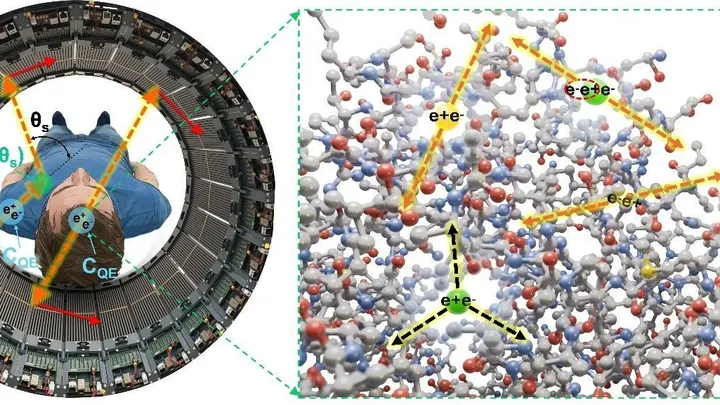
Two photons fly out from a single point in a patient's chest. They are twins: alter one, and you instantly know about the other. This connection is called quantum entanglement. In a PET scan, these pairs are born inside the body when an injected radioactive substance meets electrons in the tissues.
The degree of entanglement is not constant.
Inside every atom lives a proton. For a long time, it was considered as eternal as matter itself. But theories that unify all forces of nature predict that, sooner or later, the proton will decay. The only question is how long we have to wait.
In the Japanese detector Super-Kamiokande — a giant tank of ultra-pure water — physicists searched for signs of such a decay.
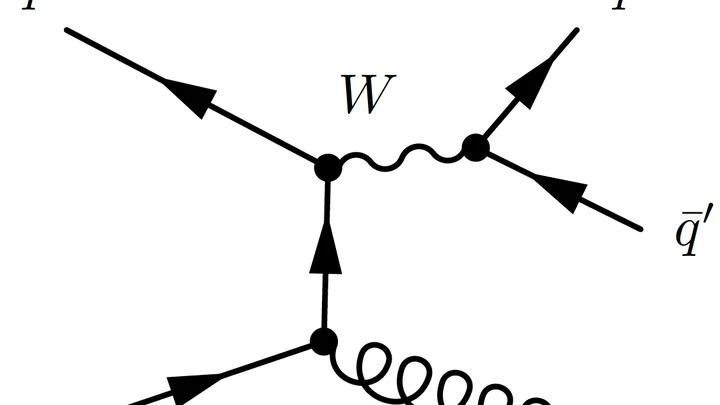
When a W boson, the particle that carries the weak force, decays into a quark and an antiquark, these two fragments fly off in nearly the same direction at the collider's immense speeds.
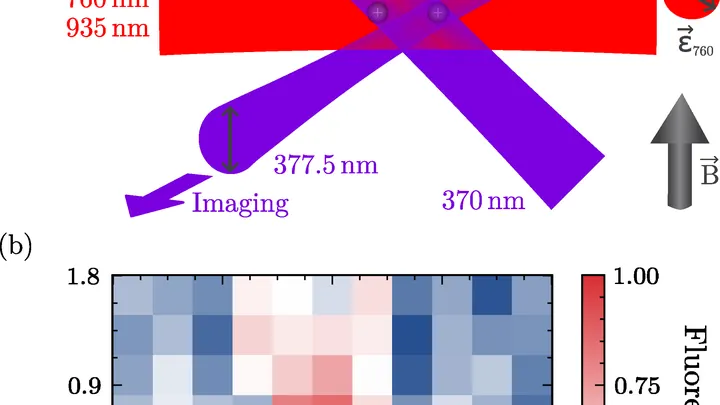
A glowing dot in a vacuum chamber refuses to go out, even though the light source has long been switched off. A single ytterbium ion, held by electric fields, is stuck in an excited state, as if the electron inside it has forgotten how to return to its usual place.
The Higgs boson lives an unimaginably short life — less than a billionth of a second. It cannot be caught directly, so physicists look at what remains after its decay: jets of particles, muons, neutrinos. But some information is lost if you consider only the explicit decay traces rather than the whole event.
In 2018, the Large Hadron Collider ran a special data-taking campaign: the CMS detector captured proton collisions at breakneck speed to collect ten billion particles containing a beauty quark.
Atomic nuclei are home to protons and neutrons. But sometimes a guest flies in — a particle called the lambda. It's like a neutron, but heavier and with a special property physicists call strangeness. A nucleus with such a guest is called a hypernucleus.
At the MAMI accelerator in Mainz, researchers created the lightest hypernucleus — a triton with a lambda inside.