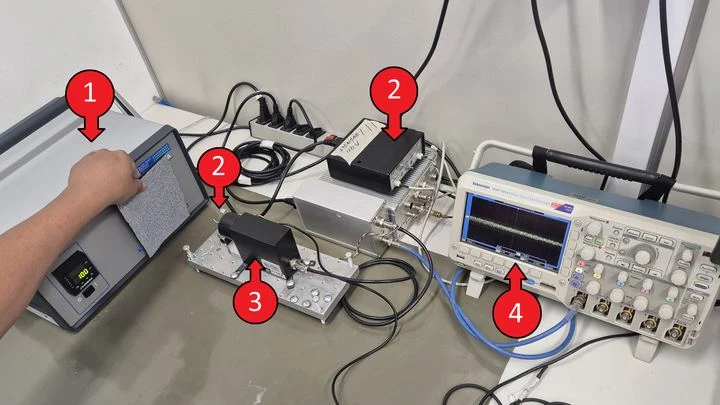
A thermal camera is a device that detects infrared radiation emitted by objects and converts it into a visual image showing temperature differences. All objects above absolute zero emit infrared radiation, and the intensity of this radiation increases with temperature. By capturing this radiation, a thermal camera creates a 'heat map' of a scene, allowing users to see temperature variations that are invisible to the naked eye.
History
The first thermal cameras were developed in the 1950s for military purposes, based on earlier infrared detection technology from the 1930s. Modern uncooled thermal cameras became widely available in the 1990s.
How it works
The camera's lensfocuses infrared light onto a detector array made of materials like microbolometers, which change electrical resistance when heated. Each pixel in the array corresponds to a point in the scene, and the camera's electronics translate the resistance changes into temperature values, assigning colors or shades of gray to create a visible image. Unlike regular cameras, thermal cameras do not need an external light source; they rely entirely on the heat emitted by objects.
In practice
Thermal cameras are used in building inspections to find heat leaks, in medicine to detect inflammation or poor circulation, in firefighting to see through smoke, and in night vision devices.
Fun fact
Some thermal cameras can detect temperature differences as small as 0.02°C, allowing them to see the faint heat signature of a handprint left on a wall.
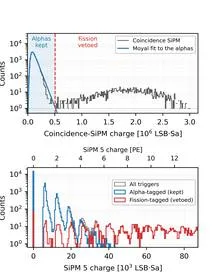
The stage is bathed in icy light, and on it stand silicon spectators. Each is an array of tiny avalanche diodes capable of spotting a single photon, but only if the surrounding temperature drops to 165 K.
A tiny diamond, invisible to the naked eye, sits on a chip and senses heat like no ordinary thermometer can. Hidden inside it are two defects: places where a carbon atom is replaced by a nitrogen atom, with a vacancy nearby.
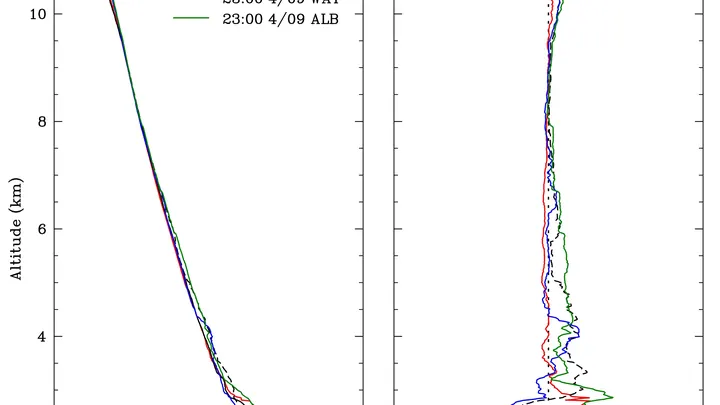
Every second, thousands of passenger aircraft in the sky transmit radio signals: that's how air traffic controllers track where each flight is. These signals don't travel in a straight line: air of varying humidity bends them like a lens. If you can measure that bending, you can work out where the air is drier and where it's more humid.
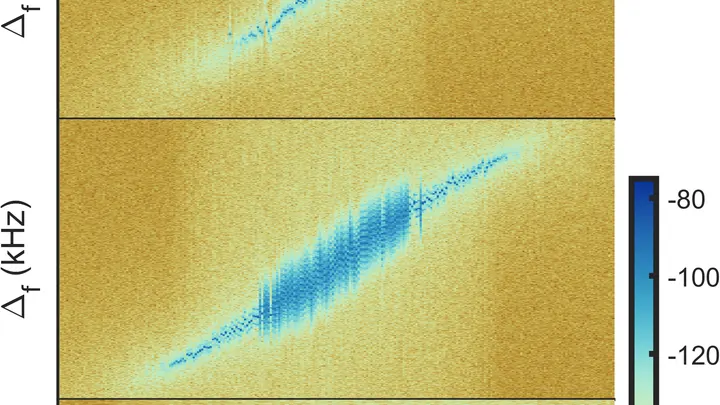
An ordinary lamp shines steadily, while a lighthouse flashes. Scientists in London have made a tiny diamond work like a lighthouse, but not for light — for radio waves. To do this, they added a bit of nitrogen to the crystal and then shone a green laser on it.
In the layered crystal CrSBr, the magnetic moments of atoms are arranged like notes in a score: within each layer they point in the same direction, but between layers they point in opposite directions. This antiferromagnetic melody plays up to 132 kelvin, beyond which thermal motion destroys the order.
A laser beam strikes a thin target hidden inside layers of another material. Within billionths of a second, the material is compressed to a density of 25 grams per cubic centimeter, as if a piece of lead became more than twice as heavy without moving an inch.
In the kitchen, when a pan heats up, your hand feels the heat before you even touch it. A solar telescope picks up similar invisible heat — only from a star, not a stove. The instrument, called HATS, captures radiation in the terahertz range, which was previously little studied due to technical difficulties.
The orchestra plays, but the musicians can't hear each other. The conductor keeps stopping the music and walking over to each player to tune the instrument. That's roughly how space telescopes with segmented mirrors work.
Usually, light does not turn an insulator into a conductor: that requires powerful laser pulses that break the material's structure. But in twisted bilayer graphene at the magic angle, things are different.
The Sun is a giant cauldron where light struggles through a thick layer of scorching matter. On its way out, photons (light particles) constantly bump into atoms and lose energy. How strongly matter holds back light is called "opacity," and it determines how quickly heat escapes.
Iron is one of the main culprits for opacity in the Sun's interior.
In a room, air touches the skin, and we feel its temperature. But if your body suddenly accelerated at a colossal rate, heat would come even from absolute emptiness. This is not fiction but a strict consequence of quantum field theory: for an accelerating observer, the vacuum becomes a warm bath.
A regular radar works like an amateur photographer: it takes a series of blurry snapshots and tries to stitch them into a panorama. Details are smeared, and in a long corridor or crowd, the robot easily gets lost.
The principle is simple: like a bat, the radar emits a wave and catches the echo.
Heat is all around us: from a car's exhaust pipe to the casing of a running laptop. Thermoelectric materials could turn that waste heat into electricity.
Dark matter detectors are essentially incredibly sensitive microphones, capable of hearing a whisper amid the roar of a rock concert. Their job is to catch the rare nudges from hypothetical dark matter particles, which are thought to occasionally collide with atomic nuclei of ordinary matter.
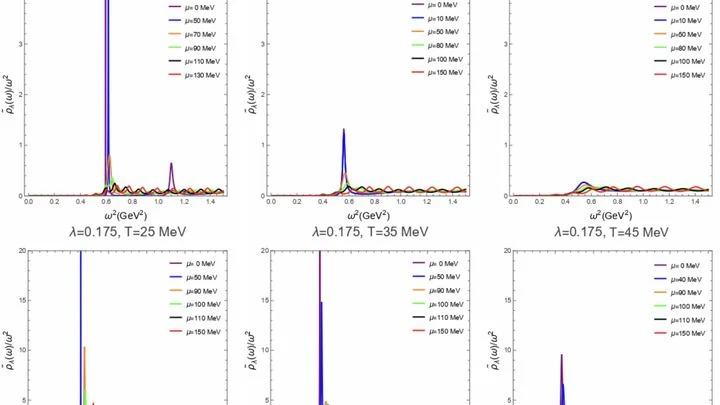
An ice cube in hot tea melts strictly at zero degrees. But what if the ice is made of subatomic particles and the tea is scorching nuclear matter? The authors studied the rho meson, a particle made of a quark and an antiquark that lives for just 4×10⁻²⁴ seconds, and searched for its 'melting temperature'.
A regular rangefinder sends a single light pulse and waits for it to return — like a person shouting into the void and listening for an echo. But if you use multiple sources that glow in unison, and analyze not the volume but the rhythm of the echo of reflected flashes, the picture becomes sharper.
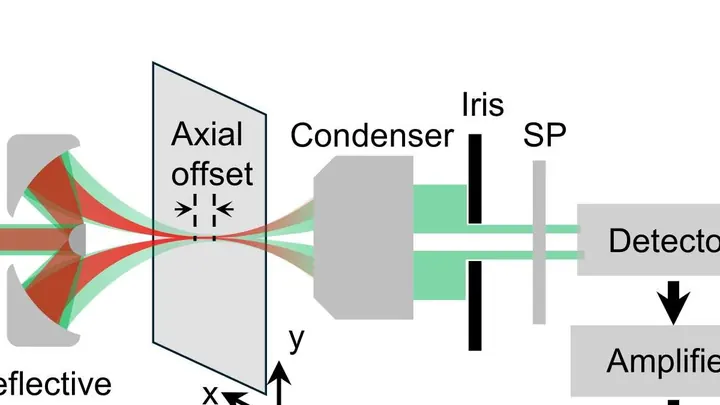
The scene is lit by spotlights, but the most interesting action happens in the shadows — where molecules invisible to the eye are hiding. The new camera picks up the heat of these "invisible" objects and turns it into ordinary light.
Light leaves a trace even when there is almost none of it. A single photon, a tiny bundle of energy, strikes a silicon wafer and knocks out a handful of electrons. The trouble is that the handful is too small to notice. You need an amplifier.
Usually, the signal is amplified by applying a voltage to metal contacts on the detector's surface.
A film of aluminum nitride, as thin as a soap bubble, hangs above a mirror with a micrometer-sized air gap between them. When invisible infrared light with a wavelength of about 15 micrometers hits it, the film starts to vibrate in sync with the light, like a string that responds only to its own note.
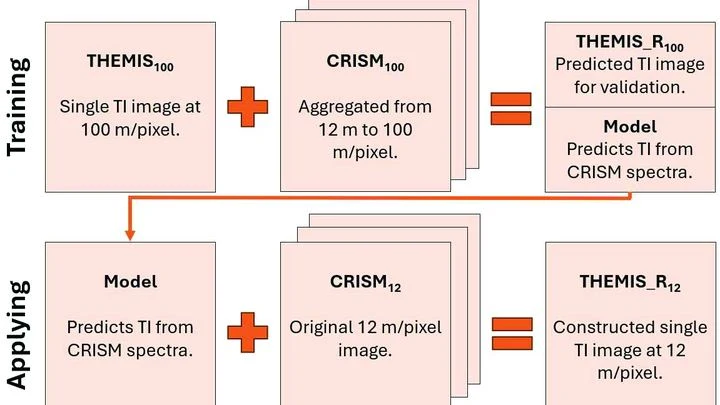
Warm rock and cold sand cool at different rates at night. An instrument orbiting Mars measures this heat, revealing whether the surface is loose dust, a dense crust, or solid rock. But thermal images have a resolution of 100 meters per point: an entire football stadium fits into a single pixel. Fine details (the beds of ancient streams, the edges of lava flows) are simply invisible.
An ordinary aluminum pot on a stove doesn't emit molecules you can catch with light. But if you take aluminum and an aluminum salt, heat them together in a small oven, you get a stream of aluminum fluoride molecules, like steam from a kettle's spout, except instead of water droplets, tiny particles fly out.
An ordinary antenna picks up radio waves, but there are fields it barely feels. We're talking about slow electric fields: those that change once a second or less. For them, physicists built a sensor from a beam of rubidium atoms.
Gas is nearly invisible, but it has a temperature, and you can read it from how the gas 'shadows' the thermal background. In the experiment, a camera looks at a warm screen through a jet of carbon dioxide. If the gas is cooler than the background, it appears as a dark spot; if warmer, it appears bright.
A semiconductor diode normally conducts current in only one direction, like a spring-loaded door: it opens easily one way but pushes back the other. But if you dope the crystal heavily, the door starts behaving strangely: under reverse bias, the current doesn't just flow: it shoots up.
Light we can't see but feel as heat turns out to be the key to cellular life. A new type of microscope uses waves 2000–2500 nanometers long, three times longer than red light, and such waves barely scatter in tissue. Thanks to this, the device peers into a tumor spheroid like a flashlight through frosted glass, illuminating individual molecules.
A fat droplet inside a living cell is like a bobber in rough water. It doesn't move in a straight line but in jerks, sometimes pausing, sometimes speeding up. Previously, such movements could only be seen in a single plane, like watching the bobber from above without knowing its depth.
A radiation sensor in the city is like a street musician: it has to hit the right notes even when fingers go numb from cold or the instrument is baked by the sun. Usually, such devices are kept in greenhouse conditions, with heating or cooling, otherwise the energy scale (which distinguishes harmless potassium in concrete from dangerous cesium) starts to lie.
An X-ray image usually brings to mind a bulky machine in a hospital. But such a picture can be taken by a device the size of a palm, assembled from hobbyist electronics. The authors took a Raspberry Pi mini-computer, a 12.3-megapixel camera, and a screen that glows under X-rays.
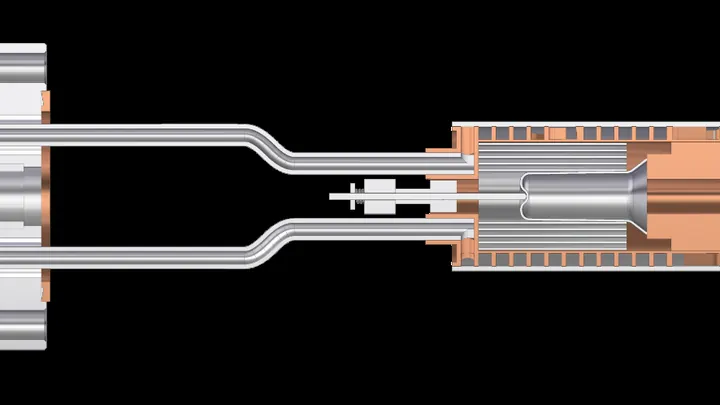
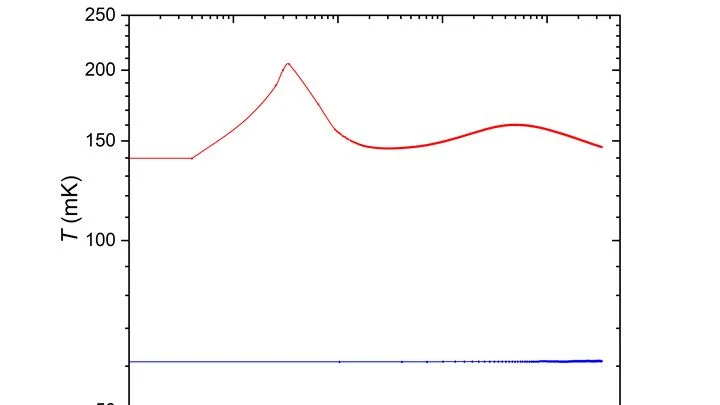
At 0.1 K, just three-tenths of a degree above absolute zero, matter stops following the usual rules. Helium becomes superfluid: it flows without friction, seeps through cracks, and behaves like one giant quantum liquid. Seeing what happens inside such cold is a challenge at the edge of possibility.
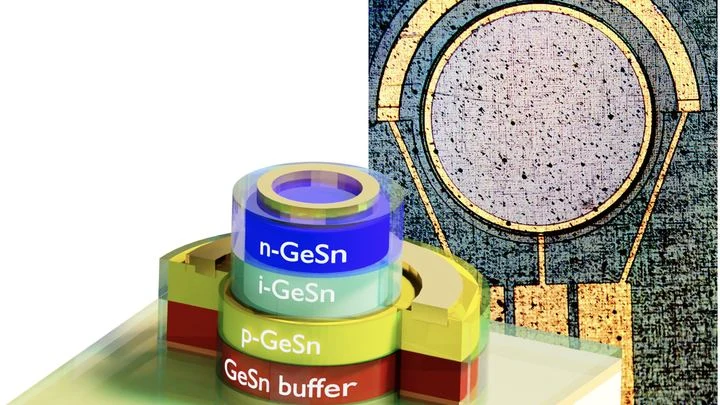
A blazing furnace in a workshop or the hot exhaust of a turbine is not just heat: it's light, invisible to the human eye. Regular solar panels catch visible light, but here you need a receiver for invisible thermal radiation.
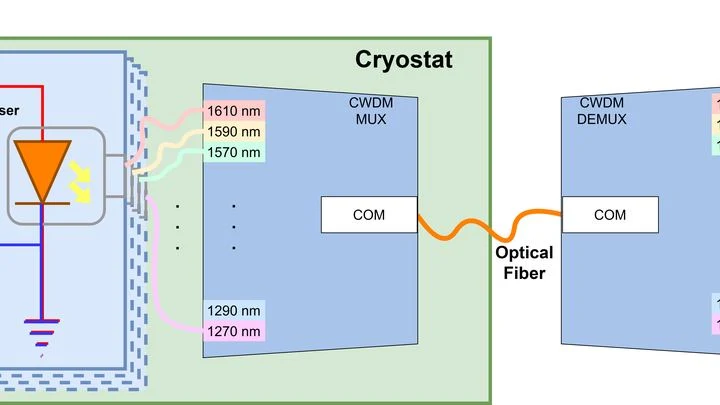
A thermos of liquid xenon cooled to minus 100 degrees Celsius. Inside are sensitive sensors that catch rare signals from dark matter particles. To bring these signals out, copper cables are usually used. But over the long haul, the signal weakens, and adjacent cables start 'cross-talking' — that's called crosstalk.
An X-ray beam strikes a piece of superconductor, and the material warms up ever so slightly. That heating, by billionths of a degree, is the only trace the light leaves behind. The new detector catches exactly that, like a sensitive thermometer pressed against cold metal.
Light from a star is not just a stream but a wave that can oscillate in different directions. Ordinary light is like a crowd where everyone waves their arms randomly. But after reflecting off dust grains or passing through a magnetic field, some waves align in a single line, like soldiers in a row.
A firefighter with a thermal imager can see the source of a fire through smoke. But how do you see a radiation source that has no smell, no glow, and no heat? Gamma cameras solve this problem: they capture gamma rays emitted by radioactive materials and overlay their 'trace' onto a regular photograph. The result is an image showing that the source is, say, behind the far door.
A conventional thermal camera is like a thermometer that slowly heats up and cools down. It shows where heat is well, but it can't keep up with fast motion. The new sensor works differently: it counts individual quanta of heat, like a droplet counter during rain.
Tiny particles that look like flowers can do two things at once: heat up and tell you how hot they are. This isn't science fiction: it's the result of working with nanoparticles made of cobalt ferrite, a magnetic material that responds to magnetic fields.
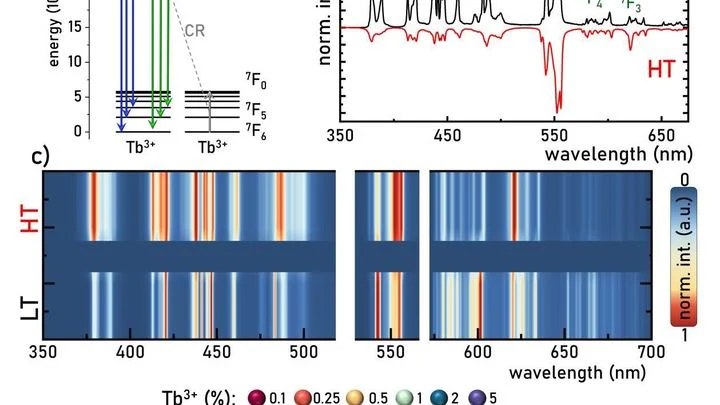
A piece of material glows blue. Heat it up, and the glow turns green, as if someone flipped a switch at a traffic light. That's how the new luminescent thermometer described in the paper works.
Inside the material are terbium ions — a rare-earth metal that knows how to shine. At room temperature, they emit blue light.
Light is like a many-voiced choir: color, direction of oscillation, and instantaneous changes all intertwine. An ordinary camera hears only one voice, while the rest are lost. Scientists have built a camera that listens to the entire choir at once, and from a single image understands what is happening.
A thermal imager typically works like a thermometer with a sensor array: it measures how much each pixel heats up and turns that into a picture. But this method has a limit — the device's own noise obscures faint heat.
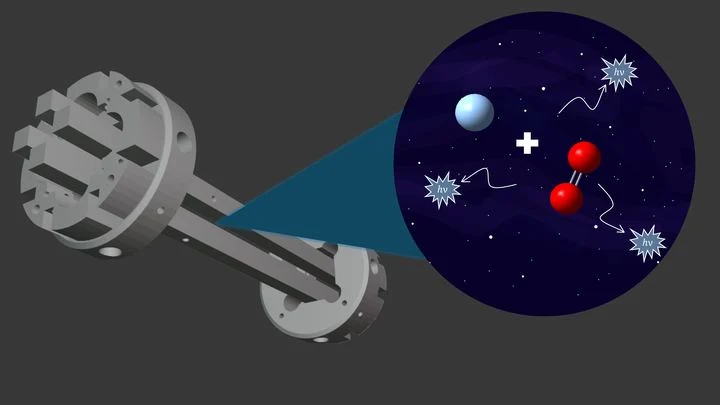
In the cold, sparse clouds of space, particles rarely meet, but sometimes an ion and a neutral molecule pass close enough to stick together. As they do, they emit light, like a muted flash carrying away excess energy. This process is called radiative association, and it is responsible for the formation of many molecules in interstellar space.