A Dance of Dust and Light Around a Young Star express
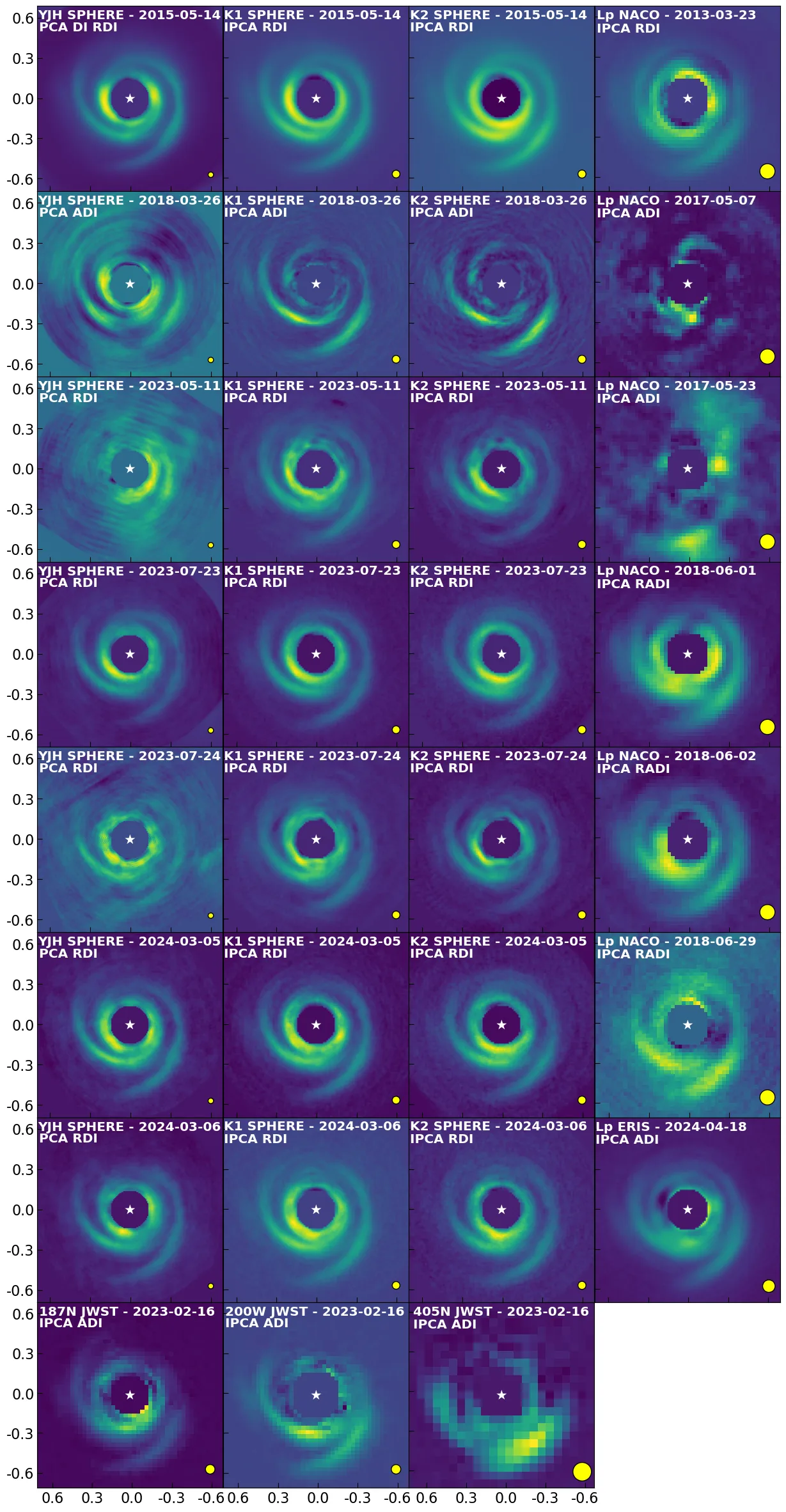
460 light-years away, around the star HD 135344B, a dense disk of gas and dust is swirling. It looks like a giant vinyl record that someone has cracked: a gap yawns in the disk, and across it, like a slender bridge, stretches a dust filament. Next to this filament, in scattered light, a twist is visible — a bend in the spiral arm, as if it had been briefly held back and then released.
Astronomers gathered images from four instruments (VLT/NACO, VLT/SPHERE, VLT/ERIS, and JWST/NIRCam) over ten years. They applied algorithms that remove the glare from the bright star without distorting extended structures. It turned out that the twist moves together with the spiral at a rate of 0.81±0.05 degrees per year. This nearly matches earlier measurements of 0.85±0.05 degrees per year.
Such motion is naturally explained if a giant planet lurks in the gap. Its orbital speed at a distance of 69±4 astronomical units (twice as far as Neptune is from the Sun) matches the observed shift of the twist. A recent image that seemed to show the planet itself turned out to be just an artifact — a ghost born from the algorithm. But the twist, the spiral, the gap, and the dust filament all fit into a single pattern drawn by an invisible hand.
One astronomical unit is the distance from Earth to the Sun. The invisible planet in the disk of HD 135344B lies 69 times farther from its star than Earth is from the Sun, meaning it would be almost at the edge of our solar system if placed here.
In Arthur C. Clarke's novel "Rendezvous with Rama," humans explore a mysterious object that hides its secrets behind a wall. So here: the planet remains invisible, but its presence is betrayed by a gravitational signature in dust and light.