Scattered light is light that has been deflected from its original trajectory by interactions with particles, molecules, or surfaces. This process is responsible for the blue color of the sky, the reddening of sunsets, and the diffuse glow around stars and galaxies. In astrophysics, scattered light carries information about the composition and structure of the scattering medium, from interstellar dust to the atmospheres of exoplanets.
History
The quantitative theory of scattering was developed by Lord Rayleigh in the 1870s, building on earlier work by James Clerk Maxwell on electromagnetism.
How it works
When light encounters a particle, its electric field induces oscillations in the particle's charges, which then re-radiate light in all directions. The intensity and angular distribution of this re-radiated light depend on the particle size relative to the wavelength, the refractive index, and the polarization. Rayleigh scattering dominates for particles much smaller than the wavelength, while Mie scattering applies to larger particles.
In practice
Used in remote sensing, atmospheric physics, and astronomy to probe the properties of dust clouds, planetary atmospheres, and even the cosmic microwave background.
Fun fact
The Tyndall effect — where a beam of light becomes visible when passing through a colloid — is a direct consequence of scattering and is why car headlights appear as cones in fog.
In July 1969, as Apollo 11 flew toward the Moon, astronauts noticed something unusual: brief flashes of light that appeared even with their eyes closed. At first, this was attributed to fatigue, but the flashes recurred in different crews. Gradually, it became clear: cosmic rays were to blame — tiny particles hurtling through space at tremendous speeds.
You're listening to the faint whisper of stars, and nearby someone keeps moving a chair. In gravitational wave telescopes, that role is played by scattered light: it reflects off trembling surfaces and creates false signals.
A candle flame flickers in a draft but doesn't go out — the tongue of fire briefly changes shape and then returns. Optical skyrmions behave much the same way — tiny vortices in a light beam, reminiscent of swirling eddies. Until recently, they were created only in the perfect, smooth light of a laser.
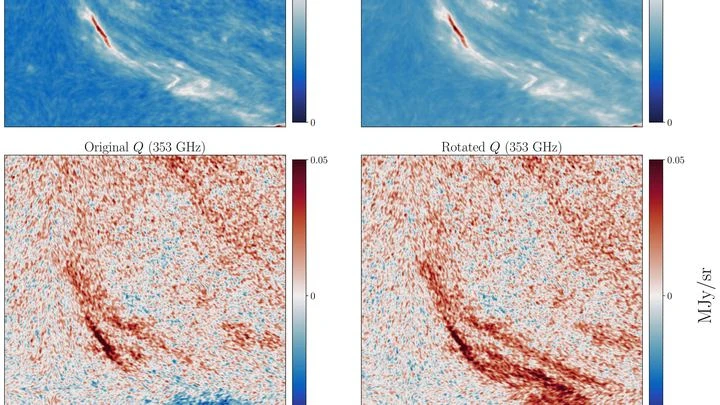
The cosmic microwave background is a faint glow left over from the Big Bang, like the cooling embers of a campfire. It encodes gravitational waves that may have arisen in the first fractions of a second, when the universe inflated faster than light.
When an X-ray burst erupts on a neutron star, its atmosphere heats up to millions of degrees. The light we catch with telescopes passes through this dense layer of gas, and gets dramatically altered along the way. The spectrum no longer looks like that of an ideal radiator: some colors get amplified, others dim.
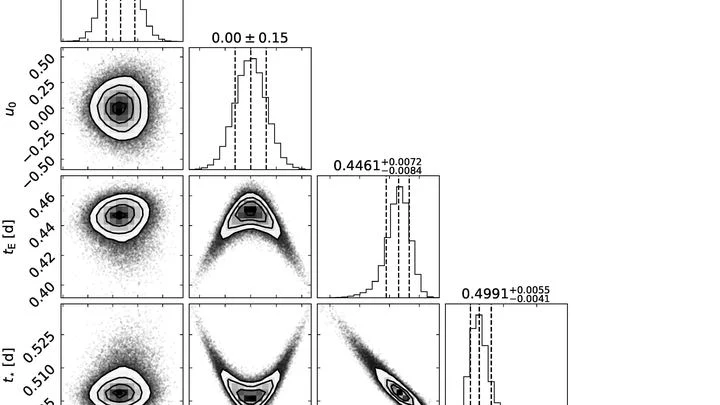
The lone planet KMT-2024-BLG-0816, one of many free-floating planets, was discovered when its gravity acted like a magnifying glass for a few hours. Passing in front of a distant star, the invisible body warped space like a glass marble, and boosted the background light.