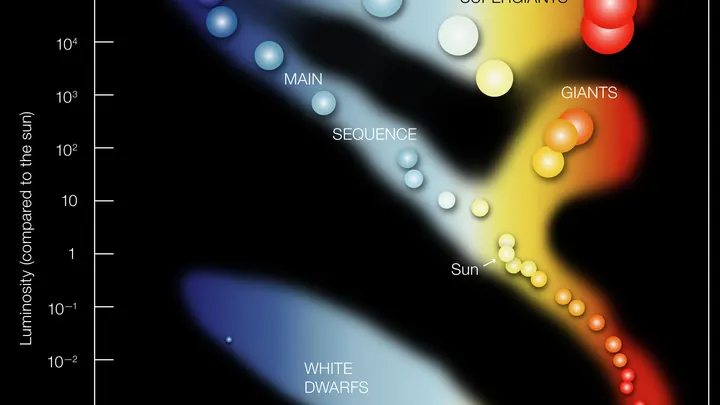
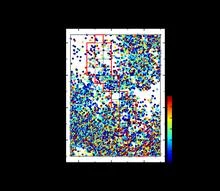
The galactic thin disk is the flattened, rotating component of a spiral galaxy where most of its stars, gas, and dust reside. It is the bright, pancake-like structure that gives spiral galaxies their iconic appearance, containing the spiral arms and the vast majority of the galaxy's luminous matter. In the Milky Way, the thin disk is where our Sun and most of the stars we see in the night sky are located, and it is the primary site of ongoing star formation.
History
The concept of the galactic disk emerged in the early 20th century as astronomers like Jacobus Kapteyn and Harlow Shapley mapped the distribution of stars in the Milky Way, revealing a flattened structure. The distinction between thin and thick disks was established later, in the 1980s, through detailed stellar population studies.
How it works
The thin disk forms from gas that collapses under gravity while conserving angular momentum, causing it to flatten into a rotatingplane. Stars in the thin disk orbit the galactic center in nearly circular paths, and their vertical motion is small, keeping the disk thin. The disk's structure is maintained by the balance between gravitational collapse and the centrifugal force from rotation, with density waves creating the spiral arms that compress gas and trigger star formation.
In practice
Understanding the thin disk is crucial for modeling galaxy evolution, interpreting observations of distant galaxies, and mapping the Milky Way's structure, including the distribution of dark matter.
Fun fact
The thin disk of the Milky Way is only about 1,000 light-years thick, but it spans about 100,000 light-years in diameter, making it proportionally thinner than a standard sheet of paper.
An old city gains new suburbs. In the center, narrow streets where life has nearly stopped, while on the outskirts construction is booming. That is what a spiral galaxy looks like when its core stars have long aged and new stars are still being born in the outer disk.
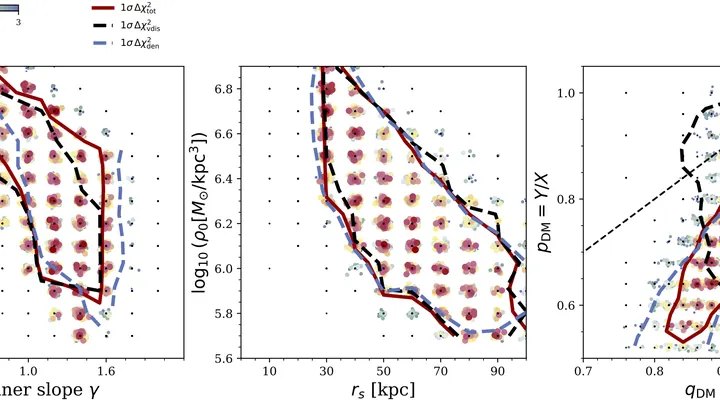
A million orbits: the same score. Nine dark matter halos: nine orchestras without a conductor. All musicians play from the same notes, but in each hall the music sounds different: sometimes in tune, sometimes out of sync. Likewise, satellite galaxies falling into a host halo follow orbits that depend not only on mass but also on the shape of the invisible stage.
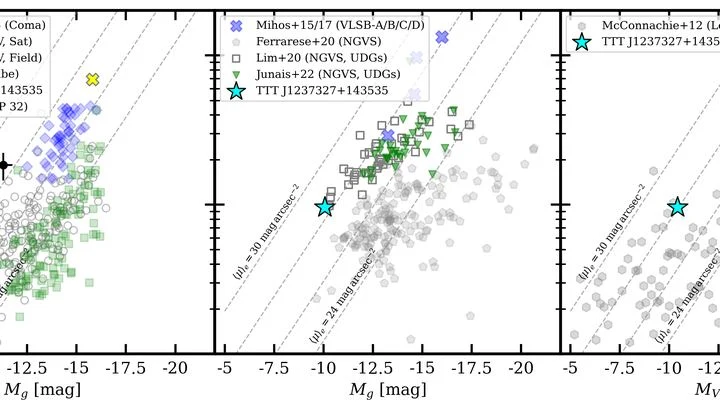
The night sky only looks black: telescopes reveal millions of galaxies, but some are so dim they blend into the background. Astronomers caught just such a "nearly invisible" one by chance while observing the Virgo Cluster with the two-meter telescope at Teide Observatory.
The galaxy is named TTT J1237327+143535.
Think of a merry-go-round: the farther you sit from the center, the faster you're carried around. For a long time, astronomers assumed galaxies work the same way — stars at the edges should orbit more slowly than those near the center. But back in the 1970s, it turned out that in many spiral galaxies, the speed of stars barely drops with distance from the center.
The night sky looks like a random scattering of stars. But zoom out to enormous distances, and the chaos disappears. Galaxies gather into long filaments and flat walls, with colossal voids gaping between them — cosmic voids. This structure is called the cosmic web.
Dwarf galaxies orbiting the Milky Way look as if they’ve survived a gravitational storm. Their stellar bodies are stretched, scattered by tidal tails, and heated from within.
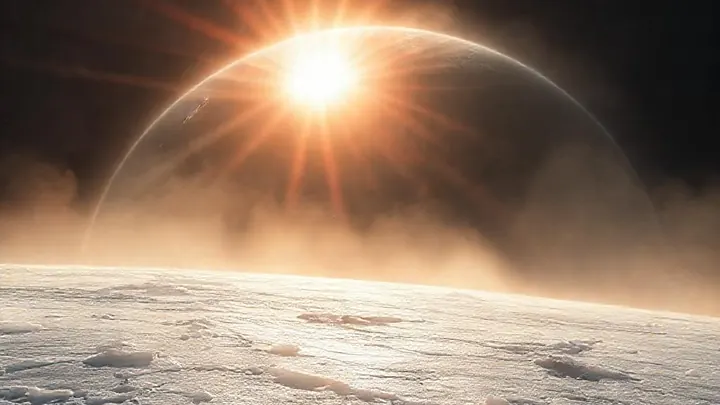
The atmosphere of Titan, discovered by Christiaan Huygens, is opaque to ordinary telescopes. But spectral analysis finds 'windows' of transparency — narrow regions where the haze parts.
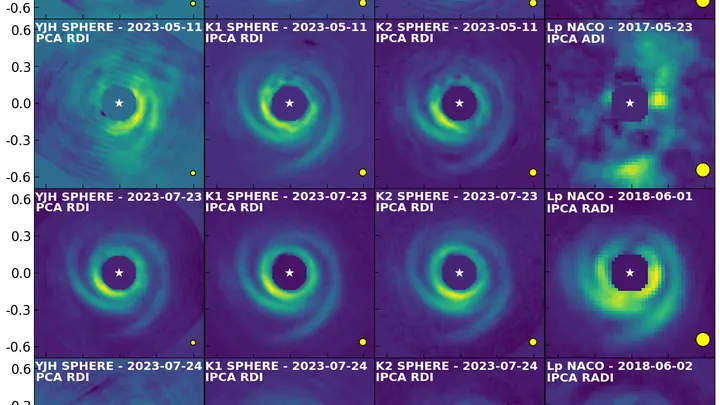
460 light-years away, around the star HD 135344B, a dense disk of gas and dust is swirling. It looks like a giant vinyl record that someone has cracked: a gap yawns in the disk, and across it, like a slender bridge, stretches a dust filament.
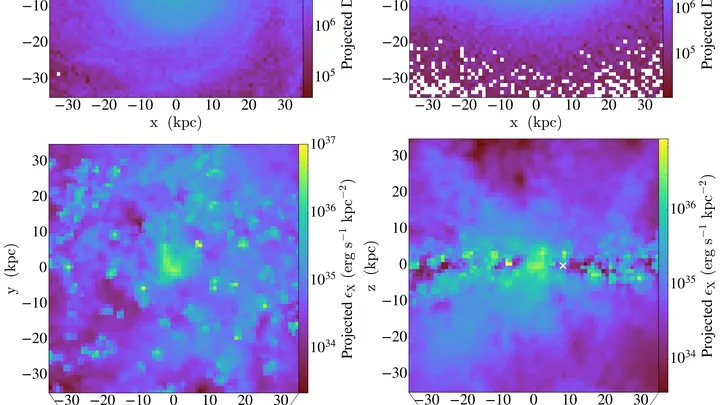
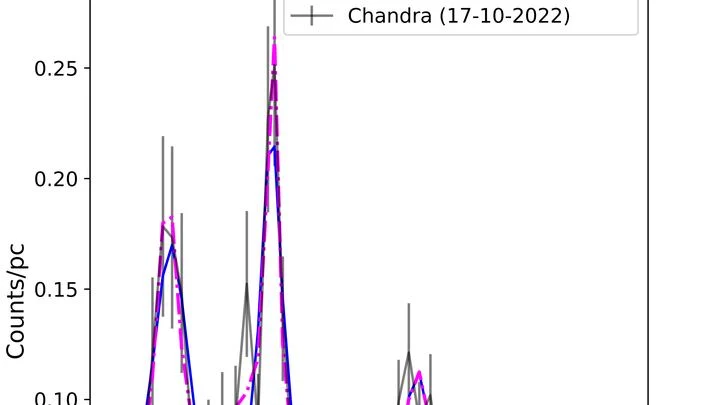
Around our Galaxy, like an invisible crown, stretches a tenuous cloud of gas heated to millions of degrees. It is called the galactic halo. Seeing this glow directly is difficult: it emits soft X-rays that are absorbed by Earth's atmosphere.
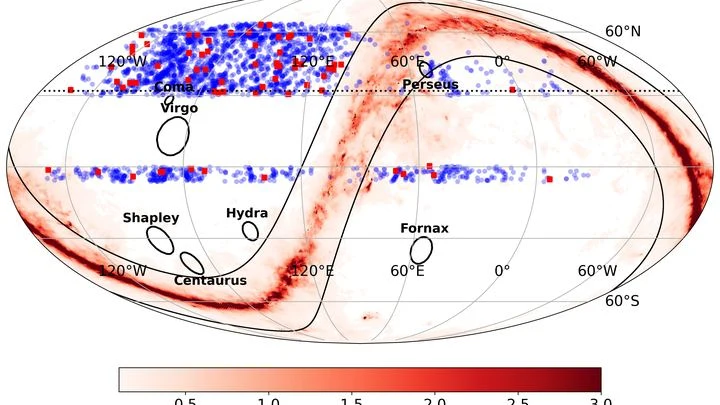
Imagine a dark room with dust floating in the air. A bright flashlight goes off, and the dust particles light up, revealing their positions. Astronomers have applied a similar trick to our Galaxy. The flashlights were gamma-ray bursts, the most powerful explosions in distant galaxies, and the dust particles were interstellar clouds.
An old chest of family heirlooms opens, and inside lie jewels that were thought to be as old as great-grandmother. But suddenly it turns out: the gold was remelted, the stones were recut, and this happened much later than thought. A similar story happened to the oldest particles in meteorites — calcium-aluminum inclusions, or CAIs.
On a playground, a merry-go-round has just been set spinning. In the first moments, kids are still crowding, grabbing the rails, and the overall picture is chaos. But a couple of seconds later, centrifugal force lines them up in a circle, giving the motion a clear shape.
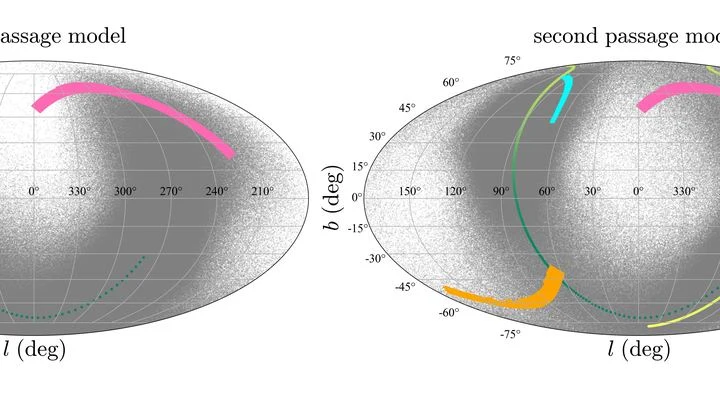
On the outskirts of our Galaxy, far beyond the familiar stellar disk, the Subaru Telescope has spotted something unexpected: a scattered cloud of stars spanning an area of one hundred square degrees across the sky.
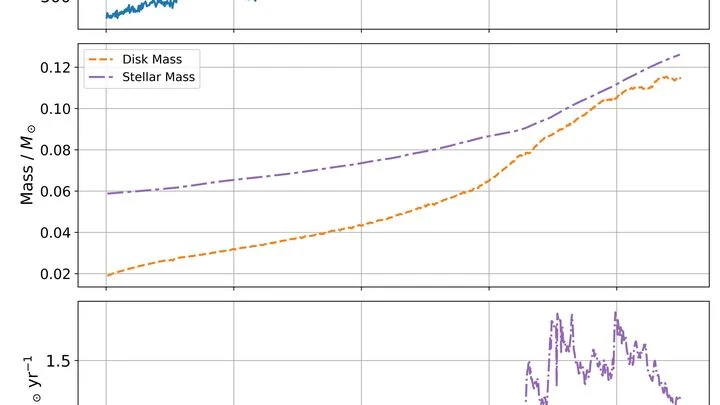
Two very small, cool stars, similar to the famous TRAPPIST-1, reside in the young Upper Scorpius star cluster. They are only 5–10 million years old — by cosmic standards, mere infants. Each is surrounded by a disk of gas and dust from which planets may eventually assemble.
In the constellation Cetus, 65 million light-years from Earth, three dwarf galaxies nestle: DF2, DF4, and DF9. All have been declared “galaxies without dark matter” — the mysterious invisible substance that usually holds stars together.
If you build a giant blanket around a star, you get a Dyson sphere. It absorbs all the radiation and glows in invisible heat rays. No such sphere has been seen yet, but astronomers know: to find it, look for this thermal glow.
On the outskirts of the Milky Way, tiny stellar systems hide, so faint that even powerful telescopes barely spot them. Until recently, astronomers knew almost nothing about these objects, dubbed ultra-faint compact satellites.
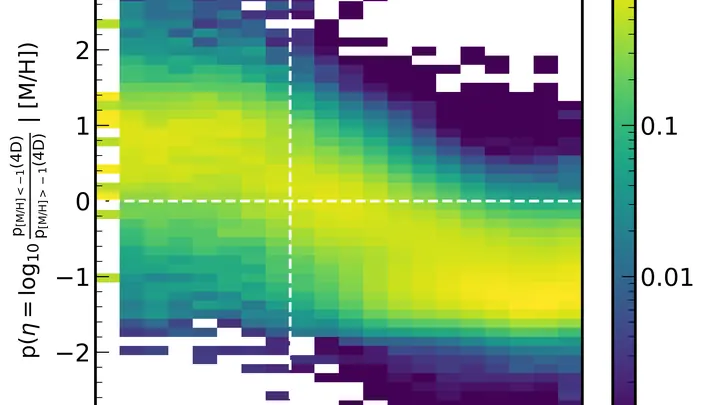
The galaxy's kitchen has a recipe for stellar soup. The main ingredient is hydrogen, but the flavor depends on a pinch of metals. Astronomers have now peered into the pots where that pinch is almost absent, and found that the smallest stars are missing.
Light from the hottest young stars usually cannot leave its galaxy: hydrogen absorbs it, like a thick curtain blocking a sunbeam. But sometimes the curtain parts, and ultraviolet photons burst into intergalactic space.
The night sky seems full of stars, but between them lurk clouds of gas where not a single star has ever ignited. Such objects are called dark galaxies: they contain enough gas, but it is too diffuse and cold to collapse into stars.
Dust in space is not just grime: it's the raw material for future stars and planets. But how it is distributed in our galaxy has long been a puzzle: dust is hard to measure directly, and it blocks the light of distant stars. Now astronomers have peered through this veil using data on five million stars: their brightness, color, and precise positions in the sky.
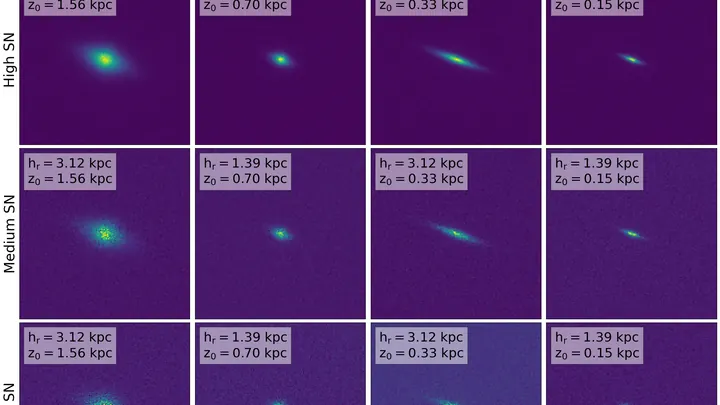
The James Webb Space Telescope peered 11 billion years back in time and spotted galaxies turned edge-on toward us. To measure their thickness, scientists devised a clever method: they calculated it the same way you'd measure the thickness of a slightly tilted pancake, not a perfectly flat one. Previous estimates were imprecise because they assumed an ideal angle.
Supermassive bodies warp space, turning into a lens that bends light from distant objects. Such spacetime curvature allows astronomers to see the invisible. Recently, this method helped detect a hidden clump with the mass of a million Suns.
The Milky Way's stellar disk is like a glowing pinwheel, and тёмное вещество is an invisible cloud around it. For the first time, its shape has been precisely measured. Astronomers tracked the motions of millions of stars and built a 3D map of the тёмное гало out to 160,000 light-years.
Someone has thrown an invisible stone into the stellar pond of the Milky Way. The ripples spread not through water but through the motion of stars: in a region 200 by 50 parsecs across, their average vertical velocity is 7 km/s lower than that of their neighbors. The deviation is statistically significant at the 6σ level, so chance cannot explain it.