Scintillator in a new package: light becomes four times brighter express
A crystal the size of a matchbox was placed under the beam of a clinical accelerator. Half of its surface was covered with a pattern of nanoscale bumps — tiny, smaller than the wavelength of light. The other half was left smooth. The difference was striking: the coated part produced a signal 4.1 times brighter.
In radiation therapy, it is crucial to know exactly how much energy the tumor and healthy tissues receive. Scintillators convert radiation into visible light, but some of it is lost inside the crystal. The nanostructure acts like a tiny lens: it helps light escape rather than reflect back. The researchers verified that the coating did not distort the linearity of the response and did not introduce dose-rate dependence. The crystal remained an honest dosimeter.
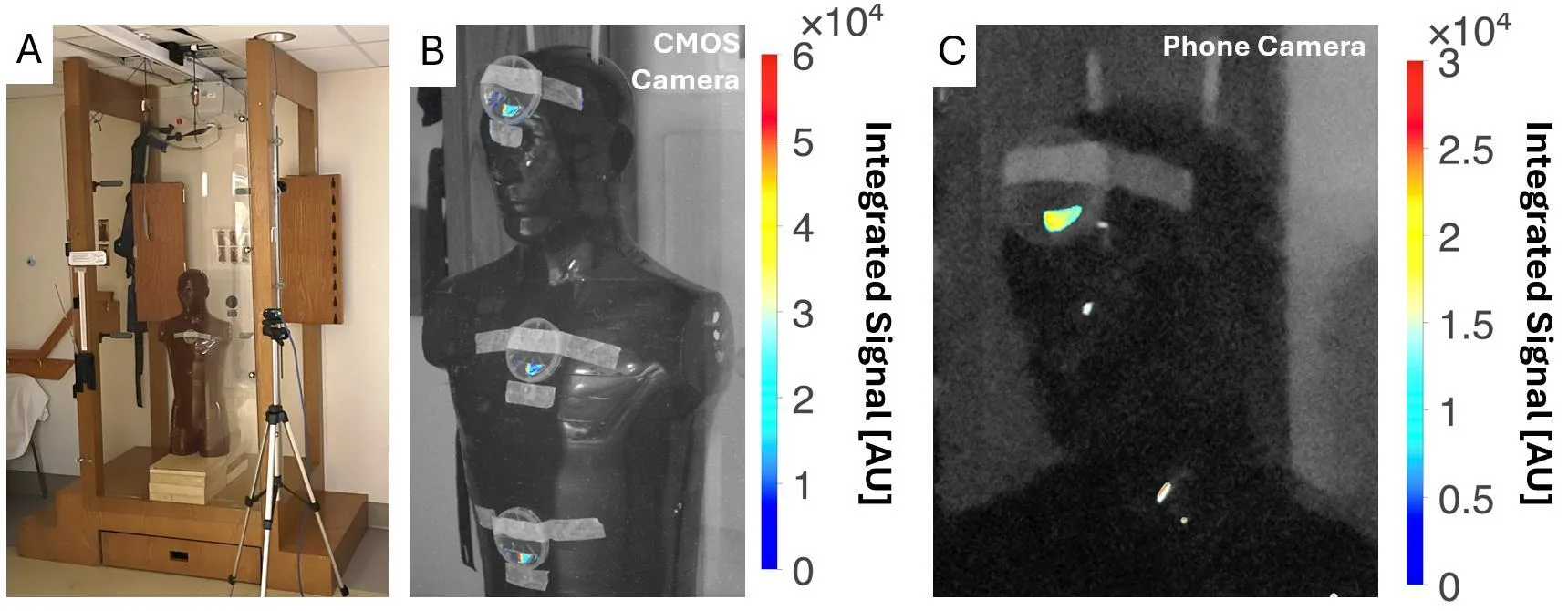
The final test was performed on a phantom in a room for total body irradiation. Light from the nanophotonic half was clearly visible both on a scientific CMOS camera and on a regular smartphone — even with room lights on. The smooth half was silent. The sensitivity was enough to see the signal without sophisticated equipment.
The metasurface-based coating works like the anti-reflective coating on eyeglasses: it suppresses unwanted reflections and lets more light through.