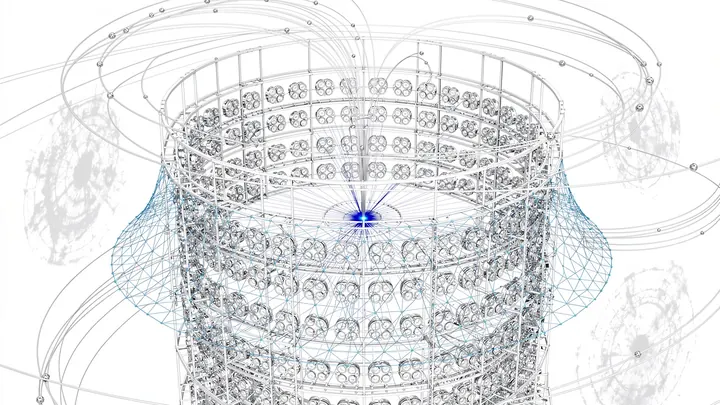
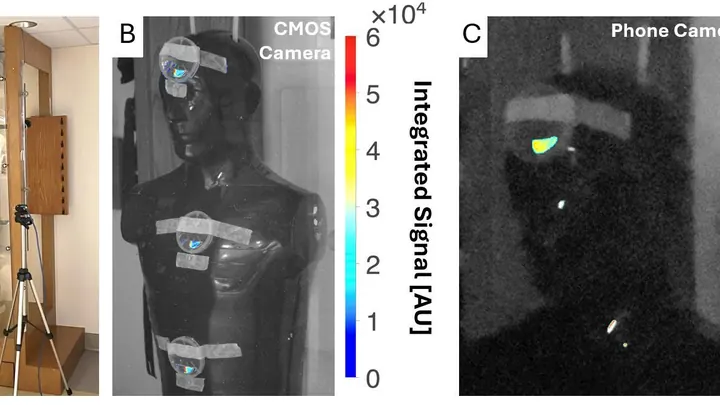
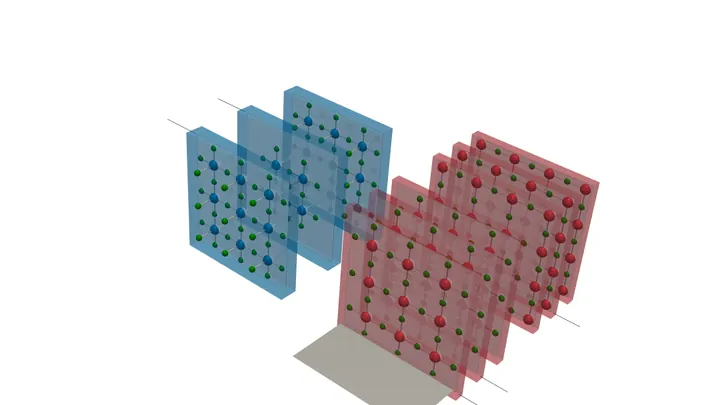
Scintillating materials emit light when struck by ionizing radiation, and they are widely used to detect thermal neutrons and neutrinos from astrophysical sources. In neutrino physics, scintillators are often organic liquids or plastics doped with special compounds that convert the energy of particle interactions into visible photons. These detectors are valued for their fast response, high light yield, and ability to be scaled to large volumes, making them ideal for observing rare events like supernova neutrinos or reactor antineutrinos.
History
Scintillation detectors were first developed in the 1940s, with organic scintillators becoming popular in the 1950s for nuclear physics. Their application to neutrino detection grew in the 1980s with experiments like KamLAND.
How it works
When a neutrino or neutron interacts with a scintillator molecule, it excites the material, which then relaxes by emitting ultraviolet or visible light. This light is collected by photomultiplier tubes and converted into an electrical signal. By measuring the intensity and timing of the flashes, researchers can infer the particle's energy and sometimes its flavor. For neutron detection, the scintillator often contains elements like lithium or gadolinium that capture neutrons and produce characteristic signals.
In practice
Scintillator detectors are used in experiments like KamLAND and JUNO to study reactor neutrinos, and in Borexino to observe solar neutrinos, as well as in neutron monitors at research reactors.
Fun fact
Some scintillator detectors use mineral oil as a solvent, and the largest ones are filled with thousands of tons of liquid, requiring careful purification to remove radioactive impurities.
Beyond Neptune's orbit lies an ocean of icy islands that has remained nearly unchanged for four billion years. These islands, known as trans-Neptunian objects, hold the recipe for planet formation. Until recently, astronomers could only see the large ones, while the small, city-sized ones stayed invisible.
No one has ever seen dark matter, but it should pass through detectors like wind through leaves. Sometimes, very rarely, a dark matter particle bumps into an atomic nucleus, and then the detector must catch that jolt. The trouble is that light dark matter particles can hardly move heavy nuclei: it's like trying to knock down a bowling pin by throwing a feather at it.
17 supernovae from the ZTF DR2 sample lit up ahead of schedule. In the first hours and days after the explosion, they emitted more light than standard models predict. Astronomers compare this to a Bickford fuse: before the blinding flash tears across the sky, a precursor spark runs through the outer layers.
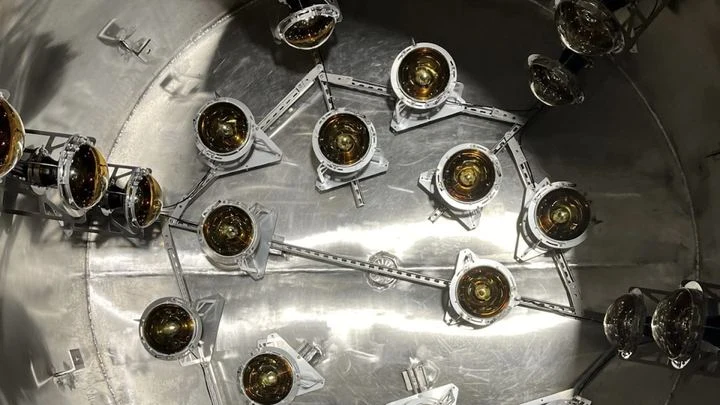
A huge pool of clear liquid is hidden deep underground. Inside, there is nothing but a pristine 'broth' that flashes with faint light when an invisible particle flies through. This is the JUNO detector—20,000 tons of liquid scintillator built to hunt for neutrinos.
The main enemy of such a hunt is not darkness but its own noise.
Deep inside a neutron star, matter is squeezed so tightly that familiar protons and neutrons give way to new players. Hyperons are born there — particles that harbor a strange quark.
A crystal the size of a matchbox was placed under the beam of a clinical accelerator. Half of its surface was covered with a pattern of nanoscale bumps — tiny, smaller than the wavelength of light. The other half was left smooth. The difference was striking: the coated part produced a signal 4.1 times brighter.
Somewhere in the galactic bulge, a massive star lies dormant, ready to trade quiet burning for collapse. Its core will exhaust its fuel, and in a fraction of a second, a neutron star or black hole will be born, releasing 10⁵⁸ neutrinos — almost all the energy of the explosion.
A flashlight beam aimed through frosted glass turns into a blurry spot with every extra millimeter of thickness. Scintillators, materials that convert X-rays into visible light, behave much the same way. They underpin medical imaging, baggage screening, and detectors at particle accelerators.
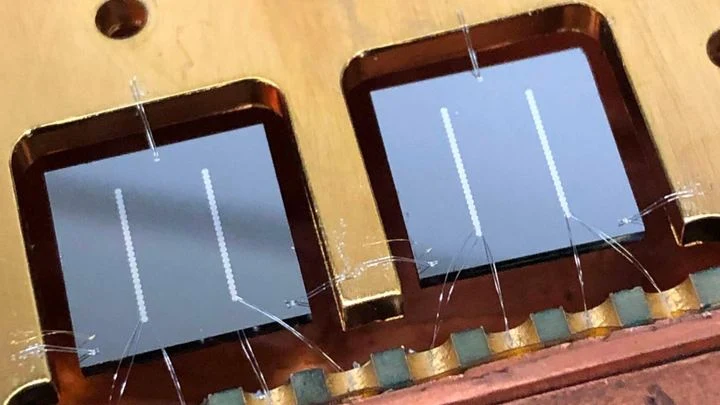
Light leaves a trace even when there is almost none of it. A single photon, a tiny bundle of energy, strikes a silicon wafer and knocks out a handful of electrons. The trouble is that the handful is too small to notice. You need an amplifier.
Usually, the signal is amplified by applying a voltage to metal contacts on the detector's surface.
In 1987, astronomers saw a supernova flare up in a neighboring galaxy — the Large Magellanic Cloud. It was a rare gift: the explosion was close enough to catch not just light but also neutrinos, those nearly undetectable particles that pass straight through Earth.
The crust of a neutron star is not just a solid shell. Under pressures of billions of tons per square centimeter, atoms lose their electrons, and the remaining nuclei arrange into a rigid crystal lattice, reminiscent of a honeycomb, but made of matter a trillion times denser than steel.
Deep beneath Japan's Mount Ikeno sits a tank holding 50,000 tons of the purest water. Inside, it catches neutrinos — ghostly particles that zip through Earth as if it weren't there. When a star explodes in our galaxy, neutrinos arrive first, hours before the light.
A distant lamp shines through uneven glass. The glass bends the rays, and instead of one flame on the wall, several appear — some brighter, some fainter. In much the same way, a massive galaxy bends the light of an exploded star. There was one explosion, but the images show four glowing points.
Neutrinos are tiny particles that pass through the planet's bulk like light through a windowpane. Every second, billions of them fly through your pinky fingernail, but catching even one is no easy feat. To do it, scientists dug a two-kilometer-deep mine in Canada and installed the SNO+ detector.
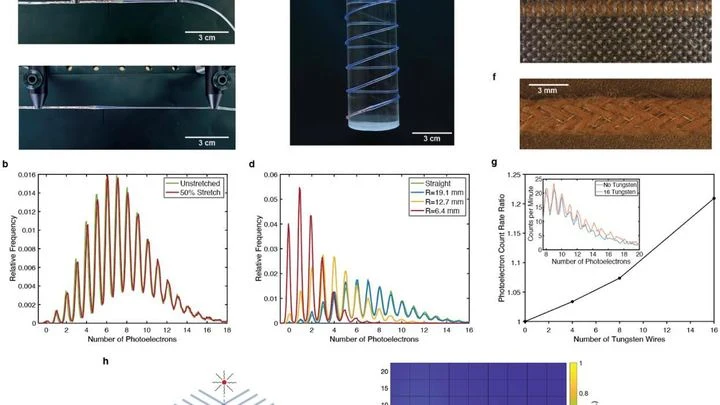
Inside an ultra-thin polymer thread are microscopic crystals — scintillators. When an invisible radioactive particle hits, they flash for a moment, like fireflies. A sensitive sensor catches each flash, turning the thread into a flexible detector.
Plain water in a glass is clear and calm. But if you add tiny carbon dots made from sugar and citric acid in an ordinary microwave, the water starts to glow when a charged particle flies through it.
In a dark tank holding thirty tons of water, the liquid glows when a ghostly particle streaks through. Neutrinos barely interact with matter, but occasionally they bump into atoms, and a flash is born. To catch it, a special substance, a liquid scintillator, is added to the water to amplify the light.
The future neutrino detector will contain millions of tiny plastic cubes: each the size of a die. They flash when a ghostly particle passes through, and that flash must be captured and measured. But if a cube is warped, has a burr, or a hole in the wrong place, the signal gets distorted, and the detector starts lying.
Checking each cube by hand is like sifting through sand on a beach.
A tiny ghostly particle zips through a piece of germanium. Usually it leaves no trace, but sometimes, like a billiard ball, it smacks into an atom's nucleus. The nucleus recoils, and that jolt can be detected. At Oak Ridge National Laboratory, the Ge-Mini detector caught such recoils for two years.
Neutrinos are the most elusive of known particles.
A dark matter detector is like a super-sensitive microphone listening for silence. It picks up tiny heat jolts, phonons, that occur when a particle grazes a crystal. But instead of silence, the instruments have been hearing noise for years: a slew of weak signals below a few hundred electronvolts.
A thin crystal of hexagonal boron nitride is a relative of graphite, but transparent and insulating. Occasionally, single defects appear in its lattice: a boron or nitrogen atom is missing, leaving a trap for electrons. Such a trap can absorb light and re-emit it, like a tiny flashlight.
Neutrons leave no trace in ordinary glass: they pass right through, like light through a window pane. But some materials flash a faint burst of light when a particle hits them. That's how a scintillator works: a substance that turns invisible radiation into visible light.
The new transparent glass SG101 is one such material.
A storm is brewing somewhere far away, and the Geiger counter is already clicking more often. That's how cosmic rays, a stream of charged particles from deep space, make themselves known. When they slam into the atmosphere, they create showers of secondary particles, including muons: heavy cousins of electrons that can reach the ground.
In a vast, dark hall, they're searching for a single person who makes almost no sound. That's how physicists hunt for sterile neutrinos — ghostly particles that pass through matter, leaving barely a trace.
A dense piece of plastic the size of a coin flashes when an invisible particle hits it. That's how scintillators work — materials that turn radiation into faint light. They're usually made from fragile crystals or expensive polymers. But now there's a simpler option: plain polyurethane, the stuff used to mold furniture foam and shoe soles.
Deep inside a dying star eight times heavier than the Sun, a quiet fever begins a few days before the final explosion. The star's core contracts and heats up, releasing neutrinos — tiny particles that barely interact with matter. This stream is like a faint whisper before a loud cry: the supernova hasn't flashed yet, but it's already sending a signal of its imminent demise.
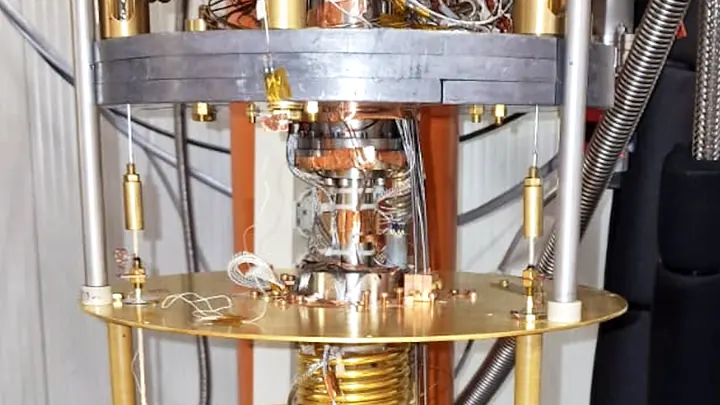
Ancient lead that lay on the seafloor for two thousand years has become the heart of a detector searching for the most elusive substance in the universe. From it, researchers grew a transparent lead tungstate crystal weighing 13 grams and cooled it to near absolute zero.
When a massive star explodes as a supernova, its material slams into the surrounding shell of cosmic dust and gas, like an invisible fur coat. The impact spawns myriads of neutrinos, ghostly particles that zip through planets without swerving.
Electrons in a metal are like a crowd in a subway: each on their own, but at the slightest push, everyone moves at once. Physicists call this collective oscillation of the electron gas a plasmon. In superconductors, these oscillations are especially important because they reveal how electrons interact with each other.
Neutrinos are ghost particles: predicted by the Standard Model, they barely interact with matter. Catching them is like trying to hear a whisper in the roar of a waterfall.
Some superluminous supernovae show a bright oxygen imprint in their light and expand rapidly, while others do not. It seemed like different phenomena. But supernova PTF12dam broke the rules: as its brightness grew, its oxygen signature changed, shifting from one type to another.
A gravitational-wave detector catches not only the roar of mergers but also the quiet splash when a star or gas cloud dives into a supermassive black hole. Such a dive, like a stone falling into a well, generates waves at all frequencies at once—and in that spectrum lies encoded the nature of the well itself.
A silicon sphere 166 nanometers in diameter floats in a beam of infrared laser light. The pressure is below 10⁻⁸ mbar, and the motional temperature is about 10 millikelvin. That is colder than the cosmic microwave background.