Irradiation is the exposure of a material or object to radiation, such as gamma rays, X-rays, or particle beams. In physics, irradiation is used to study how radiation interacts with matter, altering its properties or inducing changes at the atomic level. It is also a practical tool in medicine, industry, and research, where controlled doses of radiation are used to sterilize equipment, treat cancer, or modify materials.
History
The study of irradiation began in the late 19th century with the discovery of X-rays and radioactivity. Scientists like Marie Curie and Wilhelm Röntgen pioneered the understanding of radiation effects, leading to its widespread use in medicine and industry.
How it works
When radiation strikes a material, it can transfer energy to atoms and molecules, causing ionization, heating, or structural changes. Gamma rays, for example, can knock electrons out of atoms, creating free radicals that react with surrounding molecules. In materials like graphene, irradiation can introduce defects that change its electrical or mechanical properties, which can be harnessed for specific applications.
In practice
Irradiation is used to sterilize medical instruments and food, to treat cancer through radiotherapy, and to modify the properties of materials like polymers and semiconductors.
Fun fact
Gamma-ray bursts, the most powerful explosions in the universe, can irradiate entire planets from billions of light-years away, potentially affecting their atmospheres and life forms.
In the layered crystal CrSBr, the magnetic moments of atoms are arranged like notes in a score: within each layer they point in the same direction, but between layers they point in opposite directions. This antiferromagnetic melody plays up to 132 kelvin, beyond which thermal motion destroys the order.
A fusion reactor is like a super-hot furnace where plasma reaches millions of degrees. The walls are made of tungsten, the most refractory metal there is. But even tungsten needs protection: fast particles from the plasma bombard the surface and knock atoms loose. These ejected atoms enter the plasma and cool it down, like a spoonful of cold milk in hot tea.
The Sun is a giant cauldron where light struggles through a thick layer of scorching matter. On its way out, photons (light particles) constantly bump into atoms and lose energy. How strongly matter holds back light is called "opacity," and it determines how quickly heat escapes.
Iron is one of the main culprits for opacity in the Sun's interior.
A camera flash that fires in a thousandth of a second doesn't heat the subject — unlike a regular flash that lasts a full second. A similar trick has been found in radiotherapy: when a radiation dose is delivered in milliseconds instead of minutes, healthy tissues suffer less. This is called the FLASH effect.
Gravitational waves from merging black holes sound like bass chords, pulsars tap out a rhythm, and the cosmic microwave background carries echoes of the Big Bang. But there is a silent player — dark matter, whose presence is betrayed only by gravitational effects.
In quantum field theory, there is a long-standing mystery: infrared divergences. Usually they are seen as an annoying technical nuisance that must be carefully 'papered over' in calculations. But what if this is not a bug, but a feature?
A beam of light enters frosted glass and fades — nothing unusual. But physicists have long known how to make light pass through without losing a single photon. This trick is called electromagnetically induced transparency: two light waves cancel each other at the right point, and absorption disappears. Now a similar feat has been pulled off with atoms.
A stone falls into a pond — near the shore, the ripples are barely visible, while the water churns at the point of impact. The electric field around a charge behaves similarly: close in, it's sharp and tangled, but at a distance it stretches into a smooth wave that carries energy away. Physicists call this distant region the radiation zone.
When matter is heated to millions of degrees, it turns into plasma — a mix of free electrons and ions, like a boiling soup of charged particles. You can't measure the temperature of such a 'soup' with an ordinary thermometer, but you can shine X-rays through it.
An ordinary kitchen knife made of niobium would suddenly start conducting electricity with zero loss at −258 °C. That's how superconductivity works, and you can "switch it on" right at the metal's surface by blasting it with a laser in a nitrogen atmosphere.
When a carbon ion beam enters the body, it doesn't release energy all at once but rather at the end of its path, like a runner who gives their all on the final stretch. Doctors need to know this finish point to avoid damaging healthy tissue. But how can you look inside the body without making an incision?
A gamma-ray burst is a brief but extremely powerful flash of light, born from the merger of neutron stars or the collapse of a massive star. Inside such a flash, plasma flows race at enormous speeds and collide with each other.
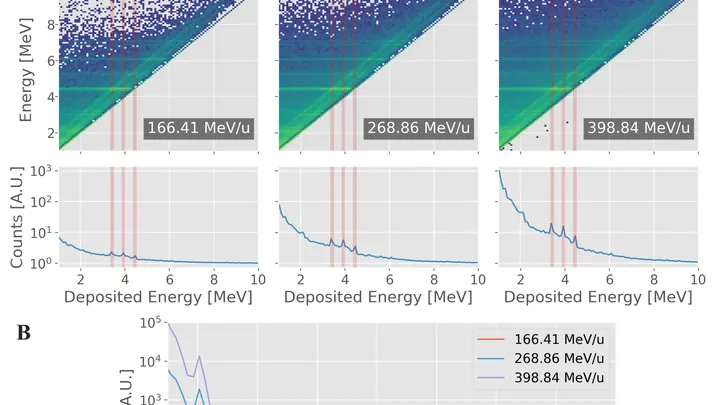
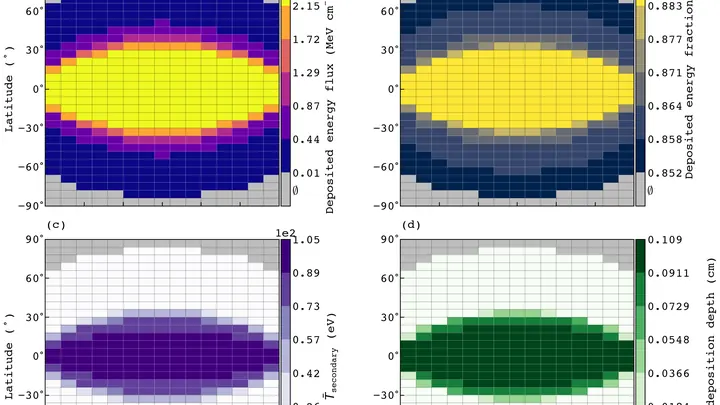
Europa's surface is an icy armor continuously bombarded by charged particles from Jupiter's magnetosphere. Electrons slam into the ice's crystal lattice, lose energy, and kick off chemical reactions. Until now, there was no tool to show how deep such bombardment pierces the ice.
Laser light is like a perfectly aligned row of soldiers on parade: all waves oscillate in the same plane. Such light is called polarized. In a new study, physicists have for the first time produced polarized gamma rays by colliding electrons with a powerful laser pulse.
A lightning bolt strikes an anthill. Some ants die instantly, some freeze, and a few days later the survivors start rebuilding the tunnels. That's roughly how a tumor behaves after electroporation — a method where short electric pulses are passed through tissue to poke holes in cancer cell membranes and kill them.
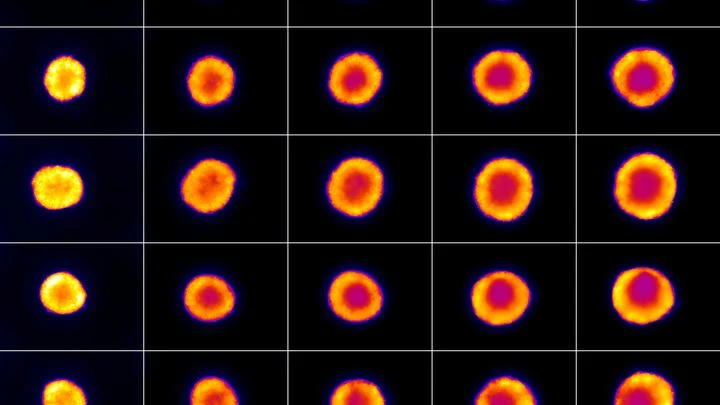
A firefighter with a thermal imager can see the source of a fire through smoke. But how do you see a radiation source that has no smell, no glow, and no heat? Gamma cameras solve this problem: they capture gamma rays emitted by radioactive materials and overlay their 'trace' onto a regular photograph. The result is an image showing that the source is, say, behind the far door.
A graphene ribbon nine atoms wide is like a track where electrons race, as water rushes down a narrow trough. Gamma radiation is a stream of particles with enormous energy, capable of punching through metal and plastic.
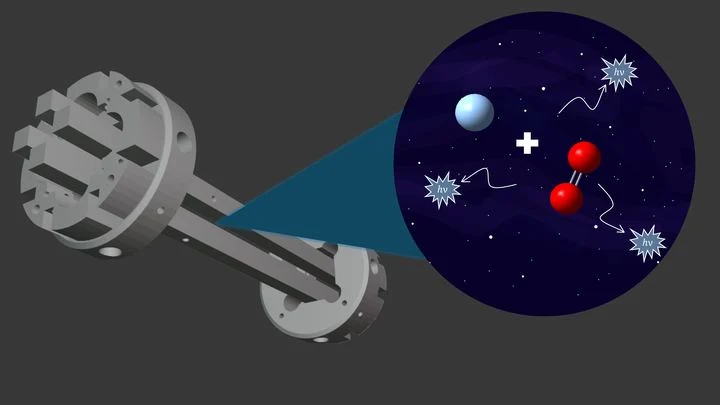
In the cold, sparse clouds of space, particles rarely meet, but sometimes an ion and a neutral molecule pass close enough to stick together. As they do, they emit light, like a muted flash carrying away excess energy. This process is called radiative association, and it is responsible for the formation of many molecules in interstellar space.
Inside a large particle accelerator, an invisible shower of gamma rays reigns, like leaving a glass thread under an X-ray machine switched on for years. Ordinary electronics there quickly fail, yet data from the detector still needs to get out. The solution is optical fiber: a thin glass core that carries light.
A quantum computer is like an orchestra that can only perform in complete silence. The slightest noise, and the delicate melody falls apart. For quantum devices, heat is that noise: even faint infrared radiation from nearby components heats up the qubits and erases their quantum states.
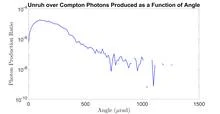
In 1976, Canadian physicist Bill Unruh asked a simple question: what does an observer see when accelerating through empty space? The answer turned out to be strange: emptiness ceases to be empty. An accelerating observer bathes in thermal radiation with a temperature proportional to the acceleration.