How Many Mice Does It Take to Understand the Microbiome? express
When you're planning a renovation, you don't buy paint by eye: you measure the wall area. In science, deciding how many samples to collect is a similar guess, but the stakes are higher. Skimp on samples, and your study becomes a lottery: you might miss a real effect, or you might mistake noise for a discovery. Overshoot, and you're wasting tubes, months, and, in animal experiments, lives.
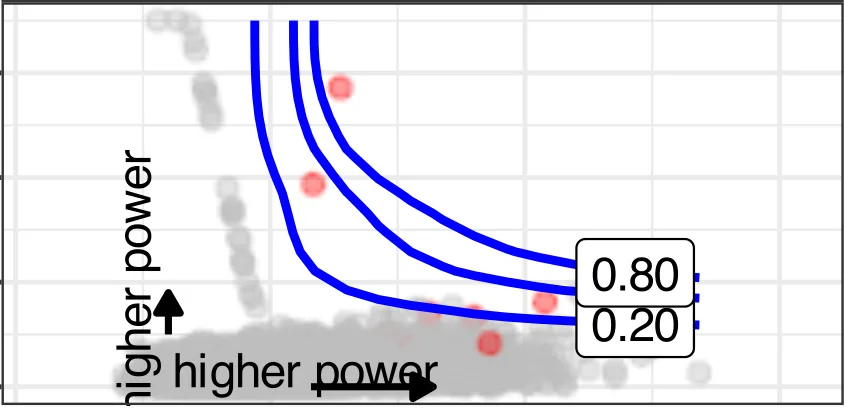
In microbiome research, this problem is especially tricky. Bacterial communities in the gut or on the skin are like a bustling city: some residents are crowds, others are a handful. If you're looking for changes in abundance after a diet or disease, a weak signal easily gets lost in the din. The authors suggest not guessing but calculating: their program, power.nb, acts like a paint calculator for renovation. It takes three numbers (how strong the shift is, how many bacteria of that type are present, and what reliability you want) and gives you the required number of samples.
The conclusion is simple: the microbial city demands a broad census. Without it, we risk studying a mirage for years.
Original abstract
as written by the authors arXiv:2606.16726
Determining an appropriate sample size for a study is a crucial step in planning scientific research. Appropriate sample size planning avoids both inadequate and inflated sample sizes. Inflated sample sizes wastes resources, time and effort of human subjects, and lives of experimental animals. Inadequate sample sizes, a much more common problem, wastes even more resources through the inability to detect biologically meaningful differences and encourages questionable research practices like $$p$$-hacking. Microbiome studies are particularly challenged by small sample sizes, particularly in studies of human subjects or expensive animal models. In practice, the statistical power of taxa within a differential abundance study is influenced by the effect size (typically quantified as fold change), mean abundance of individual taxa, and the number of samples. We present a novel approach for sample size calculation for differential abundance studies as a function of effect size, mean abundance and statistical power of taxa. Our method is implemented in the power.nb R package, available at https://michaelagronah.com/power.nb/articles/stub.html. We applied our model for sample size calculation using estimates of mean abundance and fold change of taxa obtained from thirty real-world microbiome datasets. Our results showed that differential abundance microbiome studies require larger sample sizes than are currently prevalent in the literature to achieve adequate statistical power. Our framework will help researchers make informed decisions about appropriate sample sizes.
One gram of gut contents contains more bacteria than stars in our galaxy — about one hundred billion.