Variance is a statistical measure that quantifies how much a set of numbers spread out from their average (mean). It is calculated as the average of the squared differences from the mean. A high variance indicates that the data points are widely scattered, while a low variance means they cluster closely around the mean. In physics, variance is used to describe noise, measurement errors, and the distribution of physical quantities like energy or velocity.
History
The concept of variance was formalized by Ronald Fisher in 1918, building on earlier work by Carl Friedrich Gauss on least squares and by Francis Galton on regression.
How it works
For a dataset with N values x_i and mean μ, the variance σ² is given by σ² = (1/N) Σ (x_i - μ)². The square root of variance is the standard deviation (σ), which has the same units as the original data and is often more intuitive. Variance is additive for independent random variables, making it a fundamental tool in error propagation and statistical mechanics.
In practice
Variance is used in experimental physics to quantify measurement uncertainty, in quantum mechanics to describe the spread of observable values, and in cosmology to analyze the distribution of galaxies.
Fun fact
In quantum mechanics, the Heisenberg uncertainty principle is often expressed in terms of variances: the product of the variances of position and momentum must be at least (ħ/2)².
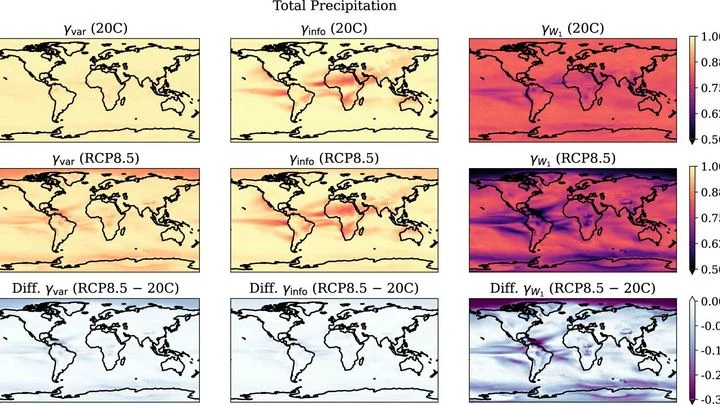
In winter, one part of town gets three times as much snow as the neighborhood next door. One year is a scorcher, the next is a cold snap. That's the whims of weather. But over decades, a different, slow shift emerges: winters, on average, get milder. Telling the two apart is the central challenge for climate scientists.
Two pieces of sandpaper are pressed tightly together. As you start to slide them, they first catch on the rough spots, then suddenly slip. A fault in the Earth behaves much the same way during an earthquake. But there's a crucial detail: how far do you need to push the edges before the grip gives way? This distance is called the critical slip distance.
It is commonly believed that a black hole is a merciless cosmic vacuum cleaner, sucking in everything indiscriminately. But new research flips the picture: right at the horizon, curvature transforms from a trap into a trampoline.
Usually, the complexity of systems, from satellite motions to heart rhythms, is assessed with averaged entropy (a measure of unpredictability, as understood by Boltzmann). But that's like evaluating the ocean only by wave height: the average figure hides the full richness of underwater currents.
Imagine a smart antenna panel, a phased array, that steers radio waves traveling at the speed of light. It works like an orchestra: hundreds of tiny emitters, like musical instruments, shift their phase (the moment they 'join' the overall sound) on command via a variable voltage.
Imagine a ball in an unfamiliar hall: two guests start from opposite corners. Their movements are not a smooth waltz but chaotic improvisation in search of rare treasures. Contrary to intuition, the outcome hinges not on tempo but on the geometry of the floor.
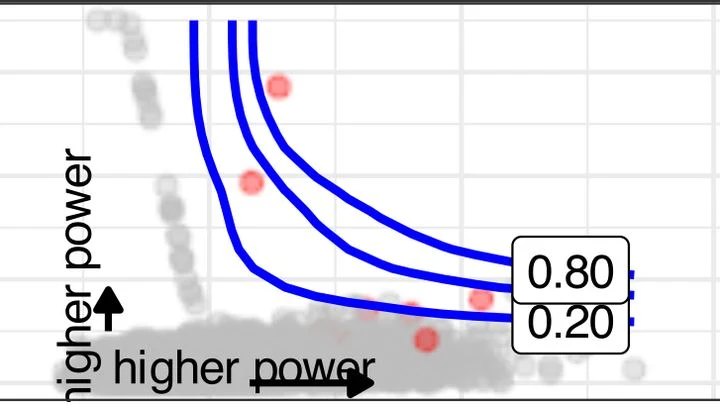
When you're planning a renovation, you don't buy paint by eye: you measure the wall area. In science, deciding how many samples to collect is a similar guess, but the stakes are higher. Skimp on samples, and your study becomes a lottery: you might miss a real effect, or you might mistake noise for a discovery. Overshoot, and you're wasting tubes, months, and, in animal experiments, lives.
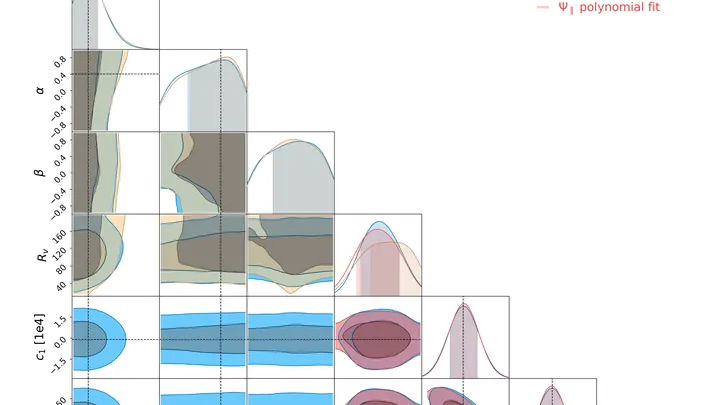
The trembling of space sounds like an orchestra. Gravitational waves caught by the LIGO and Virgo detectors tell of black hole collisions. Sometimes the music carries off-key notes — tiny deviations from Einstein's score. They might whisper of new physics or simply of dust on the bows.
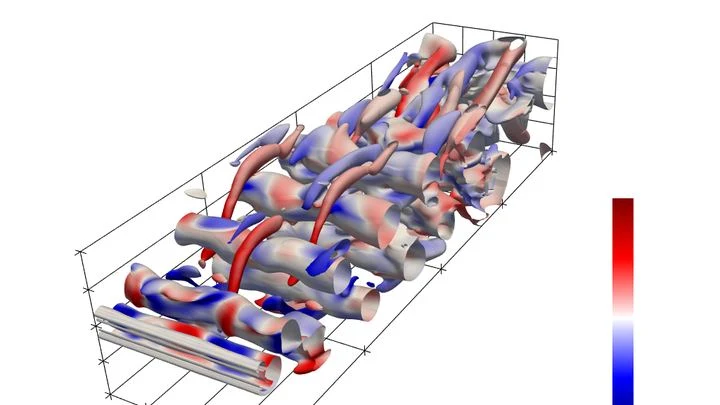
A thin plate stands across a flow of water or air. Behind it, a wake forms — a region where the flow becomes tangled and mixed. Usually, such a wake becomes turbulent when the flow speed is high enough, quantified by the Reynolds number.
When water churns behind a boat, the energy of motion is converted into heat through a cascade of vortices. Measuring how quickly this happens directly is difficult: you'd need to track all the vortices at once. So scientists use a simplification: they look at only one velocity component at a single point.
Galaxies in the Universe are not scattered randomly: neighboring ones move in the same direction, like a school of fish, while distant ones each go their own way. Where the boundary between 'together' and 'apart' lies has been unclear until now.