The trials factor (also known as the look-elsewhere effect) quantifies how much the statistical significance of a claimed signal is inflated when you search for it in many places at once. If you roll a die 100 times, you expect to see a six about 17 times; seeing one six is not remarkable. Similarly, if you scan a wide range of particle masses or energy ranges for a bump, a random fluctuation somewhere is likely. The trials factor is the number of independent chances your search had to produce such a fluctuation, and it tells you how much to penalize your initial 'local' significance to get the true 'global' significance.
History
The concept emerged in the 1970s in the context of high-energy physics searches, though its precise origin is diffuse. Louis Lyons and colleagues popularized the term 'look-elsewhere effect' in the 1980s, and the trials factor is the quantitative expression of that effect.
How it works
When you search for a signal, you compute a local p-value — the probability that a fluctuation at one specific location would look as extreme as what you saw. But because you tried many locations, the chance that at least one of them fluctuates is much higher. The trials factor is the ratio of the global p-value (probability of seeing such a fluctuation anywhere) to the local p-value. Roughly, if you have N independent search locations, the global significance is about the local significance multiplied by N (for small p-values). The correction becomes crucial when claiming discoveries in high-energy physics, where scanning over many possible new particle masses is routine.
In practice
Used in particle physics to set correct significance levels for new particle searches (e.g., the Higgs boson discovery) and in cosmology for scanning over many possible signals in cosmic microwave background data.
Fun fact
The trials factor can be as large as millions in a typical search for a new particle over a wide mass range, turning a 5-sigma local fluctuation into a mere 2-sigma global significance.
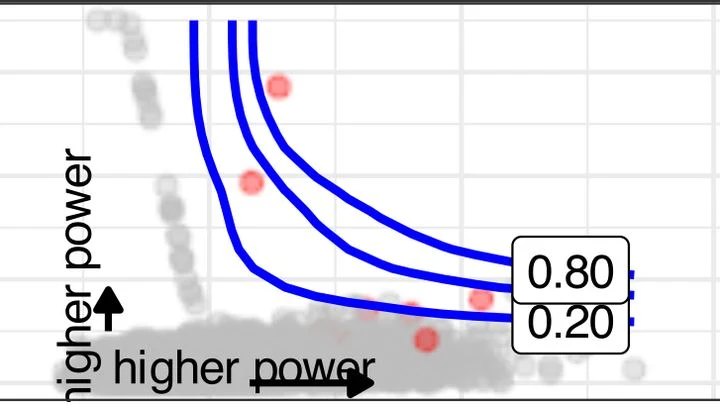
Imagine a ball in an unfamiliar hall: two guests start from opposite corners. Their movements are not a smooth waltz but chaotic improvisation in search of rare treasures. Contrary to intuition, the outcome hinges not on tempo but on the geometry of the floor.
Two dead suns circle in an eternal dance. Their orbit is a perfect metronome, keeping time with the accuracy of atomic clocks. But even dead stars can tremble.
When you're planning a renovation, you don't buy paint by eye: you measure the wall area. In science, deciding how many samples to collect is a similar guess, but the stakes are higher. Skimp on samples, and your study becomes a lottery: you might miss a real effect, or you might mistake noise for a discovery. Overshoot, and you're wasting tubes, months, and, in animal experiments, lives.
You're trying a dish at a restaurant, but you haven't seen the menu. You ask the waiter questions — too salty? what spices?—and from the answers you try to guess what kind of chef prepared it.
Two coins are flipped in different cities, but they always land the same way. Physicists call this entanglement: particles behave as if an invisible thread connects them. But what if the thread isn't instantaneous, just very fast — still not faster than light? Then some signal could slip between measurements, and the coincidences would be explained without any magic.
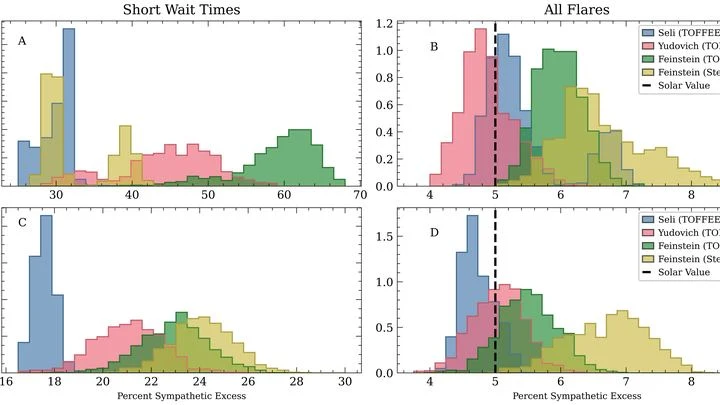
The Sun occasionally produces flares — powerful bursts of energy that last from minutes to hours. Most are random, like raindrops hitting a roof. But sometimes one flare seems to ignite another: the second begins almost immediately after the first, even though they occur in different locations. Astronomers call these sympathetic flares.
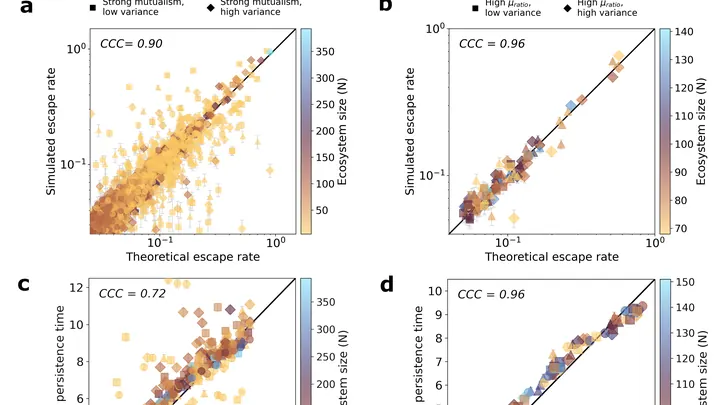
An ecosystem is like a swing that someone is subtly pushing. Previously, it was thought that the main concern was that the swing wouldn't swing too wildly. But the authors of this work showed that the greater danger is when the equilibrium point itself slides toward a place where the swing can no longer return.